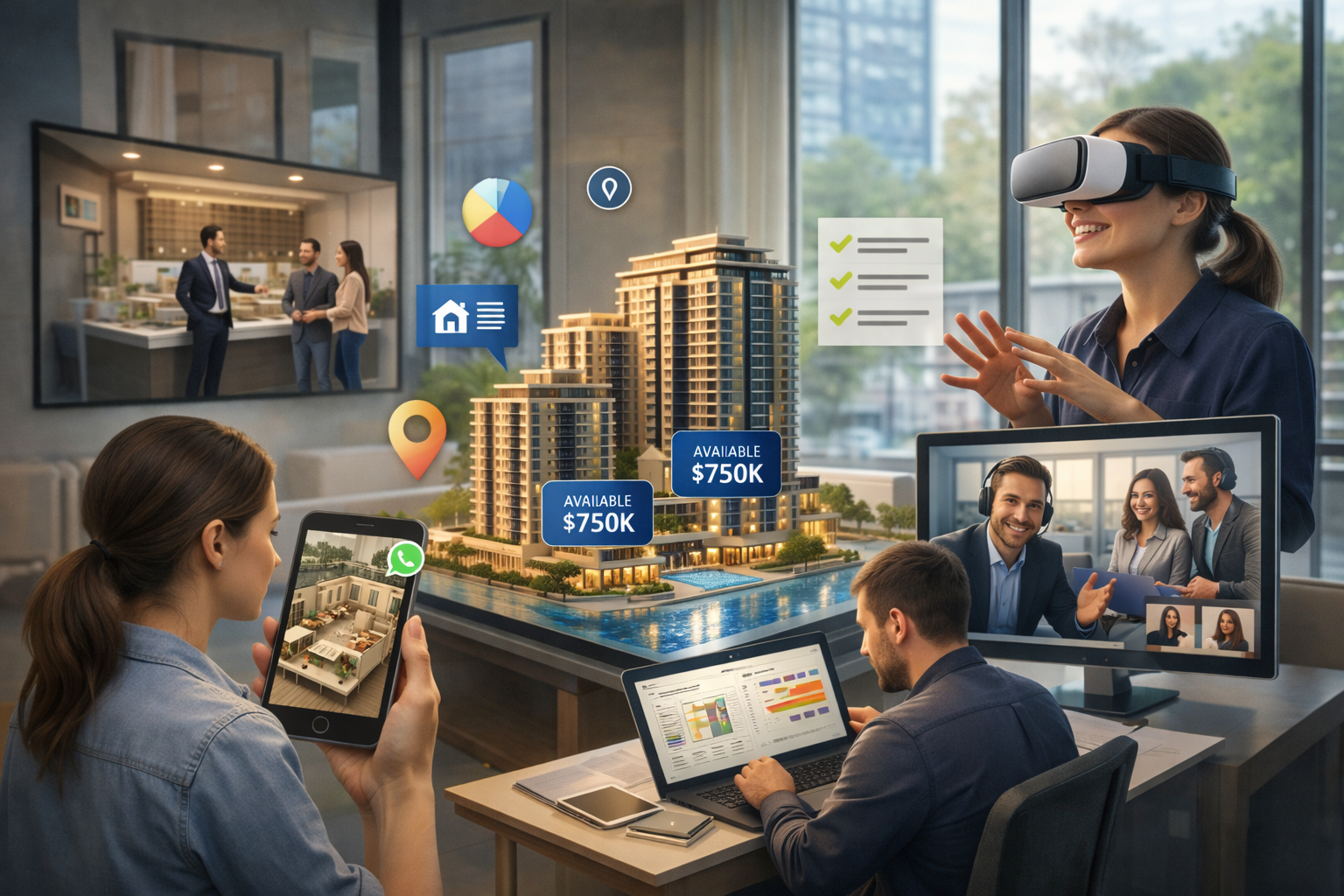
Immersive real estate marketing can improve off-plan sales, but only when it is built well. This article will discuss seven common mistakes developers make and how to avoid them.
Many developers now understand the value of digital twins, 3D walkthroughs , interactive sales apps, and richer off-plan experiences.
The problem is that adding immersive tools does not automatically create a better buyer journey. In some cases, it simply adds a new layer of complexity on top of an already fragmented sales process.
That is why some immersive real estate campaigns look impressive but still fail to convert. The visuals may be strong, yet the experience feels confusing, disconnected, or difficult to use. Buyers may notice the project, but not move closer to a decision.
For developers, the real goal is not to make the project feel futuristic. It is to make it easier to understand, easier to explore, and easier to buy. That is where many immersive real estate marketing mistakes begin.
Why immersive real estate marketing often underperforms:
Most failures happen because the experience is built around presentation instead of buyer decision-making.
Developers often invest in visual quality, but overlook the practical questions buyers need answered. They focus on wow factor, but not enough on usability. They create something that looks advanced in a showroom demo, yet feels harder to navigate in a real sales conversation.
The result is a common pattern in real estate digital experiences: strong first impression, weak follow-through.
Mistake 1: Treating immersive content like a visual extra
One of the most common mistakes is treating immersive marketing as something built to impress, rather than something built to sell.
A common example is when a developer creates a high-end VR walkthrough for a launch event or sales centre demo, but the experience is never adapted for web access, remote follow-up, or day-to-day sales conversations. The result is a polished showcase that generates interest in the room, but adds little value once the actual buyer journey continues.
The experience may look impressive, yet still fail to help a buyer compare units, understand context, or move toward a shortlist. Instead of becoming part of the sales process, it remains a visual extra around it.
Immersive real estate marketing works best when it supports real buyer actions. Buyers should leave with clearer understanding, not just stronger impressions.
Mistake 2: Poor user experience
A weak user experience can destroy the value of even the strongest visuals. This happens when navigation feels unclear, interactions are slow, menus are crowded, or important information is hidden behind too many clicks. Buyers should not have to work hard to understand where they are, what they are looking at, or how to move to the next step.
In real estate, poor UX creates a specific kind of damage. It interrupts emotional momentum. A buyer may start engaged, then lose patience the moment the experience becomes confusing. That drop in momentum has commercial consequences. A 2024 NBER working paper on virtual tours in real estate notes that “the adoption of online platforms and tools like virtual tours has greatly improved property information accessibility.” That helps explain why weak usability reduces value so quickly: if the experience is hard to navigate, the accessibility benefit is lost.
“Immersive content should be judged less like a design object and more like a sales tool. If the experience feels difficult to use, it is not helping.”
Mistake 3: No live data in the experience
A beautiful digital experience loses value fast when it is disconnected from reality.
This happens when availability, pricing, or unit status still live outside the experience. The buyer explores the project digitally, then has to switch back to spreadsheets, PDFs, or manual follow-up to answer the practical questions that matter most.
That creates friction at exactly the wrong moment.
If an immersive sales tool cannot connect the buyer to real inventory logic, it risks becoming just another presentation layer.
Developers do not need more digital surfaces. They need experiences that keep visual discovery and sales information aligned.
Mistake 4: Weak device accessibility
Many immersive real estate experiences are designed for ideal conditions rather than real buyer behaviour.
They may work well on a showroom touchscreen or a powerful desktop, but break down on mobile, perform poorly in browsers, or require too much effort to access remotely. That becomes a serious weakness when a large part of the audience is exploring from phones, laptops, or overseas locations.
Accessibility is not a side issue. It is part of the sales strategy.
If buyers cannot access the experience easily across devices, then the project becomes harder to engage with at scale. In the UAE market, that has direct commercial consequences. Property Finder says WhatsApp is where UAE property buyers make decisions, and reports that enabling WhatsApp on listings can lift mobile lead conversion by as much as 25%.
A strong digital experience should not depend on one location, one device type, or one guided sales meeting to be useful.
Mistake 5: Building for the showroom only
Showrooms still matter, but they are only one part of the sales journey.
A common mistake is designing an immersive experience mainly for in-person presentations while underinvesting in what happens before and after that meeting. Buyers may have a strong first session in the sales centre, but the momentum fades because they cannot revisit the experience easily, share options clearly, or continue exploring remotely.
That leaves too much value trapped in a single touchpoint. Nearly half of home buyers rate virtual tours as “very useful” in the buying process, according to a 2024 NAR finding cited by Matterport, which shows how important it is for the experience to continue beyond the showroom.
Developers should think of immersive real estate marketing as a connected system across web, showroom, follow-up, and remote selling. When the experience is limited to one setting, it becomes harder to build sustained engagement.
Mistake 6: Making unit discovery too complicated
Some immersive tools look advanced but make unit selection harder, not easier.
Buyers need to compare floors, layouts, views, orientations, and prices without getting lost in the experience. If discovery feels slow or confusing, the tool starts working against the buyer journey. Too much motion, too many paths, or unclear filters can make the experience feel impressive but inefficient.
That is a real problem in large developments, where the number of choices is already high.
A strong immersive experience should make comparison simpler. It should help buyers narrow options with less mental effort, not turn the process into something more theatrical.
Mistake 7: Disconnected sales workflows
This is where many immersive projects quietly fail.
The experience may exist, the showroom team may use it, and marketing may promote it. But the workflow around it remains fragmented. Follow-up still happens through separate files. Sales consultants still rely on disconnected brochures. Brokers still receive static materials. Availability updates still need manual confirmation.
That disconnect weakens everything the immersive layer is supposed to improve. In practice, it means the digital experience ends where the real sales process begins. Buyers may leave with a stronger impression, but the team still must manage the rest of the journey through separate tools and manual follow-up.
This is exactly the gap a more connected setup is meant to solve. NNTC’s digital twin solutions for off-plan sales are designed to support immersive presentation as part of the wider sales workflow, linking buyer experience with follow-up, inventory visibility, and cross-channel consistency.
Immersive real estate marketing works best when it is part of a broader sales workflow. If the experience stops where the actual sales process begins, developers lose much of its value.
What better immersive real estate marketing looks like:
If developers want a quick way to assess whether an immersive real estate experience is built to support sales, this is the simplest checklist to use:
- Is it easy for buyers to access without special setup?
- Does it work smoothly across mobile, desktop, and showroom devices?
- Does it connect visuals with live sales information such as availability or pricing?
- Does it help buyers understand the wider project context, not just the unit?
- Does it make unit discovery and comparison simpler?
- Can buyers revisit, share, and continue exploring after the first meeting?
- Does it fit naturally into the broader sales workflow instead of sitting outside it?
If the answer to several of these is no, the experience may still look impressive, but it is unlikely to support conversion as well as it should.
How to build immersive off-plan marketing that converts:
Developers need to use immersive tools more strategically.
That starts with a better question: what part of the decision process should this experience improve?
In some cases, the answer is buyer understanding. In others, it is remote accessibility, clearer unit discovery, stronger follow-up, or better sales consistency across channels. Once that objective is clear, the experience becomes easier to design properly.
The strongest immersive real estate marketing is not built to impress everyone. It is built to remove friction where it matters most.
For developers looking to apply this more strategically, NNTC’s solutions show how immersive experiences can support buyer understanding, remote accessibility, clearer unit discovery, and stronger sales consistency across channels.
Immersive real estate marketing can help developers create stronger first impressions, deeper buyer engagement, and clearer off-plan sales journeys. But only when the experience is built to support real decisions.
The most common mistakes are not technical. They are strategic. Poor UX, missing live data, weak device accessibility, and disconnected workflows all reduce the value of what should be a stronger sales experience.
Developers who avoid those mistakes usually do one thing differently: they treat immersive marketing as part of the sales process, not as a layer placed on top of it.
About NNTC:
NNTC helps developers build connected digital experiences for real estate sales. Its solutions combine digital twins, immersive 3D walkthroughs, interactive showroom experiences, and remote sales tools to help buyers explore projects more clearly and help sales teams work more consistently across channels.
To learn more, explore our immersive real estate solutions or get in touch with the team.
