INDUSTRY 4.0 TO REDUCE THE NUMBER OF ACCIDENTS AT OIL AND GAS FACILITIES

INDUSTRY 4.0 TO REDUCE THE NUMBER OF ACCIDENTS AT OIL AND GAS FACILITIES

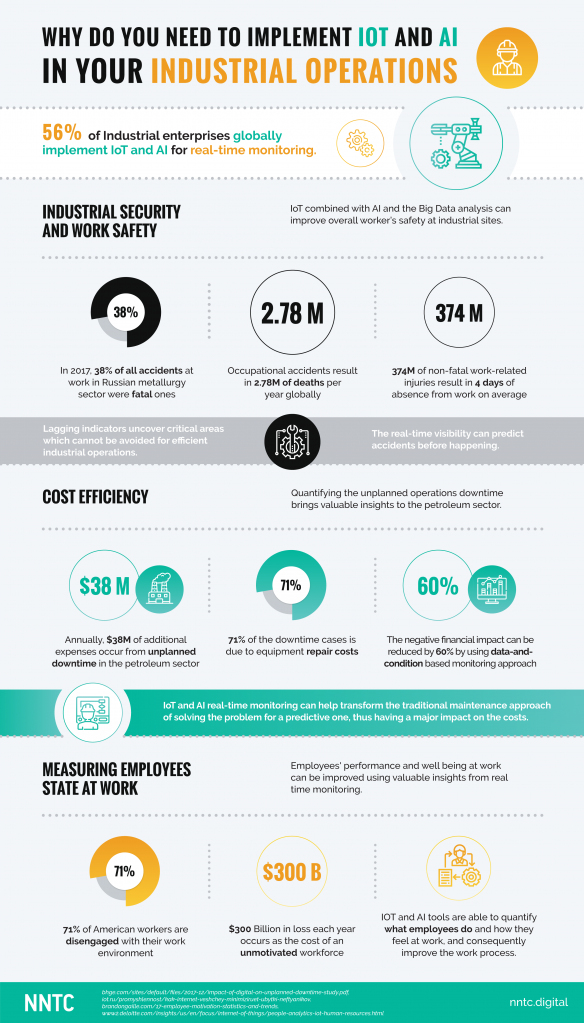
Virtual reality (VR), Internet of Things (IoT), and video analytics are the technologies curtailing occupational accidents and creating a safe environment for both white and blue-collar workers at hazardous manufacturing facilities.

Have you heard about Vision Zero? It is a campaign developed by the International Social Security Association (ISSA) to improve safety, health and wellbeing at work, providing the seven golden rules:

1. Take leadership  – demonstrate commitment
2. Identify hazards – control risks
3. Define targets – develop programs
4. Ensure a safe and healthy system – be well-organized
5. Ensure safety and health in machines, equipment and workplaces
6. Improve qualifications – develop competence
7. Invest in people – motivate by participation

Today, the Vision Zero principles underpin draft regulations and intensively penetrate into industrial facilities, especially via the adoption of innovative technologies. Industry 4.0 solutions are a perfect match being Vision Zero compliant by default.

The Industrial Internet of Things (IIoT) at hazardous manufacturing facilities is used to monitor both personnel actions and environment. Sensors are placed on personal protective equipment (PPE) to take temperature and pressure readings and detect movement. Digital Worker platform combines a range of video analytics, smart wearable devices, and global and local positioning solutions.

Intelligent video analytics, delivered as a platform component or stand-alone unit, leverages machine vision and neural networks. Installed throughout a facility, cameras recognize threats, identify HSE violators (e.g., employees working unprotected), and alert dispatchers in real time.

Another platform component, an 80-gram IоТ module for a smart hard hat is certified for use in explosion hazardous areas and can be installed on most hard hat models to check if employees wear PPE, identify and locate them even in case of limited visibility. A buzzing hard hat alerts a worker to dangers, and an embedded emergency button provides the fastest way to send for help. The accelerometer will detect if a hard hat wearer is hit, falling down or not moving at all, while built-in sensors capture critical environmental fluctuations.

Virtual reality is widely adopted to improve safety at manufacturing facilities and, particularly, staff professional skills in the oil and gas and petrochemistry sectors. VR/AR technologies make it possible for workers to get professional training when hands-on experience at actual technological facilities is unobtainable. For example, a virtual simulator of equipment assembly and disassembly or VR training for an emergency situation is a safe way to both exercise skills and monitor facility health and parameters in real time. Such models can also contribute to production chain optimization and evacuation plan development. 

AIRPORT INNOVATIONS: WHERE TO FIND AND HOW TO USE

Innovations are spreading tentacles in airports around the globe to surround travelers with comforts and take the excessive strain out of transport hubs. So let’s take a look at the most popular everyday objects you might not even guess are smart.

Combining versatile technologies, the global smart airport market is estimated to reach USD 31.10 billion by 2026 growing at a CAGR of 11.2% during the forecast period, according to a new Market Study Report.

Self-service kiosks
The growing implementation of self-service kiosks at airports is driven by travelers’ desire to save check-in time, enjoy personalized services, and obtain updates in real time.

Biometrics
The face recognition and biometrics identification technologies are actively adopted in the international airports. Once a traveler has submitted a passport and registered in the system, his or her face turns into a single travel token, like a traditional passport. For instance, Hong Kong International Airport (HKIA) embedded powerful intelligent technologies to scan and match traveler biometrics — an eye retina and fingerprint — with their passport chip data.

Dubai International Airport was among the first airports to offer smart security gates with automatic identification. Anyone with a machine-readable passport can simply use the smart gate and pass further.

Ads in crowded areas
Another airport leveraged Wi-Fi hotspots to detect passengers’ whereabouts and the exact time spent there. Following the aggregated data analysis, the airport placed ads in the most crowded locations, thus increasing its advertising earnings.

Robotics-enabled luggage storage
Domodedovo International airport, one of the largest airports in Eastern Europe with annual passengers’ flow of +30M, offers luggage check-in and drop-off 24 hours before the scheduled flight. Early birds’ bags go to an automated short-term luggage storage, where six steel arm robots move the chipped bag boxes running along rails to navigate through 12 three-meter shelves at a speed of 14 km/h. When the time comes, the robots are automatically triggered to bring certain bags to a certain flight in just two minutes.

Beacon-based navigation
Beacon-based indoor navigation systems are becoming increasingly popular, as well as multiple wireless sensors helping control air quality and lighting and observe presence of people in the area. In addition, these sensors can contribute to not only automation and engineering system management tasks, but also building of heat maps of popular passenger places across airport to adjust space lease pricing policy.

Beacons also provide the fastest and free to access Wi-Fi in Dubai International Airport. The “world’s fastest airport Wi-Fi” required the installation of new wireless access points throughout the airport, and each of these also includes a Bluetooth Low Energy (BLE) beacon.

Drone detection
In July 2019, Muscat airport first in the World got drone detection system: it detects drones and other devices using radio frequency to protect the surrounding areas of the airport. 

“If you look at IoT apps, most are either security or manufacturing related. We see the lack of demand from the airports still following their passenger management routine. However, in the coming years, we will see how IoT enters consumer-related markets with digital helpers, robots, cashier-less shops and many more personalized services provided even before you arrive to the place. Travel experience will become personalized as well,” said Alexander Belyaev, NNTC Technical Director.