Discover how digital twins help real estate developers present off-plan projects as explorable environments, improving buyer confidence and accelerating sales.
Selling an off-plan project has always involved a gap between promise and perception. Buyers are asked to commit to something they cannot walk through, compare in real life, or fully test before making a decision. Developers try to close that gap with renders, brochures, floor plans, and showroom presentations, but those tools often stop short of giving buyers real clarity. They create interest, but not always a clear understanding.
That is where digital twins become useful.
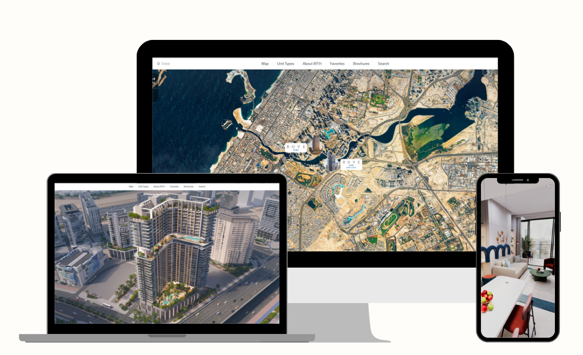
In off-plan sales, a digital twin gives developers a way to present a project as an explorable environment rather than a set of static assets. Instead of asking buyers to imagine how a tower, unit, or amenity might feel, the project can be explored in a way that is closer to how people actually evaluate property.
Buyers can understand layout, context, surroundings, and available choices with far less guesswork. For developers, that means stronger presentations, smoother sales conversations, and a better way to support both in-person and remote selling.

Why traditional off-plan sales content fails to convert buyers :
Most off-plan sales content is built to persuade. The problem is that buyers need content that helps them decide.
A render can show beauty, but not always orientation. A brochure can explain features, but not spatial relationships. A floor plan can show dimensions, but not the lived sense of a space. Even a strong showroom presentation can become limited when the buyer wants to compare units, revisit details later, or include family members and other decision-makers in the process.
This creates friction at exactly the wrong stage. The buyer is interested, but still uncertain. The sales team is engaged, but has to spend more time filling in gaps that the content itself should have solved.
For developers, the issue is not only the buyer experience. It is also operational. Sales content often becomes fragmented across channels, with one version built for the website, another for the showroom, another for events, and another for follow-up. Over time, teams end up managing separate assets that are difficult to update and even harder to keep consistent. This is where a digital twin becomes more than a visual tool: it creates one connected environment that can support web-based 3D walkthroughs, interactive showroom experiences, and real-time sales information without relying on disconnected assets.
What is an off-plan real estate digital twin?
In simple terms, an off-plan digital twin is an interactive digital version of the project that buyers and sales teams can explore before the project is built.
That sounds basic, but the difference is significant. A digital twin goes beyond visuals to move to a functional sales tool. In practice, that means more than a 3D model. It means a connected environment that can show towers, units, amenities, views, and surrounding infrastructure while also linking to sales workflows such as availability, pricing, and buyer interaction data.
A buyer can move through the project, view the development in context, compare units, explore surrounding infrastructure, and understand how different elements connect. A sales consultant can use the same environment to guide a conversation, answer specific questions, and move from interest to shortlist more naturally.
The strongest versions go further. They become part of the broader sales workflow, supporting web journeys, sales centre presentations, immersive rooms, remote guided sessions, and in some cases even inventory visibility and buyer behaviour tracking.
That shift matters. It turns the project from a campaign asset into a reusable sales tool.
How digital twins help buyers decide faster :
The first and most immediate benefit is clarity.
Off-plan buyers are often making decisions under uncertainty. They are trying to picture a future building, compare options that are not yet tangible, and assess value from incomplete information. A digital twin reduces that uncertainty by making the project easier to understand in practical terms.
That matters because property decisions are not made on specifications alone. Buyers want confidence. They want to feel that they understand what they are choosing. The easier it is to create that confidence, the easier it becomes to keep momentum in the sales process.
Digital twins also make comparison and shortlisting easier. Buyers can move between units more naturally, revisit options, and understand trade-offs faster. Instead of relying on memory or scattered files, they can evaluate choices in a way that feels more direct and intuitive. In NNTC deployments, interactive 3D sales apps have helped increase consultation-to-reservation conversion by 18%, which suggests that when buyers can explore a project more clearly, they are more likely to move forward with confidence.
This is especially useful in projects with many units and multiple variables. Floor level, view, size, layout, orientation, and proximity to amenities all influence the decision. When those factors can be explored clearly, the buyer has less cognitive load and the sales conversation becomes more productive.
In other words, a better experience does not just look modern. It helps buyers understand options faster, shortlist with more confidence, and move through the decision process with less friction.
A stronger real estate sales tool for consultants and developers :
Digital twins are not only useful for buyers. They also improve how sales teams sell.
In a traditional setup, consultants often need to jump between systems and materials. They may show a render on one screen, pull out a floor plan on another, check availability elsewhere, then send follow-up materials later. That creates a stop-start flow.
A digital twin gives the team a more unified way to present the project. It helps them tell a clearer story, respond to buyer questions more naturally, and keep the conversation anchored in one environment instead of several disconnected ones.
That consistency matters at scale. When multiple consultants, brokers, or channel partners are presenting the same project, a shared sales asset improves accuracy and reduces variation in how the project is explained. It becomes easier to train teams, easier to standardize the buyer journey, and easier to maintain quality across locations and markets.
What developers should consider before investing in a digital twin :
The first question is not technical. It is commercial.
Where does the current sales journey break down? Where do buyers hesitate? Where do consultants lose time? Which parts of the project are hardest to explain using current materials? Those are the questions that should shape the investment.
Once that is clear, the practical requirements become easier to define. Developers need to consider the quality of the available project data, how often the content will need to be updated, which channels the experience should support, and whether it should connect with inventory, pricing, or other sales systems.
The strongest results come when a digital twin is planned as part of the buyer journey rather than treated as a visual add-on. If it is built only to impress, it may look polished and still underperform commercially. If it is built to help buyers understand the project, compare options, and move forward with confidence, it becomes far more valuable.
Explore how NNTC supports off-plan sales :
To see how NNTC helps developers bring unbuilt projects to life, explore our Digital Twin solutions for off-plan property sales, including web-based 3D walkthroughs, interactive showroom experiences, and remote interactive sales tools. If you want to discuss a specific project or sales use case, get in touch with our team.
About NNTC :
NNTC is a Dubai-based technology company specializing in interactive digital twins. Its platforms combine high-fidelity visualization with live data integration and web delivery, helping organizations present projects consistently across showrooms and remote stakeholder journeys.
