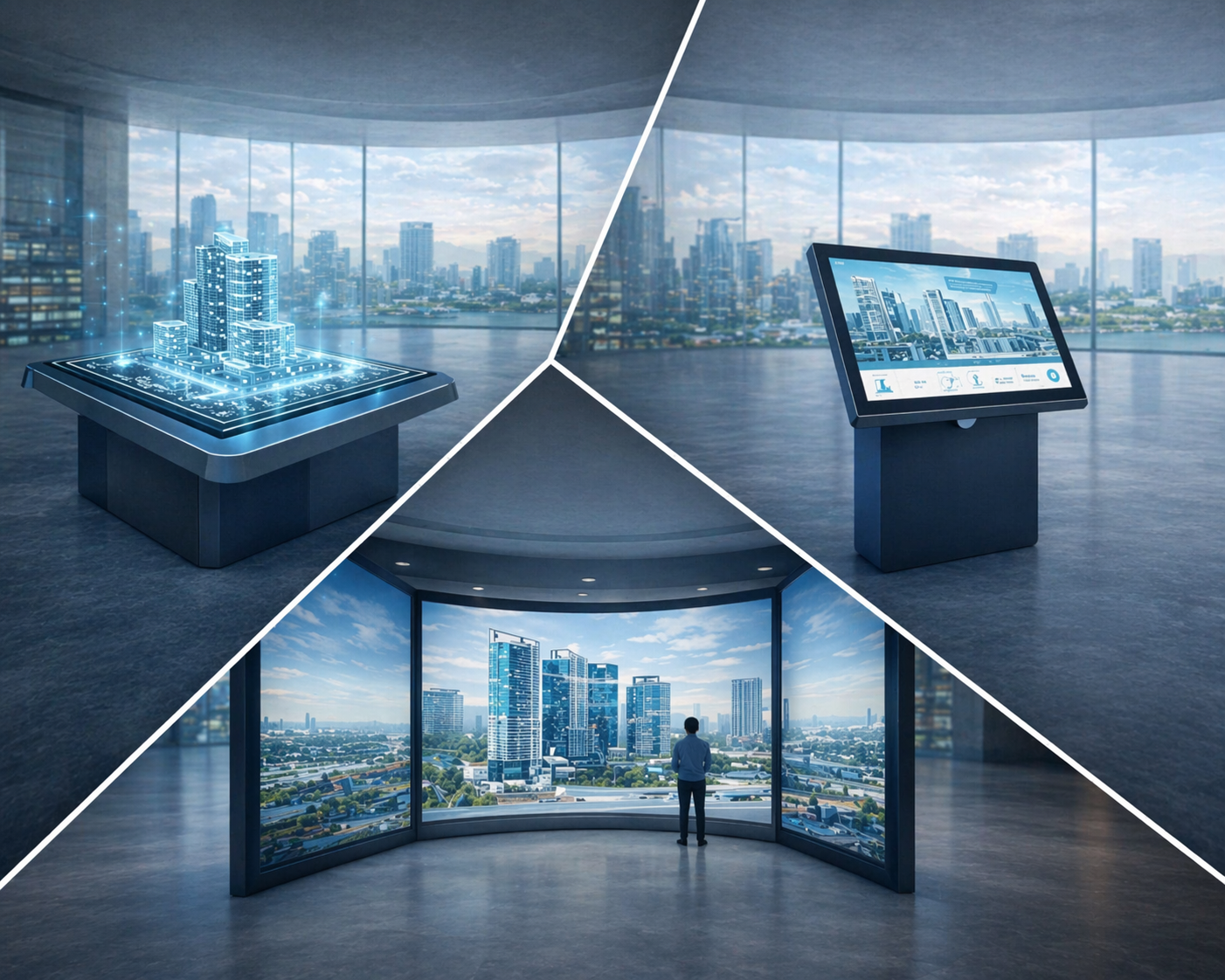
Which immersive real estate setup actually helps developers sell better? Compare hologram tables, touchscreen kiosks, and immersive rooms by sales use case, buyer journey, and commercial value.
Some real estate technologies look impressive in a demo, but that does not always mean they help developers sell more effectively.
That distinction matters even more in Dubai, where off-plan activity now dominates a large share of residential sales.
Knight Frank review on Dubai Residential Market reported that off-plan launches accounted for roughly 73% of deals in Q3 2025. In that kind of environment, the formats that are used to explain, compare, and differentiate projects start to matter far more.
For property developers, the question is no longer whether immersive technology belongs in the sales journey. It is which immersive real estate sales tools actually help buyers understand the project, compare options, and move closer to a decision.
Why Immersive Real Estate Sales Tools Need to Be Compared Carefully
Developers are investing more in immersive real estate sales tools, but those tools do not all solve the same problem.
Some formats are built for guided consultation. Some are built for emotional immersion. And some are simply more useful in the daily mechanics of selling than others.
That matters because buyer confidence is not created by novelty alone. The best immersive tools are the ones that reduce uncertainty, support real buyer actions, and fit naturally into the sales process.
This is why the choice between hologram tables, touchscreen kiosks, and immersive rooms should be made as a sales decision, not a technology decision.
Hologram tables: strong for attention, weaker for everyday selling
Hologram tables are usually strongest at creating a strong first impression.
They work well when the goal is to generate curiosity at a launch, stand out at an event, or make a project feel futuristic in a high-visibility setting.
That aligns with broader marketing research on holograms. Baltezarević and Baltezarević, in their 2023 paper Benefits of Using Holograms in Marketing Communication, argue that holograms are especially effective in promotional environments where novelty, memorability, and visual surprise matter. They describe them as tools that create unforgettable experiences” and a strong “factor of surprise” in promotional settings. For developers trying to create buzz around a new launch, that has real value.
The weakness appears when the sales conversation needs to go deeper. Buyers rarely move forward because a display looked impressive. They move forward when they can understand the project, compare options, and revisit what they have seen later.
In that context, hologram tables are often more useful as launch theatre than as everyday sales tools. They can be harder to update, harder to scale across channels, and less effective when the discussion shifts from brand attention to practical decision-making.
That does not make holographic installations useless. It makes them specialized. They are usually better suited to creating attention at key moments than to supporting the daily work of helping buyers evaluate units, understand context, and continue the journey after the first presentation.
Touchscreen kiosks: the most practical format for day-to-day sales
Touchscreen kiosks are usually less immersive than hologram tables and more useful in actual sales conversations.
That is their advantage. A good interactive sales tool or touchscreen kiosk can help buyers navigate a masterplan intuitively, explore buildings, compare units, understand views, and move through the project with more control.
It also gives sales teams a practical way to guide the conversation without forcing buyers to rely on static brochures, PDFs, or verbal explanation alone.
This format fits the sales centre especially well because it combines visual clarity with usability. Buyers can move from a big-picture understanding of the project to specific unit discovery in one place. That matters because control and clarity directly affect decision-making.
A 2026 study published in the Journal of Business Research by marketing scholars on immersive technology found that when people use interactive tools to resolve shopping decisions, perceived control rises, which in turn improves decision comfort.
In real estate, that same logic helps explain why touchscreen-led exploration is often more useful than a purely visual display.
Zillow reports that listings with an Interactive Floor Plan receive 60% more views and are saved 79% more than listings without one, while 69% of buyers say a dynamic floor plan would help them determine whether a home is right for them.
The pattern is consistent: when buyers can explore layout and flow more actively, they engage more deeply and make decisions with more confidence.
A touchscreen kiosk is often the strongest all-around choice when the goal is to support everyday consultations, clearer unit comparison, and repeatable use by the showroom team.
Immersive rooms: strongest for emotional engagement
Immersive rooms have a different job.
Where kiosks are strongest in guided practicality, immersive rooms are strongest in emotional impact. When done well, they can make scale, atmosphere, architecture, and lifestyle feel much more tangible than a brochure or static display ever could. That is especially useful in premium developments where emotional connection is a large part of the sale.
A premium villa or branded-residence project in Dubai, for example, could use an immersive room to do more than display floor plans. It could place buyers inside the future setting, letting them experience ceiling height, material mood, view corridors, landscaping, and the overall atmosphere of the project in a way that feels closer to lived reality. That kind of presentation is not only about helping buyers understand the property. It is about helping them feel it.
In off-plan real estate, that emotional dimension matters. Buyers are being asked to connect with a property they cannot yet step inside. The more vividly they can imagine space, context, and future use, the more likely they are to form attachment early.
A 2024 NBER working paper on virtual tours in real estate found that digital exploration improves property information accessibility and helps buyers gather information more effectively, which helps explain why immersive environments can make unbuilt projects feel easier to understand and emotionally engage with.
But immersive rooms come with trade-offs. They are more dependent on physical setup, harder to extend beyond the showroom, and less naturally portable into web, follow-up, and remote selling unless they are built as part of a wider digital system.
So immersive rooms are usually best when the goal is premium storytelling, emotional immersion, and differentiation at the sales-centre level, not broad sales utility on their own.
Which Immersive Real Estate Sales Tool Fits Which Property Developer Need:
The clearest way to compare these formats is by sales use case, practical fit, and how easily they can support the wider buyer journey.
| Format | Best Use Case | Best Sales Stage | Buyer Understanding | Unit Comparison | Remote / Follow-up Use | Scalability | Cost Level |
| Hologram tables | Launch buzz, event attention, first-impact storytelling | Awareness / launch | Low to medium | Low | Low | Low to medium | High |
| Touchscreen kiosks | Guided consultations, masterplan navigation, unit discovery | Consideration / active evaluation | High | High | Medium | Medium to high | Medium |
| Immersive rooms | Premium storytelling, atmosphere, spatial immersion | Consideration / emotional conversion | Medium to high | Low to medium | Low | Low to medium | High |
The comparison becomes clearer when each format is judged by the role it plays in the sales journey. What this table shows is that the best format depends less on how impressive the technology looks and more on what the sales team needs it to do.
Some tools are better at creating curiosity, others are better at helping buyers compare and understand, and others are better at building emotional connection. For most property developers, the strongest long-term value comes from a setup that can do more than one job, support more than one touchpoint, and stay useful after the first presentation.
That is why the conversation often shifts from choosing a device to choosing a wider digital sales system.
What Property Developers Should Prioritize in Immersive Real Estate Sales Tools:
Once the use case is clear, the next question is which setup will remain useful after the launch event, after the showroom meeting, and after the buyer leaves the sales centre.
In practice, that means choosing tools that are easy to update, work across channels, connect to live sales information, and support follow-up without creating extra friction for the sales team.
For property developers, the stronger choice is usually the one that supports real buyer actions rather than one-time reactions. The best immersive real estate sales tools help buyers compare options, revisit the project, and continue the journey with more confidence.
Before choosing an immersive setup, ask:
- Can buyers revisit it after the first meeting?
- Does it work across showroom, web, and follow-up?
- Is it easy to update as inventory or pricing changes?
- Can it connect to live sales information?
- Does it help buyers compare options more clearly?
- Will sales teams use it easily in day-to-day conversations?
If the answer to most of these is no, the setup may create attention, but it is less likely to create lasting sales value.
About NNTC:
NNTC helps developers turn complex projects into connected digital sales experiences. Its work combines digital twins, immersive 3D walkthroughs, touchscreen-led sales tools, and immersive showroom experiences to help buyers explore projects more clearly and help sales teams present them more consistently across channels. Moreover, NNTC’s Virtual Hologram Table is a good example of this kind of format: visually striking, memorable and effective when the goal is to attract attention quickly.
To see how NNTC applies this in practice, explore the company’s digital twin solutions, interactive sales tools, immersive showroom experiences, and relevant real estate case studies, or talk to the team about your next sales centre project
