What property developers should know before building an immersive room for off-plan sales: hardware, software, budgets, and common mistakes.
Off-plan buyers are asked to commit serious money to a project that does not fully exist yet. An immersive room for real estate sales helps close that imagination gap by letting buyers experience scale, location, views, and atmosphere before the project is built.
But an immersive room is no longer just a larger video wall. It is a full sales-gallery environment built around real-time visuals, synchronized displays, interactive content, and trained sales hosts.
For property developers, the real question is:
Will this room help buyers understand the project faster, compare options more clearly, and move closer to a decision?
This guide explains :
- What Is an Immersive Room for Real Estate Sales?
- Why Real Estate Sales Galleries Use Immersive Rooms?
- What an Immersive Room Can Help Buyers Understand?
- Hardware Decisions That Shape the Immersive Room Experience
- Software Decisions That Matter More Than Hardware
- What an Immersive Room Cannot Replace
- Budget Ranges for Immersive Rooms in Real Estate
- Common Mistakes to Avoid
- A Practical Starting Point for Developers
What Is an Immersive Room for Real Estate Sales?
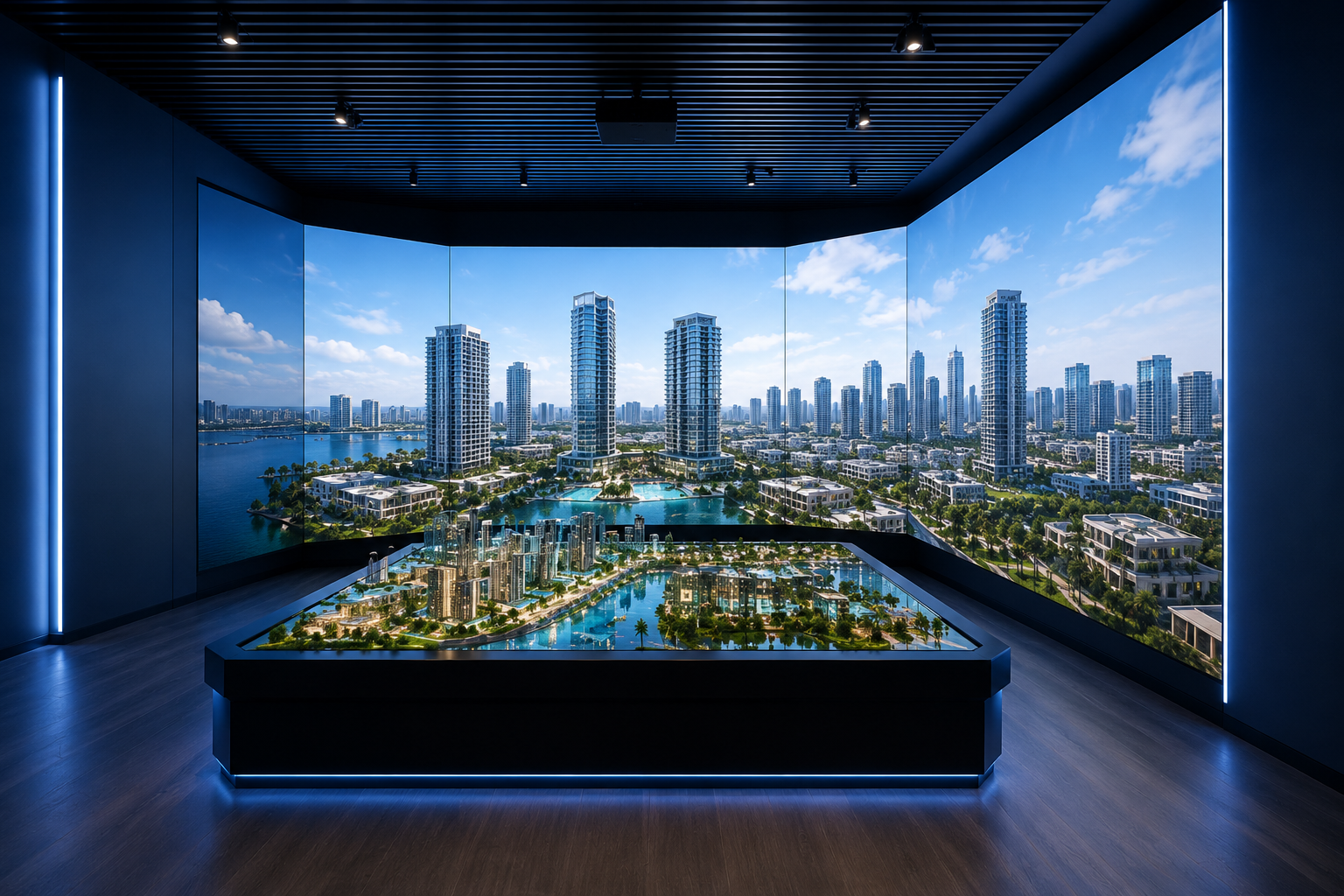
An immersive room is a dedicated sales-gallery space where buyers can experience an off-plan real estate project at room scale before it is built.
In a real estate sales gallery, this usually means a room with LED display surfaces on multiple sides, real-time 3D content, spatial audio, lighting control, and interactive presentation tools.
The purpose is to help buyers feel the scale, location, atmosphere, and flow of the development before it is built.
A basic immersive room usually includes three core elements.
Multi-Side Visual Display
An immersive room starts when visuals surround the visitor on multiple sides, usually with a front wall and two side walls working together as one continuous experience.
Some advanced setups also include a floor display. This is closer to what academic virtual reality literature calls a CAVE, or Cave Automatic Virtual Environment.
The original CAVE system was described in 1993 as a surround-screen projection-based virtual reality environment.
For real estate, the goal is simple: make the buyer feel inside the project, not in front of a screen.
Real-Time 3D Rendering
A pre-rendered video on three walls is still just video playback.
Whereas a real immersive room should respond in real time. The host should be able to change views, move through a masterplan, switch lighting conditions, compare units, open amenities, or zoom into specific parts of the project.
This is where real-time engines such as Unreal Engine or Unity matter.
Real-time rendering allows the room to act like an interactive sales environment, not a fixed media loop.
Audio, Lighting, and Sensory Control
Visuals alone are not enough.
A strong immersive room should include spatial audio, controlled lighting, and, where relevant, additional sensory effects such as airflow or scent.
For example, a waterfront project, luxury resort, branded residence, or mixed-use destination can feel more convincing when sound, lighting, and visual movement work together.
These details should support the sales story. They should not become distractions.
Why Real Estate Sales Galleries Use Immersive Rooms
Off-plan property buyers are often asked to make high-value decisions before the project exists in full physical form.
Brochures, renders, videos, and floor plans can show the project, but they do not always answer the questions buyers actually care about:
- How does the entrance feel?
- What does the view look like from a specific floor?
- How does the destination feel at sunset?
- Where is parking compared to the lobby?
- How do the amenities, roads, towers, and public areas connect?
An immersive room helps answer these questions in one guided session. Instead of moving between disconnected brochures, screens, renders, and maps, the buyer can experience the project as one connected environment.
That is why immersive rooms are becoming more relevant for real estate sales centres. They help buyers understand scale, atmosphere, movement, and location context before visiting the site or committing to a shortlist.
Psychology supports this. Research on immersive virtual environments, including Mel Slater’s work on place of illusion and plausibility, shows that people can respond realistically to virtual environments when the experience feels spatially convincing and believable.
For real estate, that matters because buyers are not only evaluating images. They are trying to imagine a place.
What an Immersive Room Can Help Buyers Understand
A well-built immersive room can help buyers understand the parts of a project that are difficult to communicate on paper.
Scale
Buyers can understand the size of a lobby, street, tower, amenity deck, or masterplan more easily when they experience it at room scale.
For example, a large arrival lobby may look impressive in a render, but an immersive room helps buyers feel the height, width, and movement through the space. This makes the project easier to judge as a real destination, not just an image.
Location Context
The room can show the project’s relationship to nearby roads, landmarks, water, skyline, transport links, and surrounding districts.
This matters when location is part of the value. A buyer can see how close the entrance is to the main road, how the tower sits in relation to nearby landmarks, or how the development connects to the wider masterplan.
Views and Orientation
Buyers can compare views from different towers, floors, or units. This is especially valuable when view quality affects pricing.
For example, a buyer comparing a 42nd-floor unit with a 28th-floor unit can understand the skyline, water view, privacy, and obstruction differences more clearly than they could from static renders.
Atmosphere
Lighting, time of day, sound, and movement help buyers understand how the project may feel, not just how it may look.
A sales host can show the same destination in daylight, sunset, or evening mode. For hospitality, waterfront, retail, or mixed-use projects, this helps buyers understand the mood of the place and how it may change throughout the day.
Comparison
Sales teams can guide buyers through different units, layouts, amenities, or phases without switching between disconnected assets.
Instead of opening separate brochures, videos, and floor plans, the host can compare options inside one environment. This makes it easier to explain why one unit, view, or phase carries a different value from another.
Confidence
When buyers understand more in one session, they usually ask better questions and shortlist with less uncertainty.
The value is not only visual. It is practical. Buyers leave with a clearer sense of location, layout, view, access, and atmosphere, which helps them move from general interest to a more serious conversation.
Hardware Decisions That Shape the Immersive Room Experience
The hardware behind an immersive room affects more than the project budget. It also shapes how realistic, comfortable, and convincing the experience feels inside the sales gallery.
For real estate developers, four hardware decisions matter most.
LED Wall Layout
The first decision is the display format.
A front wall is useful for presentation, but it does not create full immersion. A three-wall setup gives buyers a stronger sense of being inside the project. A three-wall setup plus floor LED creates a deeper experience, but it also increases cost, complexity, maintenance, and safety considerations.
For most real estate sales galleries, a three-wall LED room is the practical starting point.
Pixel Pitch
Pixel pitch affects how sharp the visuals look at close viewing distances.
For indoor sales galleries, fine-pitch LED is usually required because buyers may stand close to the walls. A 1.2 mm to 1.5 mm pixel pitch is often a practical range for viewing distances of around 1.5 to 3 metres.
Going below 1.0 mm can raise costs sharply without a major visible benefit at normal viewing distance. Going above 1.5 mm can make the pixel grid more visible from the front row.
The key is not to buy the smallest pitch available. The key is to match pixel pitch to viewing distance, content detail, room size, and budget.
Brightness and Color Calibration
More brightness is not always better.
In a controlled indoor sales room, around 800 nits is often enough. Higher brightness can make the experience uncomfortable and harder to calibrate, especially when multiple LED walls need to look like one continuous environment.
Color accuracy and consistency across all walls matter more than raw brightness numbers. The same façade, sky, water, or interior finish should look consistent from one wall to another.
This requires proper calibration for brightness, color temperature, gamma, and wall-to-wall uniformity. Without this, the room may look premium in parts but uneven as a full experience.
Refresh Rate and Camera Capture
If the room will be filmed for marketing videos, social media, PR, or investor content, refresh rate and camera compatibility matter.
Low-quality panels can create flicker, banding, or rolling shutter effects on camera.
This should be considered early if the immersive room will also become a content production space.
Structure, Power, and Cooling
An immersive room is a civil and MEP project as much as a digital project.
LED walls need structural support, electrical capacity, cable routing, cooling, and maintenance access.
Many delays happen because teams treat the immersive room as a marketing installation instead of a built environment. The room must be coordinated with interior design, MEP, AV, IT, and content teams from the beginning.
Software Decisions That Matter More Than Hardware
The LED panels are the most visible part of an immersive room, but the software decides whether the room feels like a real space or just a large screen.
Three software decisions matter most.
Cluster rendering and synchronization keep all display surfaces working as one environment. In a three-wall room, each wall cannot run as a separate video. The content needs to stay frame-locked across every surface. Unreal Engine’s nDisplay framework is commonly used for this kind of synchronized multi-display setup, especially in virtual production and multi-screen environments.
Off-axis projection and parallax make the room feel spatial. With normal flat-camera content, three walls can still feel like three screens. With head-tracked perspective, each wall behaves more like a window into the virtual project. As the visitor moves, the view changes with them. This principle goes back to CAVE-style immersive environments, originally described as surround-screen virtual reality systems, and is supported by research on place illusion and plausibility, which shows that believable virtual environments can produce more realistic user responses.
Content reusability keeps the investment practical. The same 3D project asset should be planned for the immersive room, sales-gallery kiosks, web-based 3D walkthroughs, cinematic videos, and presentation content. If each channel uses separate assets, costs rise and the project story becomes inconsistent.
In short, hardware gives the room its scale. Software gives it the feeling of space.
What an Immersive Room Cannot Replace
An immersive room is powerful, but it should not be oversold.
It does not replace every part of the real estate sales process.
It Does Not Replace a Site Visit
An immersive room can explain a masterplan, view, unit position, and atmosphere.
But it cannot fully replace the physical experience of location, traffic, neighborhood, and surrounding activity.
It Does Not Replace a Model Home or Sample Unit
Buyers still want to feel materials, inspect finishes, test room proportions, and experience fixtures in real life.
The immersive room explains the project. The sample unit explains the product.
Both can work together.
It Does Not Replace a Skilled Sales Host
A weak sales presentation does not become strong because it happens inside an immersive room.
The host still needs to know the project, control the experience, answer buyer questions, and guide the conversation.
The room amplifies good sales behavior. It does not fix poor preparation.
Budget Ranges for Immersive Rooms in Real Estate
Immersive room budgets depend on room size, LED specification, real-time content, audio, tracking, lighting, installation, and support. For GCC real estate sales galleries, typical ranges are:
- AED 300K-500K: Entry-level video wall setup
Usually a single front LED wall with basic playback and touchscreen control. Useful for presentations, but not a full immersive room.
- AED 800K-1.5M: Mid-level immersive sales room
Usually three LED walls, real-time 3D content, basic interactivity, and surround audio. Strong for sales presentations, but may still feel flat without parallax or tracking.
- AED 1.8M-3M: Production-grade immersive room
Usually includes synchronized multi-wall rendering, head-tracked perspective, spatial audio, lighting control, reusable 3D content, and service support. This is the stronger fit for premium sales galleries.
- AED 3M+: CAVE-style room with floor LED
Adds floor LED for deeper immersion. Best suited for flagship sales centres, large masterplans, and high-value destination projects.
These ranges are indicative and should be validated through project scoping. The biggest cost drivers are usually the LED surface area, pixel pitch, real-time content complexity, interactivity, and long-term support model.
Common Mistakes to Avoid
Buying LED Panels Before Defining the Content
The content concept should guide the hardware.
Wall size, aspect ratio, pixel pitch, interactivity, and rendering approach all depend on what the room needs to show.
Buying panels too early can force the content team to work around the wrong physical setup.
Treating Audio as an Afterthought
Bad audio weakens immersion quickly.
Spatial audio should be designed with the room, not added at the end. Sound should support the visual story, guide attention, and make the environment feel more believable.
Skipping the Technical Mock-Up
Cluster rendering, synchronization, lighting triggers, and interaction logic should be tested before final installation.
A small lab build or technical mock-up is cheaper than discovering problems on site.
Hard-Coding Content to One Project
The immersive room should outlive one launch.
Build the content system so future projects, phases, availability updates, and new sales stories can be added without rebuilding everything from scratch.
Forgetting the Sales Host
The room needs a trained operator or sales host.
If the host does not know how to guide the buyer through the experience, the technology becomes expensive decoration.
A Practical Starting Point for Developers
Before specifying hardware, answer these three questions:
What should the room help buyers understand that brochures, renders, and models do not?
Which channels should use the same 3D asset: immersive room, kiosk, web, video, or sales presentation?
Who will run the room day to day, and how will they be trained?
Once those answers are clear, the hardware, software, content, and budget decisions become much easier.
Related NNTC Solutions
FAQs About Immersive Rooms for Real Estate Sales
How is an immersive room different from a video wall?
A video wall usually shows fixed or pre-rendered content on one display surface. An immersive room uses multiple synchronized display surfaces, real-time 3D content, and interactive controls to make the buyer feel inside the project rather than in front of a screen.
Why do real estate developers use immersive rooms?
Developers use immersive rooms to help buyers understand scale, location, views, atmosphere, amenities, and unit positioning before the project is complete. This is especially useful for off-plan sales, premium launches, masterplans, and mixed-use developments.
Does an immersive room replace a model home or site visit?
No. An immersive room helps buyers understand the project, location, views, and atmosphere, but it does not replace the physical experience of a site visit or the tactile value of a model home. It works best as part of a wider sales-gallery experience.
What technology is used in an immersive room?
An immersive room usually combines LED display walls, real-time 3D engines such as Unreal Engine or Unity, synchronized rendering, spatial audio, lighting control, interactive controls, and sometimes tracking, scent, airflow, or floor LED.
