How VR Improved Office Safety Training for a UAE government organization
This case study looks at how NNTC developed a VR office safety training solution for a UAE government institution to make workplace safety training more practical, interactive, and easier to assess.
- Team Size: 8 members
- Platform: HTC Vive Focus 3
- Timeline: 8 weeks
- Impact: Hundreds of employees trained in the first year
Traditional office safety training often struggles to keep employees engaged or prepare them for real workplace situations, and passive training formats such as presentations or e-learning do not always support practical learning.
To address that, NNTC developed a VR office safety training simulator for a UAE public sector organization over an 8-week delivery timeline, with an initial rollout for 8 employees. The solution recreated a realistic office environment where trainees could move through safety scenarios, complete task-based exercises, and receive results after each session.
This approach was also motivated and supported by broader research made by PWC: The study found that employees trained in VR were up to 4 times more focused, trained 4 times faster than classroom learners on average, and were 275% more confident in applying what they learned compared to traditional methods.
This work also aligns with NNTC’s broader capabilities in VR and AR Solutions and Health and Safety VR Training Simulators.
Why the VR Training Was Needed:
The organization wanted to improve how office safety training was delivered and experienced by employees.
Existing methods are mostly passive. They could communicate procedures, but in a very theoretical-based way, which made the transition to applying what they have learned in real time situations harder.
NNTC’s goal was to create a more practical and engaging training approach using immersive technologies.
By leveraging capabilities from NNTC’s team and solutions, the project focused on turning safety awareness into an interactive experience where users could identify hazards, make decisions in context, and respond to common risks in a simulated environment.
This approach is also aligned with broader use cases in health and safety VR training simulators, where users can actively engage with safety scenarios rather than simply read about them.
The Solution: A VR Training Platform for Office Safety
NNTC developed a standalone offline VR training simulator that ran on the client’s existing headset setup, avoiding the need for external integrations and making deployment easier within the organization’s training environment. The platform was structured around six office safety scenarios, each designed to place trainees inside a realistic office setting where they could identify hazards, complete task-based exercises, and receive results after each session.
Interactive scenarios:
Each module followed a similar logic: the trainee entered a scenario, explored the environment, completed a task or identified risks, and then received an on-screen result based on awareness, concentration, or answer accuracy.
- Office ergonomics: Users reviewed workstation setups and body posture to identify issues that could lead to strain or long-term discomfort.
- Lighting conditions: Users completed tasks in different lighting environments to understand how poor visibility can affect focus, reading accuracy, and awareness.
- Noise distractions: Users were exposed to disruptive sound conditions while trying to communicate or stay focused on a task.
- Electrical and fire hazards: Users identified unsafe electrical setups and potential fire risks, including exposed wiring and improper equipment use.
- Housekeeping risks: Users identified clutter, blocked access, and unsafe storage conditions in shared office areas.
- Slips and falls: Users detected wet floors, obstacles, and walkway hazards that could lead to accidents.
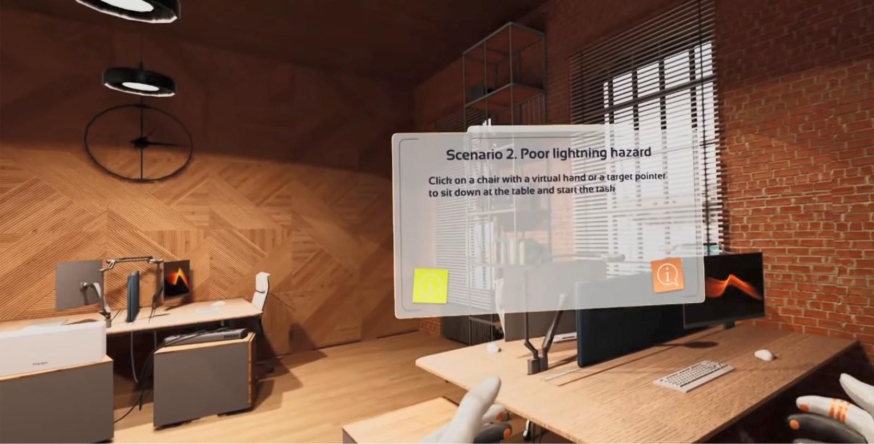
Scenario prompt shown inside the VR office safety training simulator
Realistic learning environment:
The training was delivered through a detailed 3D office simulation designed to reflect a familiar workplace setting. Users moved through realistic spaces, interacted with virtual objects, and assessed situations that closely matched everyday office conditions. This made the learning experience more practical than static training formats, because users were not just reading about risks, they were identifying them in context and responding as they would in a real environment.
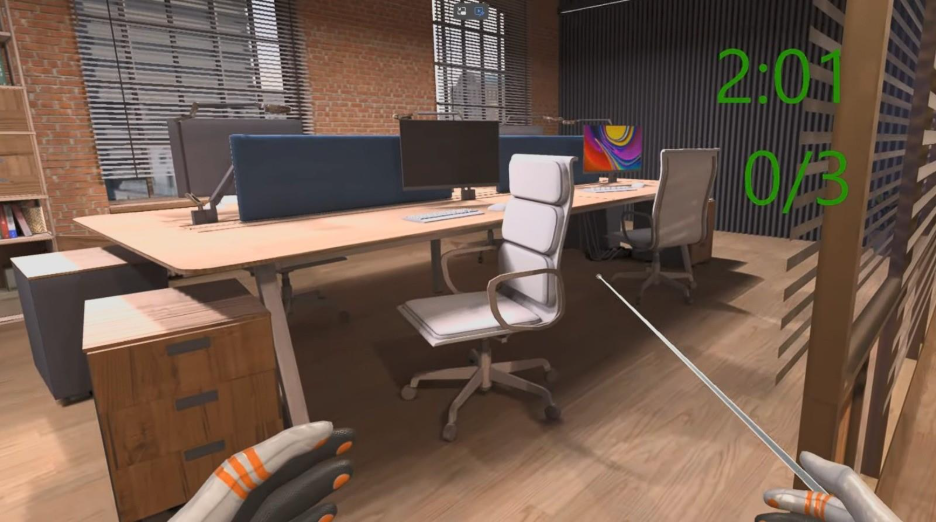
Hazard identification task with time tracking and scenario scoring
Feedback and analytics:
The platform combinesd training, testing, and reporting in one experience. After every scenario, the system displayed results on screen, giving trainees immediate visibility into how they performed and how accurately they identified risks or completed the required task. At the same time, the platform collected and processed training statistics so administrators could review results across users and sessions.
- Instant feedback: After each scenario, trainees can see a visual summary of their results, including whether their answers were correct and their percentage of awareness or concentration for that module. This makes the experience more interactive and helped reinforce the learning point immediately after the exercise.
- Performance scoring: Each module uses a clear scoring logic tied to the scenario. In some cases, performance was measured by the number of hazards correctly identified. In others, it was based on answer accuracy, posture accuracy, or concentration under conditions such as poor lighting or noise. This gives the training a more structured and testable format rather than treating it as a passive simulation.
- Administrator reporting: The system allowed administrators to enter trainee details before the session, track outcomes after completion, and generate results for individual users or all trainees. Results could also be printed or saved as a PDF, making it easier for the training team to review performance, monitor awareness levels, and maintain records across sessions.
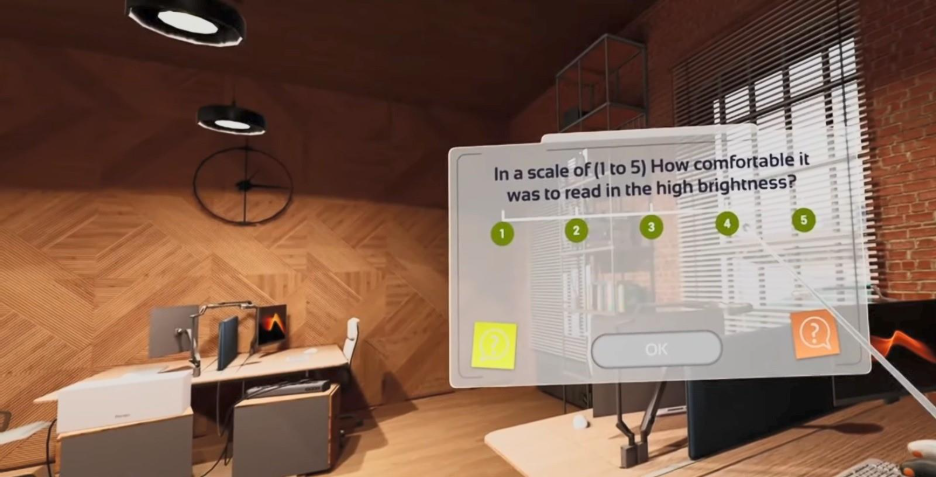
Example of in-scenario assessment used to measure user response and awareness
Implementation and Deployment Approach:
The platform was developed and delivered over an 8-week timeline, covering design, development of six scenarios, testing, and final deployment.
The solution was built as a standalone VR application for HTC Vive Focus 3 headsets already in use by the client, which simplified deployment and removed the need for external integrations.
The initial rollout included 8 trainees, allowing the organization to test the experience, validate the training flow, and review performance reporting before expanding usage.
From the start, the system was designed as a reusable training platform rather than a one-time simulation, enabling future expansion into additional modules and scenarios.
Results of the VR Office Safety Training:
The VR simulator gave the organization a more structured and interactive way to deliver office safety training. Instead of relying only on passive instruction, trainees actively engaged with scenarios, identified risks, and received immediate feedback on their performance.
Key outcomes included:
- More active participation: Trainees moved through realistic office scenarios and completed task-based exercises instead of only consuming information.
- Context-based hazard awareness: Users identified risks across multiple scenarios, including ergonomics, lighting, noise, electrical safety, housekeeping, and slips or falls.
- Measurable training sessions: Each module included scoring based on awareness, concentration, or hazard recognition, giving both trainees and administrators visibility into performance.
- Structured reporting: Results were captured and could be reviewed, printed, or exported, making training easier to track and manage across sessions.
- Scalable training model: The standalone platform allows consistent delivery across users without relying solely on classroom-based training.
- Foundation for future expansion: The system was designed to support additional modules and new training scenarios over time.
Future of VR Safety Training: What Comes Next?
While the first phase focused on office safety awareness, the platform creates a foundation for more advanced and specialized training scenarios.
Future development could extend beyond basic hazard recognition into role-specific simulations, where employees are trained on workflows, emergency response, or compliance procedures within the same VR environment. For example, scenarios could simulate evacuation processes, incident reporting, or coordination between teams during safety-critical situations.
Another potential direction is the integration of performance analytics over time, where training data is tracked across sessions to identify recurring gaps in awareness or behaviour. This would allow organizations to move from one-time training to continuous improvement in safety practices.
As immersive technologies continue to mature, platforms like this can expand from training tools into broader workforce enablement systems, supporting onboarding, compliance training, and operational readiness within a single VR environment.
Explore Related Solutions:
Learn more about VR and AR Solutions to see how NNTC supports immersive training projects.
Contact the Team:
Interested in building a similar solution? Get in touch with the NNTC team to discuss your training requirements and explore how immersive technologies can support safer, more engaging learning experiences.
About NNTC :
NNTC is a leading technology solutions provider specializing in innovative, immersive platforms for various industries. With a strong focus on digital transformation, NNTC designs cutting-edge solutions such as industrial digital twins, VR training simulators, and smart city technologies. The company has successfully delivered impactful solutions to organizations across the Middle East and beyond, helping them enhance operational efficiency, safety, and business outcomes.
- Location: Dubai, UAE
- Customer: Government Entity
- Year: 2023
- Category: VR&AR
