
How Face Recognition System Puts Things Right on Construction Site and Helps Contractor Avoid Penalty 6

A mess on a construction site is quite a common thing and can be tolerated to some extent if it is an organized mess. However, when this mess creeps into core processes, a construction site turns into a hurrah’s nest, and a developer faces risk of large penalties, downtime, and even death toll. In this blog, we’ll tell you how CROC, our strategic partner, implemented a face recognition system on a construction site.

One fine, sunny day, when the site was buzzing with activity and dozens of workers were moving around cheerful and positive, a former workman penetrated the site. He passed through a checkpoint, greeted a guard who knew him well (but did not know that he had been fired already), entered the territory, and went to his friends. Half an hour later, a fire was burning, with the workers drinking tea, resting, and enjoying their lives.

The problem was that they made the fire near two gas cylinders, one of which suddenly exploded. Neither warning nor alert. Just exploded, and that’s it! Fortunately, people were just shocked, not injured, but a police came to the site the same day and initiated an inspection, which revealed some unpleasant facts for a contractor:

  • Many workers used forged documents. In other words, one family member obtained necessary documents, got hired at the construction site, and then his brother went for work instead of him.
  • For each worker using forged documents, a fine of $7,600 or even more may be imposed, and the construction process may be suspended for 14 – 90 days with almost catastrophic consequences for a general contractor and customer.

That is why the contractor asked CROC for help.

How to solve a problem?

Initially, the construction site was equipped with just run-of-the-mill employee recognition systems:

  • Palm vein identification, which performs poorly even in clean offices if people eat some greasy food there. After eating, this vein pattern changes causing recognition errors.
  • Iris identification, which is more expensive and time consuming. It is hardly the best option when every morning buses arrive at a construction site and some 600 workers have to pass the checkpoint within one hour, from 7 to 8 a.m. It’s as slow as a snail!

Therefore, it was the time to try video analytics.

Each turnstile is equipped with two cameras: one aimed at incoming people, and the other, at outgoing.

There is a small cooled server room on site, having a rack with two servers and a switch. The first server receives video stream from cameras and identifies frames containing faces and being of the best quality. The second server receives these “clear” frames with faces and runs a recognition algorithm to find a match in a database.

If a frame contains only one face and this person is authorized to pass through, then the turnstile opens. Otherwise, a guard is alerted.

No Internet connection is needed for the system, just a copper cabling on site. However, if connected, the system allows for continuous monitoring, email reports, and remote second line support for operators.

The system runs perfectly in typical situations:

  • Using a pass card of another person to enter — an alerted guard stops a trespasser and investigates the incident.
  • A former employee attempts to enter the site — a guard does not let him in.
  • An employee attempts to enter the site in wrong time — a guard asks the employee to get a pass card at an access control office and then come back to the checkpoint.

In addition, every evening, executives get a report on how many people were scheduled for work and how many arrived actually. It is very important since contractor’s favorite trick is to schedule 50 workers, provide only 30, and then report on 50.

Moreover, this information — like 600 people scheduled, only 450 arrived — shows if a project is running out of time already. And you see it right now, but not a week or month later.

Outcome

Morning queues have almost disappeared. Instead, it takes one hour for two turnstiles to let 700 people in, even including guard intervention cases. The customer enjoys reports on the actual number of people arrived at the construction site, which was a sad news for some of the contractors. Neither a $7,600 penalty nor work suspension for 14 – 90 days is pending now, with the system itself costing less than this penalty.

NNTC actively partners with CROC and implements face recognition solutions in GCC countries. If you are interested in this technology, feel free to contact our consultants.

How Face Recognition System Puts Things Right on Construction Site and Helps Contractor Avoid Penalty 5

A mess on a construction site is quite a common thing and can be tolerated to some extent if it is an organized mess. However, when this mess creeps into core processes, a construction site turns into a hurrah’s nest, and a developer faces risk of large penalties, downtime, and even death toll. In this blog, we’ll tell you how CROC, our strategic partner, implemented a face recognition system on a construction site.

One fine, sunny day, when the site was buzzing with activity and dozens of workers were moving around cheerful and positive, a former workman penetrated the site. He passed through a checkpoint, greeted a guard who knew him well (but did not know that he had been fired already), entered the territory, and went to his friends. Half an hour later, a fire was burning, with the workers drinking tea, resting, and enjoying their lives.

The problem was that they made the fire near two gas cylinders, one of which suddenly exploded. Neither warning nor alert. Just exploded, and that’s it! Fortunately, people were just shocked, not injured, but a police came to the site the same day and initiated an inspection, which revealed some unpleasant facts for a contractor:

  • Many workers used forged documents. In other words, one family member obtained necessary documents, got hired at the construction site, and then his brother went for work instead of him.
  • For each worker using forged documents, a fine of $7,600 or even more may be imposed, and the construction process may be suspended for 14 – 90 days with almost catastrophic consequences for a general contractor and customer.

That is why the contractor asked CROC for help.

How to solve a problem?

Initially, the construction site was equipped with just run-of-the-mill employee recognition systems:

  • Palm vein identification, which performs poorly even in clean offices if people eat some greasy food there. After eating, this vein pattern changes causing recognition errors.
  • Iris identification, which is more expensive and time consuming. It is hardly the best option when every morning buses arrive at a construction site and some 600 workers have to pass the checkpoint within one hour, from 7 to 8 a.m. It’s as slow as a snail!

Therefore, it was the time to try video analytics.

Each turnstile is equipped with two cameras: one aimed at incoming people, and the other, at outgoing.

There is a small cooled server room on site, having a rack with two servers and a switch. The first server receives video stream from cameras and identifies frames containing faces and being of the best quality. The second server receives these “clear” frames with faces and runs a recognition algorithm to find a match in a database.

If a frame contains only one face and this person is authorized to pass through, then the turnstile opens. Otherwise, a guard is alerted.

No Internet connection is needed for the system, just a copper cabling on site. However, if connected, the system allows for continuous monitoring, email reports, and remote second line support for operators.

The system runs perfectly in typical situations:

  • Using a pass card of another person to enter — an alerted guard stops a trespasser and investigates the incident.
  • A former employee attempts to enter the site — a guard does not let him in.
  • An employee attempts to enter the site in wrong time — a guard asks the employee to get a pass card at an access control office and then come back to the checkpoint.

In addition, every evening, executives get a report on how many people were scheduled for work and how many arrived actually. It is very important since contractor’s favorite trick is to schedule 50 workers, provide only 30, and then report on 50.

Moreover, this information — like 600 people scheduled, only 450 arrived — shows if a project is running out of time already. And you see it right now, but not a week or month later.

Outcome

Morning queues have almost disappeared. Instead, it takes one hour for two turnstiles to let 700 people in, even including guard intervention cases. The customer enjoys reports on the actual number of people arrived at the construction site, which was a sad news for some of the contractors. Neither a $7,600 penalty nor work suspension for 14 – 90 days is pending now, with the system itself costing less than this penalty.

NNTC actively partners with CROC and implements face recognition solutions in GCC countries. If you are interested in this technology, feel free to contact our consultants.

INNOVATIVE MEDICAL KIOSK FOR THREE-MINUTE HEALTH CHECK

Any hazardous occupation calls for continuous health checks to make sure that manufacturing workers, bus drivers and pilots are medically fit to deal with their jobs, as well as nuclear operators are clean and sober before the shift. This job list can be continued.

Many plants make medical examinations a must for rank-and-file employees, too many for one physician to conduct but not so thorough as for pilots or nuclear operators. Such a health check includes measuring blood pressure, heart rate, temperature, blood oxygenation, and basic reflexes. Some local regulations prohibit robots from examining these health indicators, some do allow it, but still require a medical professional to approve the results. Thus, humans remain in change, but may enjoy great automation benefits.

Medical kiosk is a comprehensive solution to measure all relevant indicators allowing workers to undergo every morning’s medical examination in just three minutes.

What is a medical kiosk? It is a Linux machine with a variety of medical sensors and the software to identify patients by a card, fingerprint, face or eye, run examinations, enter the results into a database, and even print them out. The database can either be inside the kiosk or stored in the company’s HR system or on another external server. 

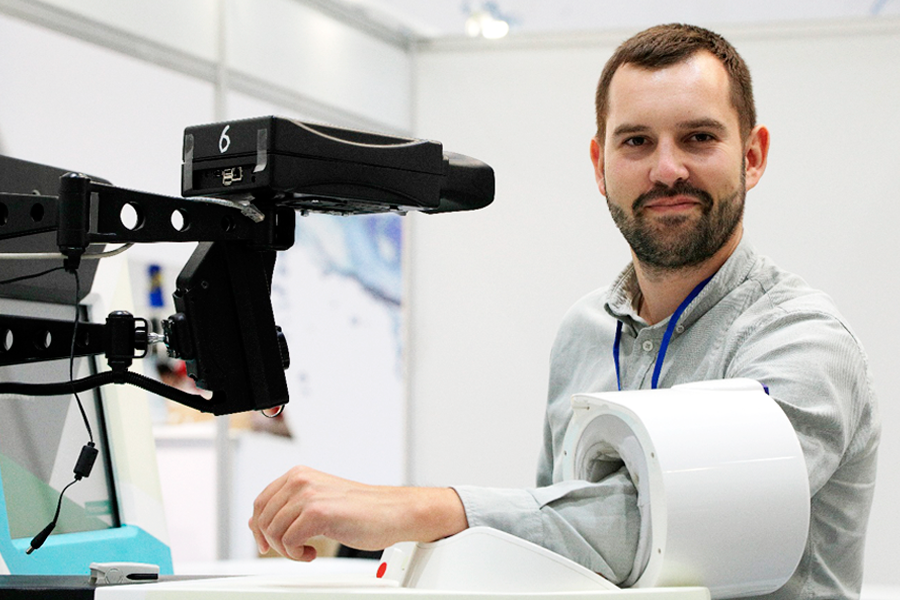
Basic configuration consists of a case, vandal-proof touch screen (16 mm glass), printer, and camera for a doctor to supervise the examination or detect patient change after authentication. The default sensors measure heart rate, blood oxygenation by transillumination, blood pressure (a cuff), and alcohol intoxication. The advanced configuration provides additionally a pupillometer, touch-free thermometer, scales and any sensors of choice, like glucose meter or contact thermometer, etc.

Default sensors

The breathalyzer is a device consisting of an ethanol (or rather alcoholic fumes) sensor connected to the access control system. If a person is OK, the turnstile opens. If alcohol intoxication is detected, then security is notified and the turnstile remains closed.

Such kiosk at the entry turnstiles doesn’t substitute medical personnel but significantly reduces their workload and minimizes human factor impact on result accuracy.

Additional sensors

Thermal imaging cameras are not the news, so we decided to adapt them for touch-free thermometers that use the forehead to take a temperature. The point sensor is located right above a breathalyzer. Our test subject was savvy enough to quickly find a way of cheating the system by rubbing the forehead before examination, with the terminal immediately triggering an alarm and offering to call an ambulance, a quarantine control and neutralizing teams.

A pupillometer measures pupil response time: a flash – and the count begins. The response time helps determine nervous system condition, particularly nervous exaltation or slowness, which are usually caused by diseases, alcohol, drugs, medication, fatigue, sleepiness or mental disorders.

Summary

Full health check session takes three minutes (the more sensors, the longer it takes).

Doctors concur that the terminal can quickly identify hypertensive crisis with potential to develop into myocardial infarction or stroke, tachycardia (increased pulse rate) or bradycardia (decreased pulse rate), fever caused by acute infection, ARVI, influenza, and alcohol intoxication (a usual suspect for any plant).

Generally, this kiosk is a kind of a construction set that you can turn into a full-fledged and handy medical tool of choice. You can even choose the case.

Medical terminals are used for daily staff checks before shifts. The three-step employee identification process includes an individual USB key reading, photo recognition, and fingerprint scanning, while the comprehensive medical examination consists of blood pressure and heart rate measurement, and respiratory alcohol level testing.

The customer confirmed that daily pre-shift health checks via medical terminals help to reduce industrial injury and emergency risks, and improve staff behavior.

How Face Recognition System Puts Things Right on Construction Site and Helps Contractor Avoid Penalty 4

A mess on a construction site is quite a common thing and can be tolerated to some extent if it is an organized mess. However, when this mess creeps into core processes, a construction site turns into a hurrah’s nest, and a developer faces risk of large penalties, downtime, and even death toll. In this blog, we’ll tell you how CROC, our strategic partner, implemented a face recognition system on a construction site.

One fine, sunny day, when the site was buzzing with activity and dozens of workers were moving around cheerful and positive, a former workman penetrated the site. He passed through a checkpoint, greeted a guard who knew him well (but did not know that he had been fired already), entered the territory, and went to his friends. Half an hour later, a fire was burning, with the workers drinking tea, resting, and enjoying their lives.

The problem was that they made the fire near two gas cylinders, one of which suddenly exploded. Neither warning nor alert. Just exploded, and that’s it! Fortunately, people were just shocked, not injured, but a police came to the site the same day and initiated an inspection, which revealed some unpleasant facts for a contractor:

  • Many workers used forged documents. In other words, one family member obtained necessary documents, got hired at the construction site, and then his brother went for work instead of him.
  • For each worker using forged documents, a fine of $7,600 or even more may be imposed, and the construction process may be suspended for 14 – 90 days with almost catastrophic consequences for a general contractor and customer.

That is why the contractor asked CROC for help.

How to solve a problem?

Initially, the construction site was equipped with just run-of-the-mill employee recognition systems:

  • Palm vein identification, which performs poorly even in clean offices if people eat some greasy food there. After eating, this vein pattern changes causing recognition errors.
  • Iris identification, which is more expensive and time consuming. It is hardly the best option when every morning buses arrive at a construction site and some 600 workers have to pass the checkpoint within one hour, from 7 to 8 a.m. It’s as slow as a snail!

Therefore, it was the time to try video analytics.

Each turnstile is equipped with two cameras: one aimed at incoming people, and the other, at outgoing.

There is a small cooled server room on site, having a rack with two servers and a switch. The first server receives video stream from cameras and identifies frames containing faces and being of the best quality. The second server receives these “clear” frames with faces and runs a recognition algorithm to find a match in a database.

If a frame contains only one face and this person is authorized to pass through, then the turnstile opens. Otherwise, a guard is alerted.

No Internet connection is needed for the system, just a copper cabling on site. However, if connected, the system allows for continuous monitoring, email reports, and remote second line support for operators.

The system runs perfectly in typical situations:

  • Using a pass card of another person to enter — an alerted guard stops a trespasser and investigates the incident.
  • A former employee attempts to enter the site — a guard does not let him in.
  • An employee attempts to enter the site in wrong time — a guard asks the employee to get a pass card at an access control office and then come back to the checkpoint.

In addition, every evening, executives get a report on how many people were scheduled for work and how many arrived actually. It is very important since contractor’s favorite trick is to schedule 50 workers, provide only 30, and then report on 50.

Moreover, this information — like 600 people scheduled, only 450 arrived — shows if a project is running out of time already. And you see it right now, but not a week or month later.

Outcome

Morning queues have almost disappeared. Instead, it takes one hour for two turnstiles to let 700 people in, even including guard intervention cases. The customer enjoys reports on the actual number of people arrived at the construction site, which was a sad news for some of the contractors. Neither a $7,600 penalty nor work suspension for 14 – 90 days is pending now, with the system itself costing less than this penalty.

NNTC actively partners with CROC and implements face recognition solutions in GCC countries. If you are interested in this technology, feel free to contact our consultants.
How Face Recognition System Puts Things Right on Construction Site and Helps Contractor Avoid Penalty 3

A mess on a construction site is quite a common thing and can be tolerated to some extent if it is an organized mess. However, when this mess creeps into core processes, a construction site turns into a hurrah’s nest, and a developer faces risk of large penalties, downtime, and even death toll. In this blog, we’ll tell you how CROC, our strategic partner, implemented a face recognition system on a construction site.

One fine, sunny day, when the site was buzzing with activity and dozens of workers were moving around cheerful and positive, a former workman penetrated the site. He passed through a checkpoint, greeted a guard who knew him well (but did not know that he had been fired already), entered the territory, and went to his friends. Half an hour later, a fire was burning, with the workers drinking tea, resting, and enjoying their lives.

The problem was that they made the fire near two gas cylinders, one of which suddenly exploded. Neither warning nor alert. Just exploded, and that’s it! Fortunately, people were just shocked, not injured, but a police came to the site the same day and initiated an inspection, which revealed some unpleasant facts for a contractor:

  • Many workers used forged documents. In other words, one family member obtained necessary documents, got hired at the construction site, and then his brother went for work instead of him.
  • For each worker using forged documents, a fine of $7,600 or even more may be imposed, and the construction process may be suspended for 14 – 90 days with almost catastrophic consequences for a general contractor and customer.

That is why the contractor asked CROC for help.

How to solve a problem?

Initially, the construction site was equipped with just run-of-the-mill employee recognition systems:

  • Palm vein identification, which performs poorly even in clean offices if people eat some greasy food there. After eating, this vein pattern changes causing recognition errors.
  • Iris identification, which is more expensive and time consuming. It is hardly the best option when every morning buses arrive at a construction site and some 600 workers have to pass the checkpoint within one hour, from 7 to 8 a.m. It’s as slow as a snail!

Therefore, it was the time to try video analytics.

Each turnstile is equipped with two cameras: one aimed at incoming people, and the other, at outgoing.

There is a small cooled server room on site, having a rack with two servers and a switch. The first server receives video stream from cameras and identifies frames containing faces and being of the best quality. The second server receives these “clear” frames with faces and runs a recognition algorithm to find a match in a database.

If a frame contains only one face and this person is authorized to pass through, then the turnstile opens. Otherwise, a guard is alerted.

No Internet connection is needed for the system, just a copper cabling on site. However, if connected, the system allows for continuous monitoring, email reports, and remote second line support for operators.

The system runs perfectly in typical situations:

  • Using a pass card of another person to enter — an alerted guard stops a trespasser and investigates the incident.
  • A former employee attempts to enter the site — a guard does not let him in.
  • An employee attempts to enter the site in wrong time — a guard asks the employee to get a pass card at an access control office and then come back to the checkpoint.

In addition, every evening, executives get a report on how many people were scheduled for work and how many arrived actually. It is very important since contractor’s favorite trick is to schedule 50 workers, provide only 30, and then report on 50.

Moreover, this information — like 600 people scheduled, only 450 arrived — shows if a project is running out of time already. And you see it right now, but not a week or month later.

Outcome

Morning queues have almost disappeared. Instead, it takes one hour for two turnstiles to let 700 people in, even including guard intervention cases. The customer enjoys reports on the actual number of people arrived at the construction site, which was a sad news for some of the contractors. Neither a $7,600 penalty nor work suspension for 14 – 90 days is pending now, with the system itself costing less than this penalty.

NNTC actively partners with CROC and implements face recognition solutions in GCC countries. If you are interested in this technology, feel free to contact our consultants.

OUR TOP PICK OF TECHNOLOGY TRENDS FOR 2020

The New Year is coming! It is the time when people make plans and wishes, so we can’t resist the temptation to use our imagination and expert judgment to make a list of key innovation trends for the upcoming year. Our fellow writing experts and research centers hasten to share the dreams and realities of their experience. Studying them all inspired us to make our own list of favorites.

Hyperautomation

The trend derives from robotic process automation (RPA). Though it’s mainly about automation, things are slightly complicated as automated setup is also in the spotlight now. Hyperautomation encompasses machine learning (ML), packaged software, automation tools, and tries to understand how to automate and coordinate them. Though it’s not a full clear trend, it is expected to ‘automate automation’.

DARQ

Experts believe this group of letters, or rather technologies behind it, is a wise choice to develop business. DARQ = distributed ledger technology + artificial intelligence + extended reality (AR/VR) + quantum computing. Whatever the business task, DARQ is the answer.

Multiexperience

The name suggests that this trend is all about empirical exploration. Ever since technologies entered our lives, they have been influencing our cognition. The more we embraced innovations, the stronger was technology impact on our lives. At the dawn of the Digital Age we studied technologies, now they study us. Furthermore, the two-way road of human-technology relations is becoming a highway to a new digital world. According to Gartner, this combined shift in both perception and interaction models leads to the future multisensory and multimodal experience. In other words, the barrier between humans and machines is getting thin, diverse, and sensual.

Transparency and Traceability

Gartner predicts that by 2023 most large players (some 75%) will assign their privacy, behavior forensic, and customer trust tasks to artificial intelligence in order to avoid reputation and brand risk. Although artificial intelligence evolves quickly, people still worry what it may bring in the nearest future. So making AI algorithms more transparent and clear will become top priority along with combating fake news and AI power misuse.

Distributed Cloud

A distributed cloud allocates public cloud services to different data centers, while cloud provider stays solely responsible for cloud performance and quality of service. For what it’s worth, this trend moves us towards cloud computing.

Rapid advances in new technologies open up opportunities for us to learn, grow and evolve, but only time will tell which technologies will stay with us for good.

How Face Recognition System Puts Things Right on Construction Site and Helps Contractor Avoid Penalty 2

A mess on a construction site is quite a common thing and can be tolerated to some extent if it is an organized mess. However, when this mess creeps into core processes, a construction site turns into a hurrah’s nest, and a developer faces risk of large penalties, downtime, and even death toll. In this blog, we’ll tell you how CROC, our strategic partner, implemented a face recognition system on a construction site.

One fine, sunny day, when the site was buzzing with activity and dozens of workers were moving around cheerful and positive, a former workman penetrated the site. He passed through a checkpoint, greeted a guard who knew him well (but did not know that he had been fired already), entered the territory, and went to his friends. Half an hour later, a fire was burning, with the workers drinking tea, resting, and enjoying their lives.

The problem was that they made the fire near two gas cylinders, one of which suddenly exploded. Neither warning nor alert. Just exploded, and that’s it! Fortunately, people were just shocked, not injured, but a police came to the site the same day and initiated an inspection, which revealed some unpleasant facts for a contractor:

  • Many workers used forged documents. In other words, one family member obtained necessary documents, got hired at the construction site, and then his brother went for work instead of him.
  • For each worker using forged documents, a fine of $7,600 or even more may be imposed, and the construction process may be suspended for 14 – 90 days with almost catastrophic consequences for a general contractor and customer.

That is why the contractor asked CROC for help.

How to solve a problem?

Initially, the construction site was equipped with just run-of-the-mill employee recognition systems:

  • Palm vein identification, which performs poorly even in clean offices if people eat some greasy food there. After eating, this vein pattern changes causing recognition errors.
  • Iris identification, which is more expensive and time consuming. It is hardly the best option when every morning buses arrive at a construction site and some 600 workers have to pass the checkpoint within one hour, from 7 to 8 a.m. It’s as slow as a snail!

Therefore, it was the time to try video analytics.

Each turnstile is equipped with two cameras: one aimed at incoming people, and the other, at outgoing.

There is a small cooled server room on site, having a rack with two servers and a switch. The first server receives video stream from cameras and identifies frames containing faces and being of the best quality. The second server receives these “clear” frames with faces and runs a recognition algorithm to find a match in a database.

If a frame contains only one face and this person is authorized to pass through, then the turnstile opens. Otherwise, a guard is alerted.

No Internet connection is needed for the system, just a copper cabling on site. However, if connected, the system allows for continuous monitoring, email reports, and remote second line support for operators.

The system runs perfectly in typical situations:

  • Using a pass card of another person to enter — an alerted guard stops a trespasser and investigates the incident.
  • A former employee attempts to enter the site — a guard does not let him in.
  • An employee attempts to enter the site in wrong time — a guard asks the employee to get a pass card at an access control office and then come back to the checkpoint.

In addition, every evening, executives get a report on how many people were scheduled for work and how many arrived actually. It is very important since contractor’s favorite trick is to schedule 50 workers, provide only 30, and then report on 50.

Moreover, this information — like 600 people scheduled, only 450 arrived — shows if a project is running out of time already. And you see it right now, but not a week or month later.

Outcome

Morning queues have almost disappeared. Instead, it takes one hour for two turnstiles to let 700 people in, even including guard intervention cases. The customer enjoys reports on the actual number of people arrived at the construction site, which was a sad news for some of the contractors. Neither a $7,600 penalty nor work suspension for 14 – 90 days is pending now, with the system itself costing less than this penalty.

NNTC actively partners with CROC and implements face recognition solutions in GCC countries. If you are interested in this technology, feel free to contact our consultants.

How Face Recognition System Puts Things Right on Construction Site and Helps Contractor Avoid Penalty 1

A mess on a construction site is quite a common thing and can be tolerated to some extent if it is an organized mess. However, when this mess creeps into core processes, a construction site turns into a hurrah’s nest, and a developer faces risk of large penalties, downtime, and even death toll. In this blog, we’ll tell you how CROC, our strategic partner, implemented a face recognition system on a construction site.

One fine, sunny day, when the site was buzzing with activity and dozens of workers were moving around cheerful and positive, a former workman penetrated the site. He passed through a checkpoint, greeted a guard who knew him well (but did not know that he had been fired already), entered the territory, and went to his friends. Half an hour later, a fire was burning, with the workers drinking tea, resting, and enjoying their lives.

The problem was that they made the fire near two gas cylinders, one of which suddenly exploded. Neither warning nor alert. Just exploded, and that’s it! Fortunately, people were just shocked, not injured, but a police came to the site the same day and initiated an inspection, which revealed some unpleasant facts for a contractor:

  • Many workers used forged documents. In other words, one family member obtained necessary documents, got hired at the construction site, and then his brother went for work instead of him.
  • For each worker using forged documents, a fine of $7,600 or even more may be imposed, and the construction process may be suspended for 14 – 90 days with almost catastrophic consequences for a general contractor and customer.

That is why the contractor asked CROC for help.

How to solve a problem?

Initially, the construction site was equipped with just run-of-the-mill employee recognition systems:

  • Palm vein identification, which performs poorly even in clean offices if people eat some greasy food there. After eating, this vein pattern changes causing recognition errors.
  • Iris identification, which is more expensive and time consuming. It is hardly the best option when every morning buses arrive at a construction site and some 600 workers have to pass the checkpoint within one hour, from 7 to 8 a.m. It’s as slow as a snail!

Therefore, it was the time to try video analytics.

Each turnstile is equipped with two cameras: one aimed at incoming people, and the other, at outgoing.

There is a small cooled server room on site, having a rack with two servers and a switch. The first server receives video stream from cameras and identifies frames containing faces and being of the best quality. The second server receives these “clear” frames with faces and runs a recognition algorithm to find a match in a database.

If a frame contains only one face and this person is authorized to pass through, then the turnstile opens. Otherwise, a guard is alerted.

No Internet connection is needed for the system, just a copper cabling on site. However, if connected, the system allows for continuous monitoring, email reports, and remote second line support for operators.

The system runs perfectly in typical situations:

  • Using a pass card of another person to enter — an alerted guard stops a trespasser and investigates the incident.
  • A former employee attempts to enter the site — a guard does not let him in.
  • An employee attempts to enter the site in wrong time — a guard asks the employee to get a pass card at an access control office and then come back to the checkpoint.

In addition, every evening, executives get a report on how many people were scheduled for work and how many arrived actually. It is very important since contractor’s favorite trick is to schedule 50 workers, provide only 30, and then report on 50.

Moreover, this information — like 600 people scheduled, only 450 arrived — shows if a project is running out of time already. And you see it right now, but not a week or month later.

Outcome

Morning queues have almost disappeared. Instead, it takes one hour for two turnstiles to let 700 people in, even including guard intervention cases. The customer enjoys reports on the actual number of people arrived at the construction site, which was a sad news for some of the contractors. Neither a $7,600 penalty nor work suspension for 14 – 90 days is pending now, with the system itself costing less than this penalty.

NNTC actively partners with CROC and implements face recognition solutions in GCC countries. If you are interested in this technology, feel free to contact our consultants.

INDUSTRY 4.0 TO REDUCE THE NUMBER OF ACCIDENTS AT OIL AND GAS FACILITIES

INDUSTRY 4.0 TO REDUCE THE NUMBER OF ACCIDENTS AT OIL AND GAS FACILITIES

Virtual reality (VR), Internet of Things (IoT), and video analytics are the technologies curtailing occupational accidents and creating a safe environment for both white and blue-collar workers at hazardous manufacturing facilities.

Have you heard about Vision Zero? It is a campaign developed by the International Social Security Association (ISSA) to improve safety, health and wellbeing at work, providing the seven golden rules:

1. Take leadership  – demonstrate commitment
2. Identify hazards – control risks
3. Define targets – develop programs
4. Ensure a safe and healthy system – be well-organized
5. Ensure safety and health in machines, equipment and workplaces
6. Improve qualifications – develop competence
7. Invest in people – motivate by participation

Today, the Vision Zero principles underpin draft regulations and intensively penetrate into industrial facilities, especially via the adoption of innovative technologies. Industry 4.0 solutions are a perfect match being Vision Zero compliant by default.

The Industrial Internet of Things (IIoT) at hazardous manufacturing facilities is used to monitor both personnel actions and environment. Sensors are placed on personal protective equipment (PPE) to take temperature and pressure readings and detect movement. Digital Worker platform combines a range of video analytics, smart wearable devices, and global and local positioning solutions.

Intelligent video analytics, delivered as a platform component or stand-alone unit, leverages machine vision and neural networks. Installed throughout a facility, cameras recognize threats, identify HSE violators (e.g., employees working unprotected), and alert dispatchers in real time.

Another platform component, an 80-gram IоТ module for a smart hard hat is certified for use in explosion hazardous areas and can be installed on most hard hat models to check if employees wear PPE, identify and locate them even in case of limited visibility. A buzzing hard hat alerts a worker to dangers, and an embedded emergency button provides the fastest way to send for help. The accelerometer will detect if a hard hat wearer is hit, falling down or not moving at all, while built-in sensors capture critical environmental fluctuations.

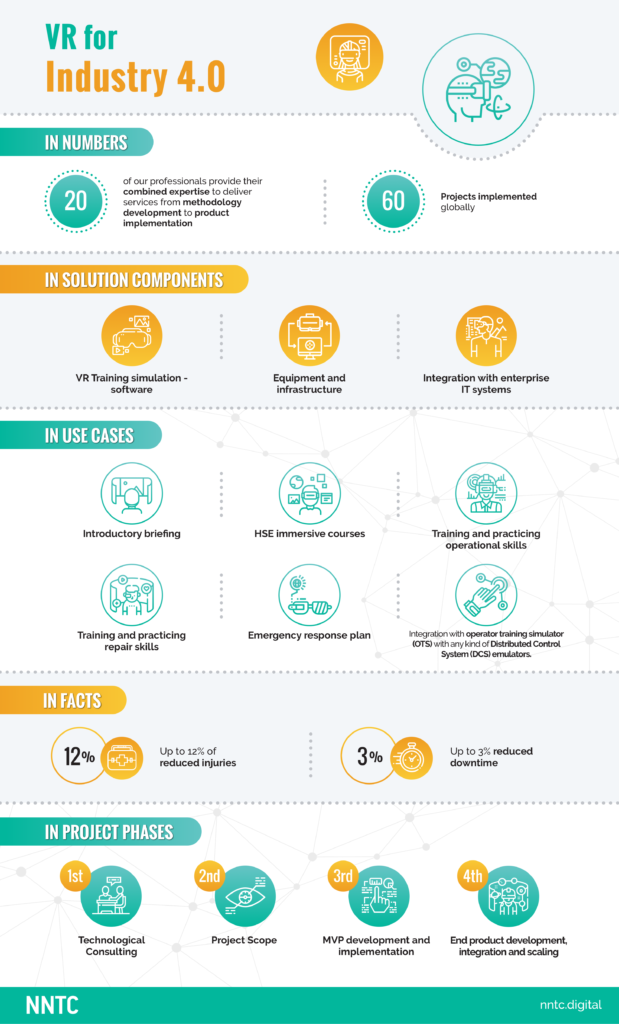
Virtual reality is widely adopted to improve safety at manufacturing facilities and, particularly, staff professional skills in the oil and gas and petrochemistry sectors. VR/AR technologies make it possible for workers to get professional training when hands-on experience at actual technological facilities is unobtainable. For example, a virtual simulator of equipment assembly and disassembly or VR training for an emergency situation is a safe way to both exercise skills and monitor facility health and parameters in real time. Such models can also contribute to production chain optimization and evacuation plan development.