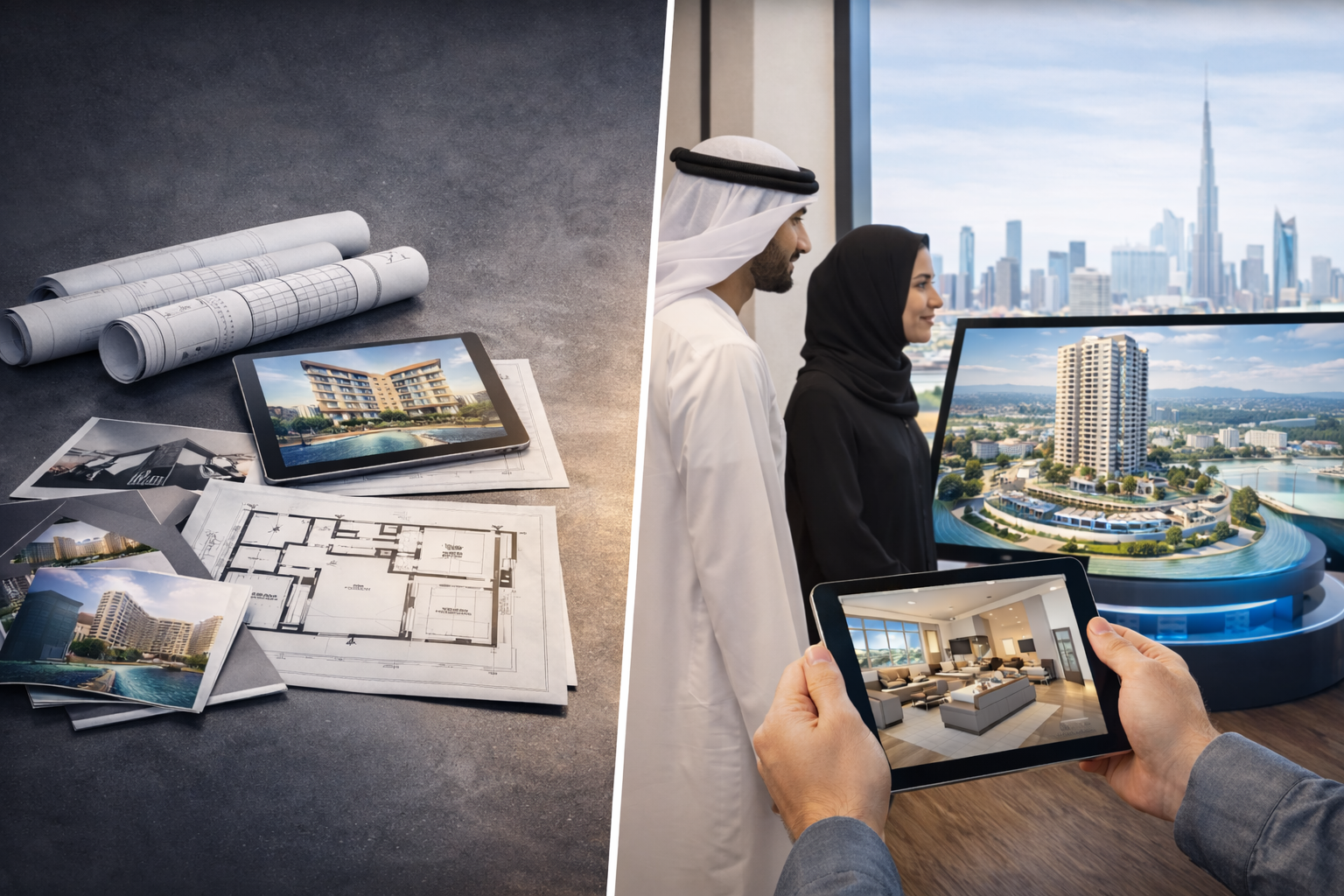
Hologram Tables, Touchscreen Kiosks, or Immersive Rooms: What Should Property Developers Choose? 

What Should Property Developers Choose?

Which immersive real estate setup actually helps developers sell better? Compare hologram tables, touchscreen kiosks, and immersive rooms by sales use case, buyer journey, and commercial value. 

Some real estate technologies look impressive in a demo, but that does not always mean they help developers sell more effectively. 

That distinction matters even more in Dubai, where off-plan activity now dominates a large share of residential sales. 

Knight Frank review on Dubai Residential Market reported that off-plan launches accounted for roughly 73% of deals in Q3 2025. In that kind of environment, the formats that are used to explain, compare, and differentiate projects start to matter far more.  

For property developers, the question is no longer whether immersive technology belongs in the sales journey. It is which immersive real estate sales tools actually help buyers understand the project, compare options, and move closer to a decision.

Why Immersive Real Estate Sales Tools Need to Be Compared Carefully  

Developers are investing more in immersive real estate sales tools, but those tools do not all solve the same problem. 

Some formats are built for guided consultation. Some are built for emotional immersion. And some are simply more useful in the daily mechanics of selling than others.  

That matters because buyer confidence is not created by novelty alone. The best immersive tools are the ones that reduce uncertainty, support real buyer actions, and fit naturally into the sales process.  

This is why the choice between hologram tables, touchscreen kiosks, and immersive rooms should be made as a sales decision, not a technology decision. 

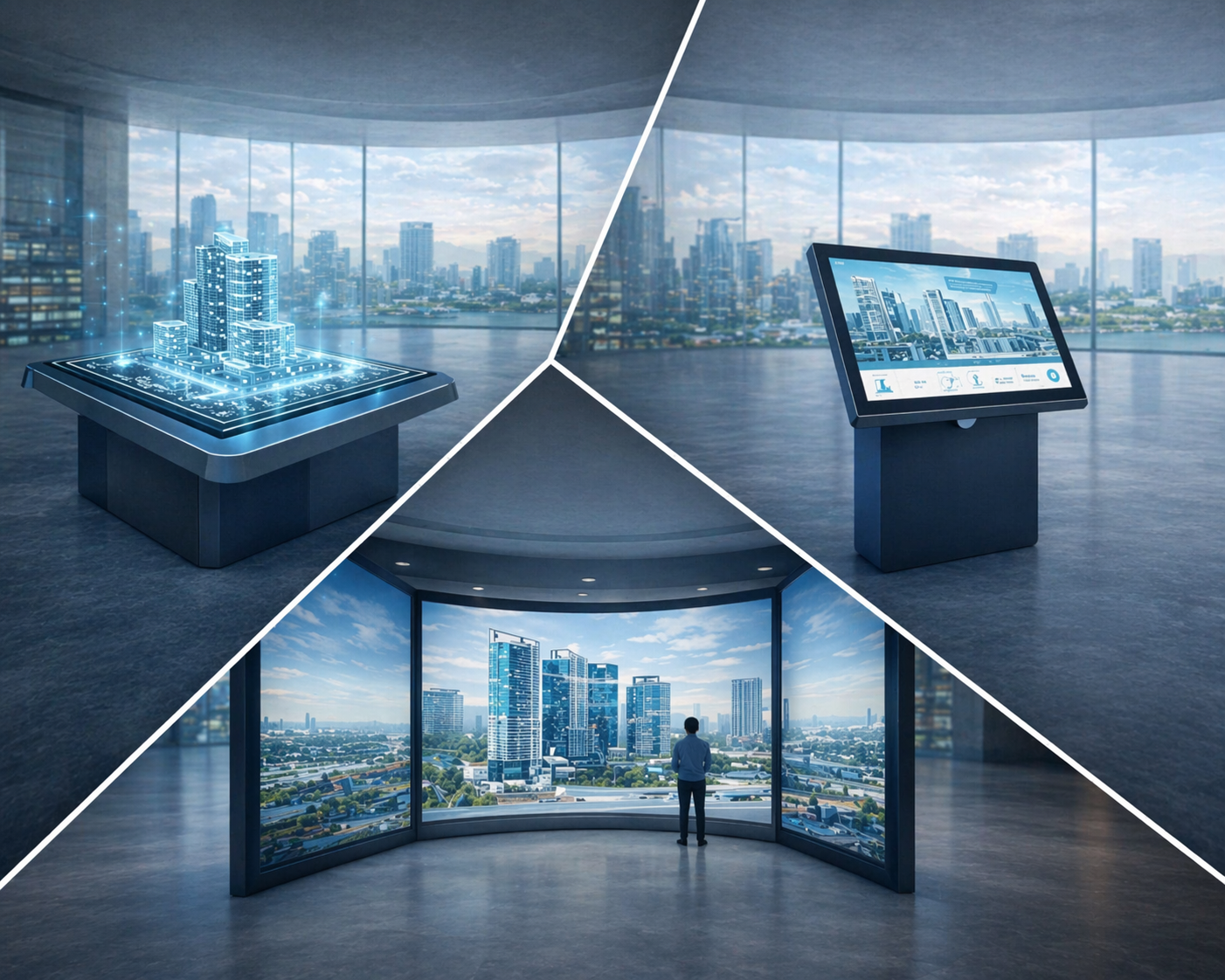
Hologram tables: strong for attention, weaker for everyday selling 

Hologram tables are usually strongest at creating a strong first impression.

They work well when the goal is to generate curiosity at a launch, stand out at an event, or make a project feel futuristic in a high-visibility setting.  

That aligns with broader marketing research on holograms. Baltezarević and Baltezarević, in their 2023 paper Benefits of Using Holograms in Marketing Communication, argue that holograms are especially effective in promotional environments where novelty, memorability, and visual surprise matter. They describe them as tools that create unforgettable experiences” and a strong “factor of surprise” in promotional settings. For developers trying to create buzz around a new launch, that has real value. 

The weakness appears when the sales conversation needs to go deeper. Buyers rarely move forward because a display looked impressive. They move forward when they can understand the project, compare options, and revisit what they have seen later.

In that context, hologram tables are often more useful as launch theatre than as everyday sales tools. They can be harder to update, harder to scale across channels, and less effective when the discussion shifts from brand attention to practical decision-making. 

That does not make holographic installations useless. It makes them specialized. They are usually better suited to creating attention at key moments than to supporting the daily work of helping buyers evaluate units, understand context, and continue the journey after the first presentation. 

Touchscreen kiosks: the most practical format for day-to-day sales 

Touchscreen kiosks are usually less immersive than hologram tables and more useful in actual sales conversations. 

That is their advantage. A good interactive sales tool or touchscreen kiosk can help buyers navigate a masterplan intuitively, explore buildings, compare units, understand views, and move through the project with more control. 

It also gives sales teams a practical way to guide the conversation without forcing buyers to rely on static brochures, PDFs, or verbal explanation alone. 

This format fits the sales centre especially well because it combines visual clarity with usability. Buyers can move from a big-picture understanding of the project to specific unit discovery in one place. That matters because control and clarity directly affect decision-making. 

A 2026 study published in the Journal of Business Research by marketing scholars on immersive technology found that when people use interactive tools to resolve shopping decisions, perceived control rises, which in turn improves decision comfort.

In real estate, that same logic helps explain why touchscreen-led exploration is often more useful than a purely visual display. 

Zillow reports that listings with an Interactive Floor Plan receive 60% more views and are saved 79% more than listings without one, while 69% of buyers say a dynamic floor plan would help them determine whether a home is right for them.

The pattern is consistent: when buyers can explore layout and flow more actively, they engage more deeply and make decisions with more confidence.

A touchscreen kiosk is often the strongest all-around choice when the goal is to support everyday consultations, clearer unit comparison, and repeatable use by the showroom team. 

Immersive rooms: strongest for emotional engagement 

Immersive rooms have a different job. 

Where kiosks are strongest in guided practicality, immersive rooms are strongest in emotional impact. When done well, they can make scale, atmosphere, architecture, and lifestyle feel much more tangible than a brochure or static display ever could. That is especially useful in premium developments where emotional connection is a large part of the sale. 

A premium villa or branded-residence project in Dubai, for example, could use an immersive room to do more than display floor plans. It could place buyers inside the future setting, letting them experience ceiling height, material mood, view corridors, landscaping, and the overall atmosphere of the project in a way that feels closer to lived reality. That kind of presentation is not only about helping buyers understand the property. It is about helping them feel it.

In off-plan real estate, that emotional dimension matters. Buyers are being asked to connect with a property they cannot yet step inside. The more vividly they can imagine space, context, and future use, the more likely they are to form attachment early. 

A 2024 NBER working paper on virtual tours in real estate found that digital exploration improves property information accessibility and helps buyers gather information more effectively, which helps explain why immersive environments can make unbuilt projects feel easier to understand and emotionally engage with. 

But immersive rooms come with trade-offs. They are more dependent on physical setup, harder to extend beyond the showroom, and less naturally portable into web, follow-up, and remote selling unless they are built as part of a wider digital system. 

So immersive rooms are usually best when the goal is premium storytelling, emotional immersion, and differentiation at the sales-centre level, not broad sales utility on their own.

Which Immersive Real Estate Sales Tool Fits Which Property Developer Need:

The clearest way to compare these formats is by sales use case, practical fit, and how easily they can support the wider buyer journey.

Format Best Use Case Best Sales Stage Buyer Understanding Unit Comparison Remote / Follow-up Use Scalability Cost Level 
Hologram tables Launch buzz, event attention, first-impact storytellingAwareness / launchLow to medium LowLowLow to medium High 
Touchscreen kiosks Guided consultations, masterplan navigation, unit discoveryConsideration / active evaluation HighHighMediumMedium to high Medium 
Immersive rooms Premium storytelling, atmosphere, spatial immersion Consideration / emotional conversionMedium to high Low to medium LowLow to medium High 

The comparison becomes clearer when each format is judged by the role it plays in the sales journey. What this table shows is that the best format depends less on how impressive the technology looks and more on what the sales team needs it to do.

Some tools are better at creating curiosity, others are better at helping buyers compare and understand, and others are better at building emotional connection. For most property developers, the strongest long-term value comes from a setup that can do more than one job, support more than one touchpoint, and stay useful after the first presentation.

That is why the conversation often shifts from choosing a device to choosing a wider digital sales system.

What Property Developers Should Prioritize in Immersive Real Estate Sales Tools:

Once the use case is clear, the next question is which setup will remain useful after the launch event, after the showroom meeting, and after the buyer leaves the sales centre.  

In practice, that means choosing tools that are easy to update, work across channels, connect to live sales information, and support follow-up without creating extra friction for the sales team. 

For property developers, the stronger choice is usually the one that supports real buyer actions rather than one-time reactions. The best immersive real estate sales tools help buyers compare options, revisit the project, and continue the journey with more confidence.

Before choosing an immersive setup, ask: 

  • Can buyers revisit it after the first meeting?  
  • Does it work across showroom, web, and follow-up?  
  • Is it easy to update as inventory or pricing changes?  
  • Can it connect to live sales information?  
  • Does it help buyers compare options more clearly?  
  • Will sales teams use it easily in day-to-day conversations?  

If the answer to most of these is no, the setup may create attention, but it is less likely to create lasting sales value. 

About NNTC: 

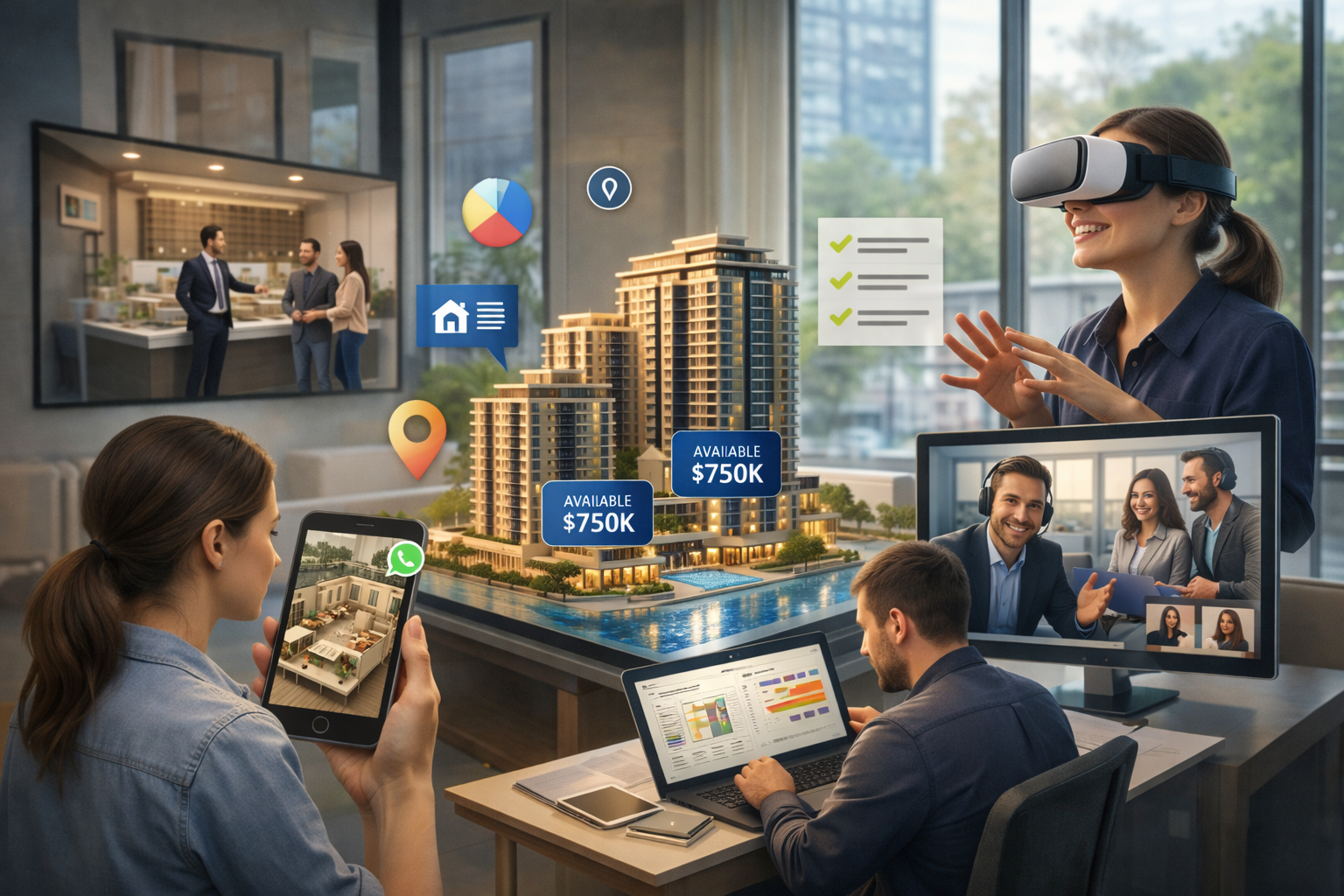
NNTC helps developers turn complex projects into connected digital sales experiences. Its work combines digital twinsimmersive 3D walkthroughs, touchscreen-led sales tools, and immersive showroom experiences to help buyers explore projects more clearly and help sales teams present them more consistently across channels. Moreover, NNTC’s Virtual Hologram Table is a good example of this kind of format: visually striking, memorable and effective when the goal is to attract attention quickly.

To see how NNTC applies this in practice, explore the company’s digital twin solutions, interactive sales tools, immersive showroom experiences, and relevant real estate case studies, or talk to the team about your next sales centre project 
Read More: 

Common Mistakes Developers Make With Immersive Real Estate Marketing 

Common Mistakes Developers Make With Immersive Real Estate Marketing

Immersive real estate marketing can improve off-plan sales, but only when it is built well. This article will discuss seven common mistakes developers make and how to avoid them. 

Many developers now understand the value of digital twins, 3D walkthroughs  , interactive sales apps, and richer off-plan experiences.  

The problem is that adding immersive tools does not automatically create a better buyer journey. In some cases, it simply adds a new layer of complexity on top of an already fragmented sales process. 

That is why some immersive real estate campaigns look impressive but still fail to convert. The visuals may be strong, yet the experience feels confusing, disconnected, or difficult to use. Buyers may notice the project, but not move closer to a decision. 

For developers, the real goal is not to make the project feel futuristic. It is to make it easier to understand, easier to explore, and easier to buy. That is where many immersive real estate marketing mistakes begin. 

Why immersive real estate marketing often underperforms:

Most failures happen because the experience is built around presentation instead of buyer decision-making. 

Developers often invest in visual quality, but overlook the practical questions buyers need answered. They focus on wow factor, but not enough on usability. They create something that looks advanced in a showroom demo, yet feels harder to navigate in a real sales conversation. 

The result is a common pattern in real estate digital experiences: strong first impression, weak follow-through. 

Mistake 1: Treating immersive content like a visual extra 

One of the most common mistakes is treating immersive marketing as something built to impress, rather than something built to sell. 

A common example is when a developer creates a high-end VR walkthrough for a launch event or sales centre demo, but the experience is never adapted for web access, remote follow-up, or day-to-day sales conversations. The result is a polished showcase that generates interest in the room, but adds little value once the actual buyer journey continues. 

The experience may look impressive, yet still fail to help a buyer compare units, understand context, or move toward a shortlist. Instead of becoming part of the sales process, it remains a visual extra around it. 

Immersive real estate marketing works best when it supports real buyer actions. Buyers should leave with clearer understanding, not just stronger impressions. 

Mistake 2: Poor user experience 

A weak user experience can destroy the value of even the strongest visuals. This happens when navigation feels unclear, interactions are slow, menus are crowded, or important information is hidden behind too many clicks. Buyers should not have to work hard to understand where they are, what they are looking at, or how to move to the next step. 

In real estate, poor UX creates a specific kind of damage. It interrupts emotional momentum. A buyer may start engaged, then lose patience the moment the experience becomes confusing. That drop in momentum has commercial consequences. A 2024 NBER  working paper on virtual tours in real estate notes that “the adoption of online platforms and tools like virtual tours has greatly improved property information accessibility.” That helps explain why weak usability reduces value so quickly: if the experience is hard to navigate, the accessibility benefit is lost. 

“Immersive content should be judged less like a design object and more like a sales tool. If the experience feels difficult to use, it is not helping.” 

Mistake 3: No live data in the experience 

A beautiful digital experience loses value fast when it is disconnected from reality. 

This happens when availability, pricing, or unit status still live outside the experience. The buyer explores the project digitally, then has to switch back to spreadsheets, PDFs, or manual follow-up to answer the practical questions that matter most. 

That creates friction at exactly the wrong moment. 

If an immersive sales tool cannot connect the buyer to real inventory logic, it risks becoming just another presentation layer.  

Developers do not need more digital surfaces. They need experiences that keep visual discovery and sales information aligned. 

Mistake 4: Weak device accessibility 

Many immersive real estate experiences are designed for ideal conditions rather than real buyer behaviour. 

They may work well on a showroom touchscreen or a powerful desktop, but break down on mobile, perform poorly in browsers, or require too much effort to access remotely. That becomes a serious weakness when a large part of the audience is exploring from phones, laptops, or overseas locations. 

Accessibility is not a side issue. It is part of the sales strategy. 

If buyers cannot access the experience easily across devices, then the project becomes harder to engage with at scale. In the UAE market, that has direct commercial consequences. Property Finder  says WhatsApp is where UAE property buyers make decisions, and reports that enabling WhatsApp on listings can lift mobile lead conversion by as much as 25%.

A strong digital experience should not depend on one location, one device type, or one guided sales meeting to be useful.  

Mistake 5: Building for the showroom only 

Showrooms still matter, but they are only one part of the sales journey. 

A common mistake is designing an immersive experience mainly for in-person presentations while underinvesting in what happens before and after that meeting. Buyers may have a strong first session in the sales centre, but the momentum fades because they cannot revisit the experience easily, share options clearly, or continue exploring remotely. 

That leaves too much value trapped in a single touchpoint. Nearly half of home buyers rate virtual tours as “very useful” in the buying process, according to a 2024 NAR finding cited by Matterport, which shows how important it is for the experience to continue beyond the showroom. 

Developers should think of immersive real estate marketing as a connected system across web, showroom, follow-up, and remote selling. When the experience is limited to one setting, it becomes harder to build sustained engagement. 

Mistake 6: Making unit discovery too complicated 

Some immersive tools look advanced but make unit selection harder, not easier. 

Buyers need to compare floors, layouts, views, orientations, and prices without getting lost in the experience. If discovery feels slow or confusing, the tool starts working against the buyer journey. Too much motion, too many paths, or unclear filters can make the experience feel impressive but inefficient. 

That is a real problem in large developments, where the number of choices is already high. 

A strong immersive experience should make comparison simpler. It should help buyers narrow options with less mental effort, not turn the process into something more theatrical. 

Mistake 7: Disconnected sales workflows 

This is where many immersive projects quietly fail. 

The experience may exist, the showroom team may use it, and marketing may promote it. But the workflow around it remains fragmented. Follow-up still happens through separate files. Sales consultants still rely on disconnected brochures. Brokers still receive static materials. Availability updates still need manual confirmation. 

That disconnect weakens everything the immersive layer is supposed to improve. In practice, it means the digital experience ends where the real sales process begins. Buyers may leave with a stronger impression, but the team still must manage the rest of the journey through separate tools and manual follow-up. 

This is exactly the gap a more connected setup is meant to solve. NNTC’s digital twin solutions for off-plan sales are designed to support immersive presentation as part of the wider sales workflow, linking buyer experience with follow-up, inventory visibility, and cross-channel consistency. 

Immersive real estate marketing works best when it is part of a broader sales workflow. If the experience stops where the actual sales process begins, developers lose much of its value. 

What better immersive real estate marketing looks like: 

If developers want a quick way to assess whether an immersive real estate experience is built to support sales, this is the simplest checklist to use: 

  • Is it easy for buyers to access without special setup?  
  • Does it work smoothly across mobile, desktop, and showroom devices?  
  • Does it connect visuals with live sales information such as availability or pricing?  
  • Does it help buyers understand the wider project context, not just the unit?  
  • Does it make unit discovery and comparison simpler?  
  • Can buyers revisit, share, and continue exploring after the first meeting?  
  • Does it fit naturally into the broader sales workflow instead of sitting outside it?  

If the answer to several of these is no, the experience may still look impressive, but it is unlikely to support conversion as well as it should. 

How to build immersive off-plan marketing that converts: 

Developers need to use immersive tools more strategically. 

That starts with a better question: what part of the decision process should this experience improve? 

In some cases, the answer is buyer understanding. In others, it is remote accessibility, clearer unit discovery, stronger follow-up, or better sales consistency across channels. Once that objective is clear, the experience becomes easier to design properly. 

The strongest immersive real estate marketing is not built to impress everyone. It is built to remove friction where it matters most. 

For developers looking to apply this more strategically, NNTC’s solutions show how immersive experiences can support buyer understanding, remote accessibility, clearer unit discovery, and stronger sales consistency across channels. 

Immersive real estate marketing can help developers create stronger first impressions, deeper buyer engagement, and clearer off-plan sales journeys. But only when the experience is built to support real decisions. 

The most common mistakes are not technical. They are strategic. Poor UX, missing live data, weak device accessibility, and disconnected workflows all reduce the value of what should be a stronger sales experience. 

Developers who avoid those mistakes usually do one thing differently: they treat immersive marketing as part of the sales process, not as a layer placed on top of it. 

About NNTC:  

NNTC helps developers build connected digital experiences for real estate sales. Its solutions combine digital twins, immersive 3D walkthroughs, interactive showroom experiences, and remote sales tools to help buyers explore projects more clearly and help sales teams work more consistently across channels.

To learn more, explore our immersive real estate solutions or get in touch with the team.

Read more: 

Why Off-Plan Buyers Struggle to Commit with Renders and Floor Plans 

Why Off-Plan Buyers Struggle to Commit with Renders and Floor Plans

Static renders, brochures, PDFs, and floor plans are still standard tools in off-plan property marketing, but they often fall short when buyers need clarity most. They can make a project look appealing, yet still leave buyers unsure about space, layout, surroundings, and the real difference between available options. 

That is where static content starts to work against the sales process. Instead of helping buyers compare and decide, it often forces them to piece the project together from disconnected visuals and technical documents. The result is a familiar problem: interest is created, but commitment slows down. 

For developers, this is not just a content issue. It affects buyer confidence, makes shortlisting harder, and creates extra pressure on sales teams to explain what the material itself should already make clear. 

Static content shows, but it rarely explains: 

A render can make a project look impressive. A brochure can list amenities and highlight value points. A floor plan can show dimensions and layouts. Each of these has a role in off-plan property marketing. In the National Association of Realtors’ 2024 buyer profile , 41% of buyers said photos were still useful; buyers rated photos, detailed property information, and floor plans among the most useful content formats in the search process.  

That matters, but it also highlights the limit of static assets: they help buyers notice a property, yet do not always help them fully understand it. 

The real problem is that buyers are not making decisions from isolated pieces of information. They are trying to answer more practical questions. What does this unit actually feel like compared with another one? How does the project sit within its surroundings? What is the difference between one view, one floor, or one building and the next? How do I picture daily life in a place that does not yet exist? 

Static content struggles with those questions because it is fragmented by nature. It presents information in separate pieces, while buyers need connected understanding. That is why more interactive formats are becoming more important in off-plan sales.  

In NNTC deployments, interactive sales tools have helped increase consultation-to-reservation conversion by 18%, suggesting that buyers move forward more confidently when they can explore a project in a clearer and more connected way. 

What makes buyers hesitate even when they like the project:  

Hesitation usually comes from three gaps. 

They cannot understand space properly: 

A floor plan can communicate dimensions, but not the lived sense of space. It does not show how a room flows, how a layout feels, or how different parts of the home relate to each other in practice. That is why more interactive formats are gaining ground. 

They struggle to compare options clearly:  

Off-plan decisions usually involve many variables at once: size, layout, view, floor level, building position, orientation, and price. Static brochures and PDFs make comparison harder because they separate information instead of bringing it together. Buyers are left to piece together the project from disconnected files instead of evaluating it in one place. 

That is one reason more interactive formats are gaining attention. Zillow reports that homes with an Interactive Floor Plan were saved 79% more than homes without one, which suggests buyers engage more when layout and navigation are easier to understand.  

As a result, buyers often leave the conversation with too many files, too many screenshots, and too little clarity. 

They cannot fully trust what they cannot explore:  

A render can be beautiful, but it is still a controlled image. Buyers know that. They understand that marketing materials are designed to present the project in the best possible light. 

What they often lack is the ability to explore the project more freely and build confidence through their own interaction. That gap matters because buyers themselves say richer formats help them judge a property more clearly.  

Another study by Zillow reports that 74% of prospective buyers agree that 3D tours help them get a better feel for a home’s space than static photos, and 70% wish more listings offered them. In other words, trust builds more easily when buyers can explore rather than just observe. 

Why remote buyers and international buyers need more than static content : 

The challenge becomes even sharper when the buyer is not physically present. Remote and international buyers usually depend almost entirely on digital material. If that material is limited to static renders, PDFs, and floor plans, the project becomes harder to understand and harder to trust. There is less room for discovery, less emotional connection, and less confidence in comparing one option against another. 

This is where a connected sales experience becomes far more useful. Tools such as a web-based 3D walkthrough or an interactive showroom experience bring units, views, and surroundings into one place, giving remote buyers a clearer and more engaging way to explore the project. 

That is a commercial problem, not just a content problem. 

If remote buyers cannot engage with the project in a meaningful way, developers lose momentum at one of the most important stages of the sales journey. 

Static content also creates friction for sales teams:

The problem with static content is not only that it limits buyer understanding. It also becomes difficult to manage at scale. 

In most off-plan sales setups, brochures, floor plans, renders, website assets, showroom presentations, and follow-up materials are created as separate pieces. Over time, those pieces can drift apart. A unit update may appear in one place but not another. A visual used in a campaign may not match what sales teams are sharing later in the journey. What starts as a content stack quickly becomes a coordination problem. 

For developers, that creates unnecessary friction. Instead of supporting one coherent buyer experience, static materials often produce multiple versions of the same project across channels. The result is not only more work for sales and marketing teams, but also a higher risk of inconsistency at the exact point where buyers need clarity. 

What developers can do instead :  

The answer is not to abandon renders, brochures, or floor plans. They still have a role in off-plan property marketing. The issue is relying on them alone to carry the full buyer journey. 

What developers need is a more connected way to present the project, one that helps buyers move from first impression to real understanding. Instead of showing isolated assets, a stronger sales experience brings the project together in one explorable environment. 

That is where digital twins become valuable. A digital twin allows buyers to explore the development more freely, understand how units relate to the wider project, compare options more naturally, and build confidence through interaction rather than guesswork. For sales teams, it creates a more unified way to present the project across website journeys, showroom consultations, and remote conversations. 

The commercial case for that shift is already visible in NNTC deployments. After introducing interactive 3D sales apps, residential projects saw a 12% boost in reservation-to-sale conversion. In other words, when buyers can explore a project in a clearer and more connected way, they are more likely to move forward with confidence. 

This changes the role of sales content. It stops being only promotional and starts becoming part of the decision-making process. Buyers can understand the project more clearly, while developers gain a sales tool that is easier to use across channels and easier to keep consistent over time. 

Commercial impact of connected sales experience for off-plan : 

For developers, the benefit is not only a better-looking presentation. It is a more effective sales process. 

When buyers can explore a project in a connected way, they reach clarity faster. When sales teams work from one environment instead of multiple disconnected files, presentations become more consistent and follow-up becomes easier. This is especially useful in projects with many units, multiple variables, or a large share of remote and international buyers. 

In practical terms, that means less friction in the buyer journey, less dependence on fragmented materials, and a stronger path from interest to commitment.  

For a broader look at how developers can use digital twins across the off-plan sales journey, read Digital Twins in Off-Plan Sales: What Property Developers Need to Know. It explores how interactive, connected experiences help buyers understand unbuilt projects more clearly while giving sales teams a stronger tool for presentation, comparison, and follow-up. 

Explore how NNTC supports off-plan sales : 

NNTC helps developers turn unbuilt projects into interactive digital sales experiences through digital twins, web-based 3D walkthroughs, interactive showroom experiences, and remote sales tools designed for off-plan property journeys. 

To see how this works in practice, explore our Digital Twins for Off-Plan Property Sales solutions or get in touch with the team. 

Read more:

Digital Twins in Off-Plan Sales: What Property Developers Need to Know 

Off Plan Digital Twin

Discover how digital twins help real estate developers present off-plan projects as explorable environments, improving buyer confidence and accelerating sales. 

Selling an off-plan project has always involved a gap between promise and perception. Buyers are asked to commit to something they cannot walk through, compare in real life, or fully test before making a decision. Developers try to close that gap with renders, brochures, floor plans, and showroom presentations, but those tools often stop short of giving buyers real clarity. They create interest, but not always a clear understanding. 

That is where digital twins become useful. 

In off-plan sales, a digital twin gives developers a way to present a project as an explorable environment rather than a set of static assets. Instead of asking buyers to imagine how a tower, unit, or amenity might feel, the project can be explored in a way that is closer to how people actually evaluate property.  

Buyers can understand layout, context, surroundings, and available choices with far less guesswork. For developers, that means stronger presentations, smoother sales conversations, and a better way to support both in-person and remote selling. 

Showroom experience used to present off-plan projects in a more engaging and explorable way.

Why traditional off-plan sales content fails to convert buyers :

Most off-plan sales content is built to persuade. The problem is that buyers need content that helps them decide.

A render can show beauty, but not always orientation. A brochure can explain features, but not spatial relationships. A floor plan can show dimensions, but not the lived sense of a space. Even a strong showroom presentation can become limited when the buyer wants to compare units, revisit details later, or include family members and other decision-makers in the process.

This creates friction at exactly the wrong stage. The buyer is interested, but still uncertain. The sales team is engaged, but has to spend more time filling in gaps that the content itself should have solved.

For developers, the issue is not only the buyer experience. It is also operational. Sales content often becomes fragmented across channels, with one version built for the website, another for the showroom, another for events, and another for follow-up. Over time, teams end up managing separate assets that are difficult to update and even harder to keep consistent. This is where a digital twin becomes more than a visual tool: it creates one connected environment that can support web-based 3D walkthroughs, interactive showroom experiences, and real-time sales information without relying on disconnected assets.

What is an off-plan real estate digital twin? 

In simple terms, an off-plan digital twin is an interactive digital version of the project that buyers and sales teams can explore before the project is built. 

That sounds basic, but the difference is significant. A digital twin goes beyond visuals to move to a functional sales tool. In practice, that means more than a 3D model. It means a connected environment that can show towers, units, amenities, views, and surrounding infrastructure while also linking to sales workflows such as availability, pricing, and buyer interaction data. 

A buyer can move through the project, view the development in context, compare units, explore surrounding infrastructure, and understand how different elements connect. A sales consultant can use the same environment to guide a conversation, answer specific questions, and move from interest to shortlist more naturally. 

The strongest versions go further. They become part of the broader sales workflow, supporting web journeys, sales centre presentations, immersive rooms, remote guided sessions, and in some cases even inventory visibility and buyer behaviour tracking. 

That shift matters. It turns the project from a campaign asset into a reusable sales tool. 

A digital twin can support web, tablet, and mobile experiences from one connected environment.

How digital twins help buyers decide faster :

The first and most immediate benefit is clarity.

Off-plan buyers are often making decisions under uncertainty. They are trying to picture a future building, compare options that are not yet tangible, and assess value from incomplete information. A digital twin reduces that uncertainty by making the project easier to understand in practical terms.

That matters because property decisions are not made on specifications alone. Buyers want confidence. They want to feel that they understand what they are choosing. The easier it is to create that confidence, the easier it becomes to keep momentum in the sales process.

Digital twins also make comparison and shortlisting easier. Buyers can move between units more naturally, revisit options, and understand trade-offs faster. Instead of relying on memory or scattered files, they can evaluate choices in a way that feels more direct and intuitive. In NNTC deployments, interactive 3D sales apps have helped increase consultation-to-reservation conversion by 18%, which suggests that when buyers can explore a project more clearly, they are more likely to move forward with confidence.

This is especially useful in projects with many units and multiple variables. Floor level, view, size, layout, orientation, and proximity to amenities all influence the decision. When those factors can be explored clearly, the buyer has less cognitive load and the sales conversation becomes more productive.

In other words, a better experience does not just look modern. It helps buyers understand options faster, shortlist with more confidence, and move through the decision process with less friction.

A stronger real estate sales tool for consultants and developers :

Digital twins are not only useful for buyers. They also improve how sales teams sell. 

In a traditional setup, consultants often need to jump between systems and materials. They may show a render on one screen, pull out a floor plan on another, check availability elsewhere, then send follow-up materials later. That creates a stop-start flow. 

A digital twin gives the team a more unified way to present the project. It helps them tell a clearer story, respond to buyer questions more naturally, and keep the conversation anchored in one environment instead of several disconnected ones. 

That consistency matters at scale. When multiple consultants, brokers, or channel partners are presenting the same project, a shared sales asset improves accuracy and reduces variation in how the project is explained. It becomes easier to train teams, easier to standardize the buyer journey, and easier to maintain quality across locations and markets. 

What developers should consider before investing in a digital twin :

The first question is not technical. It is commercial.

Where does the current sales journey break down? Where do buyers hesitate? Where do consultants lose time? Which parts of the project are hardest to explain using current materials? Those are the questions that should shape the investment.

Once that is clear, the practical requirements become easier to define. Developers need to consider the quality of the available project data, how often the content will need to be updated, which channels the experience should support, and whether it should connect with inventory, pricing, or other sales systems.

The strongest results come when a digital twin is planned as part of the buyer journey rather than treated as a visual add-on. If it is built only to impress, it may look polished and still underperform commercially. If it is built to help buyers understand the project, compare options, and move forward with confidence, it becomes far more valuable.


Explore how NNTC supports off-plan sales :

To see how NNTC helps developers bring unbuilt projects to life, explore our Digital Twin solutions for off-plan property sales, including web-based 3D walkthroughs, interactive showroom experiences, and remote interactive sales tools. If you want to discuss a specific project or sales use case, get in touch with our team.

About NNTC :

NNTC is a Dubai-based technology company specializing in interactive digital twins. Its platforms combine high-fidelity visualization with live data integration and web delivery, helping organizations present projects consistently across showrooms and remote stakeholder journeys.

Read More :

IRTH Unveils Advanced Online Sales Tool to Elevate Property Viewing and Sales Engagement

IRTH Unveils Advanced Online Sales Tool to Elevate Property Viewing and Sales Engagement

IRTH, a distinguished name in the real estate sector, has announced the launch of its cutting-edge Online Sales Tool developed in partnership with NNTC, a premier digital solutions provider in the UAE. This initiative sets a new standard in property showcasing, allowing potential buyers to explore properties interactively and make informed decisions with ease.

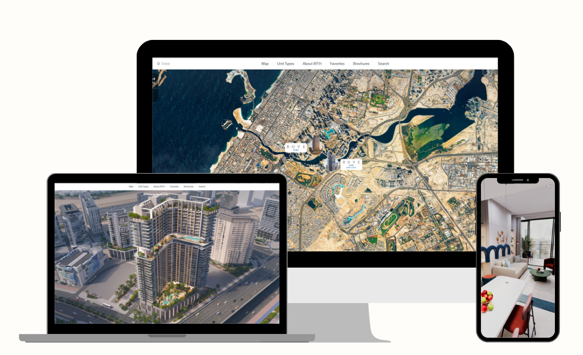
The Online Sales Tool, equipped with state-of-the-art technology, offers high-definition exterior renders from multiple angles and an immersive 360-degree walkthrough of interiors. Complemented by detailed floor layout views and an intuitive search feature, this tool enables users to personalize their property search experience. Engineered to function seamlessly across all devices—laptops, PCs, tablets, and mobile phones—the tool guarantees uninterrupted access and engagement.

Furthermore, a standout element of the platform is its secure broker login system. This system is integrated with IRTH’s CRM, providing brokers with live updates on apartment availability and pricing. The real-time data access empowers brokers to present accurate and timely information to clients, strengthening trust and streamlining the sales process.

Dmitry Doshaniy, General Director of NNTC, commented, “This collaboration with IRTH marks an exciting milestone in real estate technology. We take pride in creating innovative solutions that revolutionize customer interactions. This tool epitomizes our commitment to driving forward-thinking experiences.”

Ozhan Kalkan, Head of Operations at IRTH, shared his insights: “The introduction of this tool changes how we connect with prospective buyers. The level of transparency and interactivity it offers is unparalleled, giving both brokers and clients a transformative property search experience. Partnering with NNTC has empowered us to push boundaries and reinforce our leadership in the market.”

As IRTH continues to embrace digital evolution, this strategic launch positions the company at the forefront of property sales innovation, reshaping the landscape of real estate engagement in the UAE and beyond.

Abu Dhabi Housing Authority Adopts Digital Twin Technology to Showcase Its Housing Projects

  • 3000+ Housing Projects in 3D
  • The experience is available at ‘ISKAN Abu Dhabi Center’, or through Abu ‘ISKAN Abu Dhabi’ smart app

Abu Dhabi, UAE –  July 30, 2024: The Abu Dhabi Housing Authority has announced the adoption of digital twin technology to showcase its housing projects. This initiative focuses on 3D real-time visualization of housing options. Additionally, through collaboration with NNTC, a leading company in digital twin technologies in the UAE, the Authority offers an integrated virtual experience where individuals can explore housing options that best suit their needs and book them interactively.

Supported by advanced technologies like Unreal Engine 5 and NVIDIA’s DLSS technology, the system enables the full visualization of the internal and external layouts of more than 3,000 houses. Users can virtually tour residential complexes and view the various infrastructure, facilities, and the available services. Via integration with Geographic Information Systems (GIS), the system also provides housing details, simplifying the real-time viewing of available units and booking process. Additionally, the integration of Geographic Information Systems (GIS) through the system simplify the actual booking process.

The solution is accessible via digital kiosks at the ‘ISKAN Abu Dhabi Center’or through the ‘ISKAN Abu Dhabi’ app, which consolidates all the authority’s services under one smart app

His Excellency Hamad Hareb Al Muhairi, Director General of Abu Dhabi Housing Authority, stated, “We look forward to leveraging the adoption of these modern technologies to showcase ADHA’s housing projects through an advanced system that simulates reality. This aligns with our continuous efforts to develop more technologies to enhance our customers’ experience and empower them to make informed decisions regarding their housing needs.”

Dmitry Doshaniy, General Director of NNTC, commented, “The system offers an transformative solution that will bring about a qualitative shift in the housing sector, setting new standards and providing an interactive experience to facilitate the selection of appropriate housing. We are proud to cooperate with the Abu Dhabi Housing Authority on this project and anticipate the positive impact on its services.”

The Abu Dhabi Housing Authority continues its efforts to adopt cutting-edge technologies aimed at enhancing the customers’ experiences in line with the emirate’s digital goals. The recently integrated version of the ‘ISKAN Abu Dhabi’ smart app was launched, serving as an interactive digital platform to all services provided by ADHA.

IoT Systems Integration in Industrial Metaverse Solutions

IoT Systems Integration in Industrial Metaverse Solutions

A New Era of Smart Infrastructure Management with Industrial Metaverse Solutions

In today’s rapidly-evolving digital landscape, there is a growing demand for innovative solutions that can optimize infrastructure management, increase efficiency, and reduce costs. One emerging technology that holds significant promise in this area is Industrial Metaverse, a virtual replica of a physical asset that can be used to monitor, analyze, and optimize its performance. While Industrial Metaverse have been around for some time, the integration of IoT systems is taking this technology to a whole new level. By leveraging IoT sensors and devices, Industrial Metaverse can capture real-time data about a physical asset’s performance, enabling advanced analytics and predictive maintenance.

Daniil Gudkov,
Technology expert | Industrial Metaverse
Book consultation

IoT systems integration in Industrial Metaverse solutions allows for a comprehensive, real-time view of an asset’s performance. By combining data from multiple sources, including sensors, machine learning algorithms, and predictive analytics, organizations can gain a deeper understanding of their infrastructure, and make informed decisions that can drive efficiency, cost savings, and operational improvements.

For example, in the field of smart buildings, Industrial Metaverse solutions can help building owners and operators optimize energy consumption, reduce maintenance costs, and improve occupant comfort. By integrating IoT sensors and devices, building management systems can collect data on factors like temperature, humidity, air quality, and occupancy, allowing for real-time monitoring and optimization of building performance.

Similarly, in the field of smart manufacturing, Industrial Metaverse solutions can help improve production efficiency, reduce downtime, and optimize maintenance schedules. By integrating IoT sensors and devices, manufacturers can capture real-time data on equipment performance, and use this data to predict and prevent failures, and optimize production processes.

The benefits of IoT systems integration in Industrial Metaverse solutions are clear. By combining the power of Industrial Metaverse with the insights generated by IoT devices, organizations can gain a comprehensive, real-time view of their infrastructure, and make data-driven decisions that drive operational efficiency, cost savings, and performance improvements.

As the IoT continues to evolve, and Industrial Metaverse technology becomes more sophisticated, we can expect to see even more innovative applications of this powerful combination. From smart cities to transportation, healthcare, and beyond, IoT systems integration in Industrial Metaverse solutions is paving the way for a new era of smart infrastructure management.

Are you ready to take advantage of the power of digital twins and IoT systems integration? Contact us today to learn more about how our innovative solutions can help you optimize your infrastructure, reduce costs, and drive performance improvements.

Read more

Metaverse: a new level of digital transformation for industrial companies

The world of industrial business has always been a complex and challenging one, with a multitude of factors to consider when making critical decisions that can impact the bottom line. However, with the rise of digital twins and the industrial metaverse, businesses in this sector now have access to powerful tools that can help them optimize their operations and achieve greater efficiency than ever before.

Daniil Gudkov,
Technology expert | Industrial Metaverse
Book consultation

Digital twins are virtual replicas of physical objects or systems, created using real-world data and advanced modeling and simulation software. These digital twins can be used to analyze and optimize the performance of complex industrial systems, allowing businesses to identify inefficiencies, reduce downtime, and ultimately save money.

However, digital twins are just the beginning. The industrial metaverse takes things to the next level, by creating a virtual representation of an entire industrial system, including its components, processes, and workflows. This virtual environment can be used to simulate and optimize every aspect of an industrial operation, from the manufacturing process to supply chain logistics.

The benefits of the industrial metaverse are numerous. By creating a virtual environment that accurately reflects the real-world conditions of an industrial system, businesses can use the metaverse to test different scenarios and identify potential problems before they occur in the real world. This can help to reduce downtime and minimize the risk of costly errors and accidents.

In addition, the industrial metaverse can be used to create immersive training experiences for employees, allowing them to learn how to operate complex industrial systems in a safe and controlled environment. This can help to improve safety and efficiency, while also reducing training costs and minimizing the risk of accidents.

Ultimately, the industrial metaverse has the potential to transform the way that businesses in this sector operate, by providing them with powerful tools for optimization, analysis, and simulation. By leveraging the power of digital twins and the industrial metaverse, businesses can achieve greater efficiency, reduce downtime, improve safety, and ultimately save money. As this technology continues to evolve, it will be fascinating to see how businesses in the industrial sector use it to transform their operations and stay ahead of the curve.

Read more

How do warehouse inventory drones think?

drone warehouse

Let’s talk about inventory drones, their “brains” and capabilities, how all this stuff works, and how drones can have your back in the case of wrong pallet marking.

Kirill

Kirill Bondarenko | Technology Expert
Book consultation

From our previous posts about drone-based inventory, you already know that drones cannot fully replace humans since they cannot handle tricky non-standard cases, but, at the same time, they show unprecedented accuracy and careful record taking.

Today, I will tell you how UVL Robotics solution helps detect possible errors and inaccuracies during standard warehouse inventory.

Pallet scanning with no duplication

Every pallet is marked with a unique barcode that will be recorded in the accounting system to track the pallet location and keep the warehouse records. Unfortunately, sometimes an employee may lose count and scan the same pallet twice, which leads to accounting errors or even rack double-checks.

UVL Robotics software has an embedded specialized filter that prevents barcode duplication and creation of repeated pallets. In other words, if a drone scans the same pallet with the same code assigned, the algorithm considers it a duplication and reports an error. Therefore, this helps avoid errors emerging by accident or inattention.

In rare cases, the same barcodes can be assigned to different pallets, which happens either by mistake or in line with the customer’s preferences. In this situation, the filter reads this error up to three times. After the third reading, the counter is set to zero and the barcode can be reregistered as another pallet, which might take a little more time. Statistics can be collected manually as the UVL Robotics solution allows you to switch to manual mode and flexibly adapt to specifics of tricky marking.

Putting every pallet in place with inventory drones

Every pallet has its own unique barcode is assigned to a particular warehouse location, to a particular cell.

Drones scan pallets rightwards and downwards, moving along the warehouse racks. The inventory drone pilot watches the drone-scanned cells highlighted in the warehouse layout via tablet. It’s like reading a book where a rack is a page and pallets are words.

drone warehouse

The table accumulates not only pallet numbers and their barcodes, but also their locations. The report you get displays all deviations from the ideal pallet location. If there is an error or products are not in their cells, this problem is easily detected and handled.

Universal logic and adaptable report

The process can be customized. If you want to solve an unconventional task, we can easily adapt the tool to your business. However, considering the previous solution demonstrations and implementations, I can tell that customization is often left unrequired as the drone boasts all the necessary functionality to accelerate inventory taking and create user-friendly reports.

warehouse inventory

We can also prepare reports in a format familiar to the customer, as well as configure the filters to detect additional marking. For example, a drone can be set to scan multiple barcodes assigned to the same pallet with a further display of this data in the report; this is easy to do and usually negotiated before the works start.

If you got interested in this solution, learn more about it on our website or get a consultation with our experts.

Read more

Metacommerce: automatic parsing and product matching to win online customer

metacommerce

Business-related FOMO can be cured. How to kick-start online sales and don’t let the price policy upset you? Let’s find out.

Andrey Safokhin
NNTC Technology Expert
Contact experts

A man in a modern world has picked up another curious anxiety, which is hotly debated in the community of psychology professionals and enthusiasts. FOMO, or fear of missing out, is the feeling of apprehension that one is missing out on exciting events and experiences from which one might benefit emotionally. This fear consumes you, makes you scroll through social media miserably, and feel bitterly jealous when you see other people living the high life on Instagram, while your life is not that shiny.

social media

And now, ladies and gentlemen, I give you a new kind of FOMO specific for retail business owners. This one makes you feel a fear of missing out on an opportunity, losing customers, getting outsmarted by competitors with a better pricing policy, and failing to be quick enough to respond to market trends related to promotional activities. Now, this fear makes you scroll through your competitor’s websites miserably to catch any meaningful change in prices and offerings. You know how that feels, don’t you? The majority of online marketplace and offline store owners do.

fomo

The good news is that we know the way out of this and it’s called Metacommerce, an algorithm that will solve this problem once and for all.

Lost opportunity hurts the most

We help many different brands and businesses: FMCG, marketplaces, even niche stores because the solution works well with many different products. Since I admire technology, I’d love to use online electronics stores to illustrate how the Metacommerce algorithm works.

A lost opportunity is the worst for our customers, especially when it comes to catching customers’ attention. For example, when the same cell phone model is available at your competitor’s store at a better price, it means that your competitor takes a decent share of profit out of your pocket.

How come? There is usually more than one reason:

  • Late pricing policy updates (a blockbuster movie hero had that cell phone model, so fans rushed to buy it, and competitors raised prices to catch a hype wave)
  • Lack of information about seasonal patterns (holidays are coming and people start buying bigger gifts)
  • Discounts and better deals are either ahead of or behind the market (did you know that the current year had three Cyber Mondays in a row, and cell phones simply flew off the shelves?)
Win the customer

How Metacommerce algorithm parses your competitors

Metacommerce goes omnichannel to collect all necessary information quickly and efficiently. The algorithm analyzes brand websites, mobile apps, marketplaces, and extensive supply chains, from large distributors to particular online stores. It goes even further if the market competition is fierce (only the strongest will take it all!) by providing functionality for scanning and recognizing price tags in offline stores.

The algorithm is pretty simple: Metacommerce parses given sources, analyzes information received, and generates a report every two hours, for example, or every day at 9 am (depends on personal preferences).

The algorithm gets to every publicly available source of your competitors like a boss to analyze both what is offered in specific product categories of marketplaces and by online chain stores. It can also download the hash of the page and automatically read all necessary information, even recognize the text in the pictures.

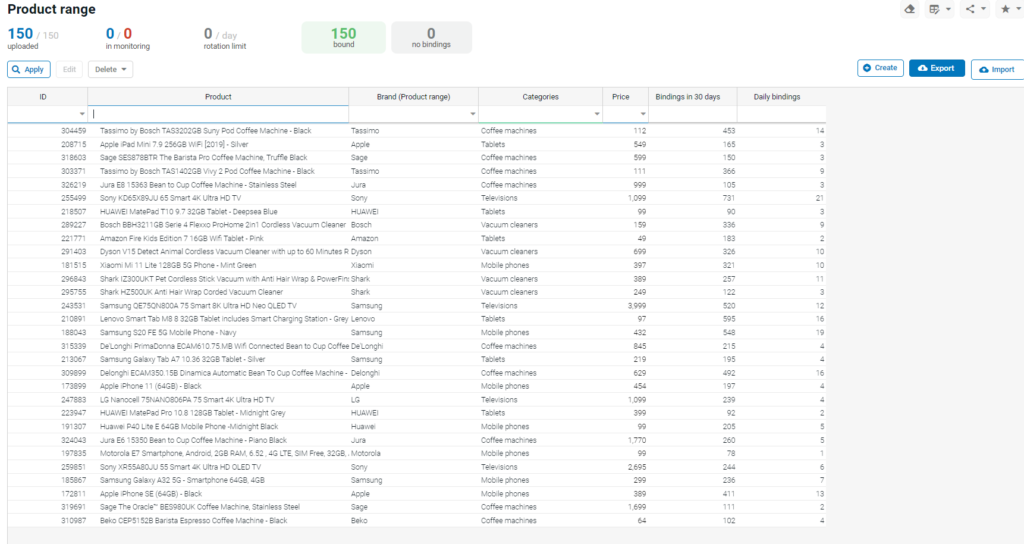
Our killer feature is the automatic comparison of the competitor’s assortment with your own (with a bunch of parameters inside!). You have a hundred TVs – a competitor has 200, Metacommerce will find the right ones itself.

Metacommerce
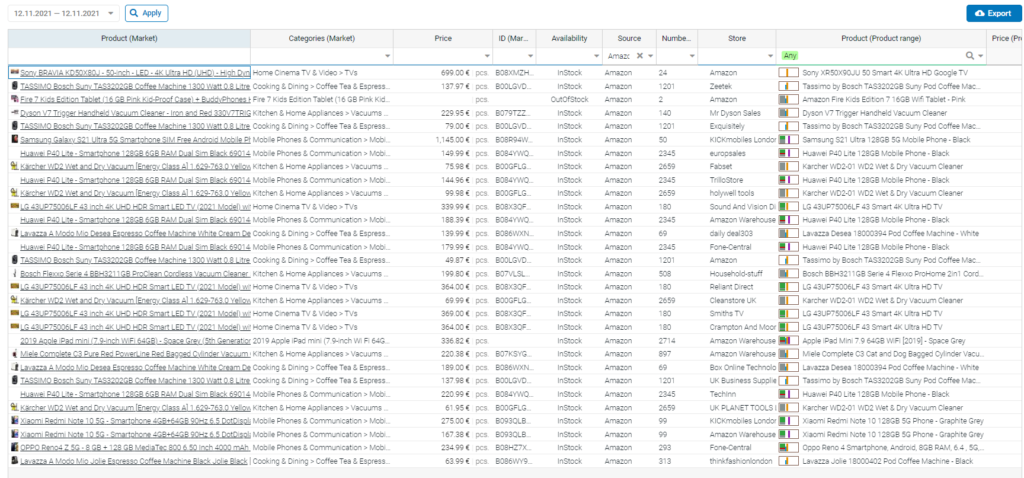
Some Metacommerce interface

Metacommerce algorithm works delicately without getting you into trouble when interacting with websites and that’s just gravy because usually parsing scripts are quite brutal and are often recognized as a DDoS attack to be instantly blocked, but Metacommerce like a cultured guest never abuses the network.

What a Metacommerce report looks like?

…Well, it’s cute. If you want to learn more, please keep reading 🙂

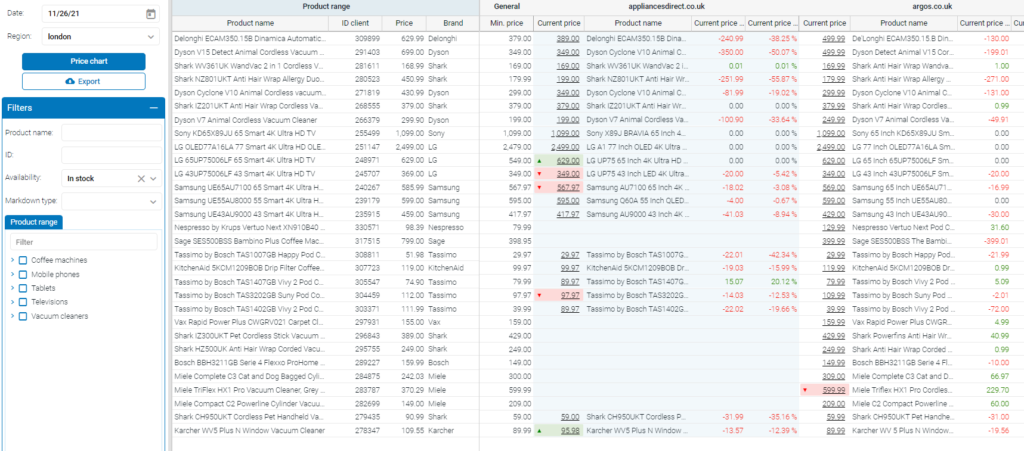
Metacommerce stores all information in a practical table format, so that you could filter and export it, view history graphs, and put it together into informative yet simple reports. Each product in your offering has an ID that automatically correlates with the corresponding SKUs of your competitors.

Win online customer
Product range comparison

Let’s say several distributors offer Playstation 5 on the online marketplace. Two of them are official stores and one is a greedy scalper; so greedy that you just wonder if that’s a price or a phone number in the ad. You put your Playstation 5 on sale too, but you really want to avoid both underpricing and overpricing. So how to choose the best price?

Open a Metacommerce report – it’s that easy. There you will see the entire list of Playstation 5 consoles on the websites you’ve asked to parse:

  • Official store price
  • Various distributors’ prices on a marketplace
  • Price fluctuation over time (you might even get surprising insights, like discover that a discount is not a miracle, but a seller’s trick to keep up with the sale rush)
  • Detailed information about the product is included: brand, distributor, marketplace, and offer details
Product range comparison

If different models of the product are analyzed (for example, Playstation 5 with different storage), you’ll see a specific model price compared to the price of a corresponding model on the competitor’s site. All clear.

Plus, in addition to comparing 1 to 1 (complete coincidence in the parameters), Metacommerce can compare products by similarity (PS5 and Xbox) or even show useful products that you do not have in your assortment.

Metacommerce offers online dashboards; and you can add an unlimited number of users having their personal accounts.

Easy to get started with your data

Metacommerce process can be launched in a few steps:

  1. Upload a product table into the database (e.g., export one from your ERP system)
  2. Specify the sources you want to track (competitors’ websites, sections on marketplace sites, etc.)
  3. The software will match the parameters of a product in your table against those of a similar product on your competitor’s website to find correlations between lots for further price tracking
  4. Congratulations! You’re ready to parse

The range of products will be updated automatically from that moment on, so you will immediately know which new models are added on the website and which are no longer available.

Now, imagine that you know every point of your competitors’ pricing policies and it takes just 10 minutes a day to complete the analysis. Furthermore, your potential customer is ready to pay lots of money for a new laptop, and this customer knows what model they want exactly: memory capacity, operating system, brand, screen size, and even the color of the keyboard backlight. The customer filters the search item by item and narrows it down to two identical models priced differently. One price is random, the other is yours, strategically calculated through Metacommerce.

Who do you think will be the winner? You will. (Oh, and the customer, of course – the customer always wins).

If you want to learn more about our solution, please visit the NNTC website or sign up for a demo.

Read more