Building the Hospital of the Future

Hospital-of-the-future

The hospital of the future may look quite different from what we are used to. Rapidly evolving technologies, along with demographic and economic changes, are expected to transform hospitals worldwide. Building the digital hospital of the future requires investments in people, technologies, processes, and premises. Therefore, hospital management should not expect ROI right away. However, in the long run, digital technologies will improve care quality, operational efficiency, and patient and staff experience.

Thank you, doctors!

With the COVID-19 spreading, hospitals worldwide are working at full capacity, and healthcare workers are saving lives every day. We admire and thank those heroes for their commitment and hard work. We wish them to stay strong in this hard time!

Moving towards hospital of the future

There is a range of solutions to improve customer experience and make hospitals more comfortable for patients and personnel. It will become a new normal sooner or later.

Digital experience

Digital solutions improve patient experience by providing real-time access to medical knowledge. The best way for hospitals to establish good relations with their customers is to become open and user friendly. Digital and AI technologies streamline the process of making appointments with doctors and reduce the number of forms patients need to fill out, while analytics, machine learning, IoT solutions, and portable devices analyze patient health condition and suggest treatment procedures to doctors.

Healing and well-being

Wristbands for patients and doctors plus visitor badges with RFID tags ensure appropriate access levels, while CCTV cameras with AI features recognize faces to locate patients who look unwell and need help, and accelerate recovery. Moreover, AI-enabled video analytics solutions can identify threatening situations as, or even before, they occur.


Hospital healing and well-being
Hospital operational efficiency

Hospital operational efficiency

RPA (Robotic Process Automation) solutions automate hospital’s ancillary and back-office services, considerably reducing costs and personnel work effort and improving service reliability; AI systems and electronic health records populated with data from various sources improve decision-making; while cognitive analytics tools sort through and find the most important personalized data points, thus boosting work speed and quality.

Talent development

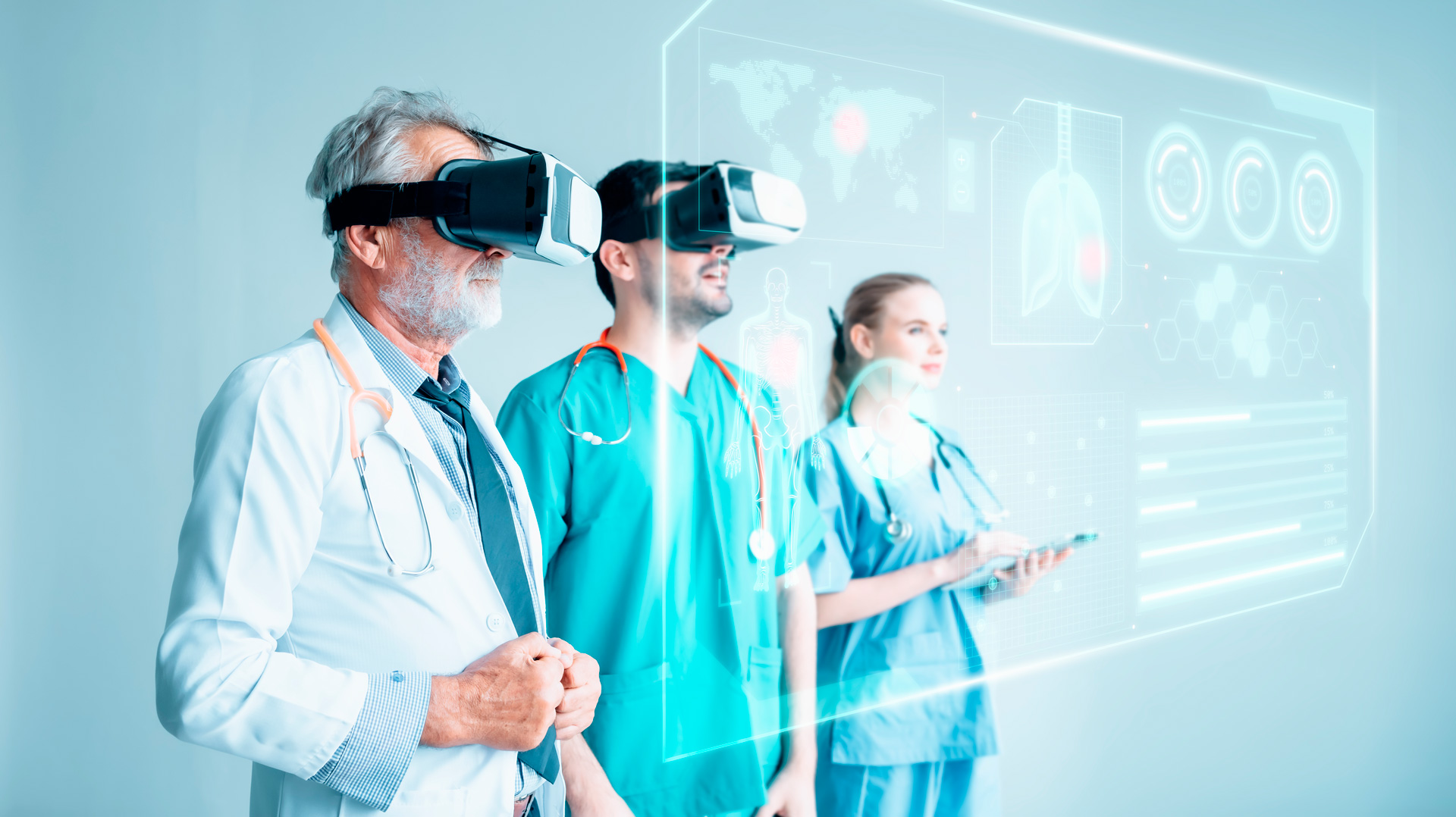
VR solutions help surgeons practice upcoming surgeries, while Learning Management Systems transcend geographical boundaries and reduce costs allowing them to share their surgery footage and specialized expertise with a larger audience of students and colleagues. Cognitive analytics and RPA solutions automate hospital personnel recruitment and study patient information and requirements to match patients with doctors having appropriate competencies.

Hospital talent development

Project: Mohammed Bin Khalifa Cardiac Center

Our team was lucky to take part in the joint project with our strategic partner NGN International (Bahrain). We provided general design, control, and implementation of the end-to-end technology infrastructure for the Mohammed Bin Khalifa Cardiac Center in Manama, Bahrain, under the patronage of His Excellency Lieutenant General Doctor Sheikh Mohammed bin Abdullah Al Khalifa, President of the Supreme Council of Health.

Hospital Mohammed Bin Khalifa Cardiac Center
Mohammed Bin Khalifa Cardiac Center

The Center has a floor space of 172,765 sq.m and one of the fastest-growing IT networks in the world. It uses a sophisticated technology to combine resources of physical and virtual servers and connect the entire work environment to the cloud.

In addition, Vocera Communications smart badges enable effective hands-free information exchange between doctors in real time. Data analysis and business intelligence solutions gather data from all systems of the Center and provide accurate results for better decision-making. Redundant IT systems ensure business continuity during various internal and external emergencies, effective data flow, and data availability anytime, anywhere.

Step by step

The hospital of the future is not built in a day. It requires consistent development and global expansion of innovations. Increasing healthcare investments and concerns about lives and health of patients and medical personnel will make hospitals more and more technologically advanced, which, we believe, will save and improve people’s lives.


Read more

Developing in partnership: how to effectively strengthen relations in the World of innovative technologies

partnership

Here, we’ll answer the hottest questions about the technology company partnership with technology companies and talk about the NNTC partnership program in simple words. Everything you wanted to know but did not dare to ask.

Why partnering with technology and innovation companies?

Creating value for customers is a must-do in the business world. Sometimes a customer wants to have a new idea implemented, which requires more development effort and fast action. This makes partnerships valuable, especially when you have partner developers ready to pack and deliver everything on demand.

Smaller companies also benefit from partnerships with technology companies. Partnership opens the door to larger resources: marketing, sales, legal, technology, and HR support. A vast selection of out-of-the-box products – even if made by partners only – gives a company a strong competitive edge in a crowded market.

What is more, infrastructure solutions are increasingly harder to sell to end customers. However, when they combine with a partner’s ready-to-use service they bring value to both IT director and business users.

IT partnership

How does it affect the partners’ business?

Partnership gives access to numerous resources that allow your company to enrich its business portfolio. Besides products and services, partnerships contribute to networking among business peers, thus feeding your market power. Partnerships lavish private events, innovation presentations or access to particularly valuable documents on its members. Remember though, that your business will experience positive effect if a partnership is aligned with your company’s strategic goals. Interestingly, there are companies using artificial intelligence to identify the most beneficial business partners.

Why partnering with NNTC?

NNTC partnership will give you access to an expert team that serves some of the largest government entities in the UAE and actively implements projects and innovations with partners around the globe. NNTC is a part of the large international IT Group with a huge customer base and wide knowledge of different IT solutions. We aim at competence exchange, IT solution portfolio expansion, and implementation of joint projects to reduce costs of customers operating across different regions of the Middle East. With our agile mindset and focus on each customer, we can easily customize most of our products in line with a specific task or certain conditions.

Another important thing: thanks to our large in-house Product Development Team and huge investments in R&D, when you work with NNTC you and your customer will always get a tailored product.

Furthermore, our partners enjoy the following extra benefits:

  • NNTC Deal Registration Program that rewards partners for bringing new customer opportunities and providing value selling by educating customers and prospects about NNTC solutions.
  • NNTC marketing development funds (MDF) on the accrual basis to support NNTC partners’ marketing and business development activities that generate demand for NNTC solutions. MDFs are calculated at the end of each quarter and available for use within the following one.
  • Partner demo equipment: affordable, robust, and portable demo kits to showcase NNTC products.
  • End-users can access NNTC Partner locator at nntc.digital website.
partnership IT company

What options does NNTC offer to its partners? What is included in the partner program?

Our program is simple, supportive, friendly, and free of complicated specializations, huge investments or boring and useless actions. All that we kept in the program are tools that help our partners grow, protect investments, and guide them to new deals or customers. NNTC partner program features three membership levels: Diamond, Gold, and Silver. Partners qualify for a single membership level based on previous and planned achievements.

  • SILVER members are interested in taking the first steps in starting a relationship with NNTC. There are a few very simple requirements that will help the partner to get basic knowledge and skills to focus on opportunities where NNTC products could be used.
  • GOLD members are experienced in delivering NNTC solutions. They achieved significant sales performance and a high level of customer satisfaction. Gold Partners enjoy enhanced benefits designed to enable sales and technical competency to meet the needs of our mutual customers and to increase revenue growth.
  • DIAMOND members deliver the highest value to their customers. They demonstrate sales and technical expertise across all NNTC solutions. They consistently achieve revenue targets while attaining high levels of customer satisfaction. Diamond level membership provides partners with the richest program benefits.

What solutions does the program include now? Will the program expand?

Authorized NNTC partners have access to our entire product portfolio, including detailed documentation and NNTC sales enablement materials. The program includes the most demanded solutions. For example, Digital Worker or the iFalcon Control solution set powered by facial recognition technology.

What are the NNTC technology company partnership requirements?

NNTC partners are companies that offer vendor products to their current or potential customers and add value by providing greater expertise or integration with business processes or third-party products.

All partners sign a Partner Agreement. When a partner initially enters the program, they have 30 days to attain certification requirement. All pre- and post-sales certifications are valid for two years from the certification date. Members shall renew certifications before the expiration date to enjoy the full range of NNTC partnership benefits.

To start your journey towards partnership with NNTC technology company, email us at partners@nntc.digital or just fill in the form on our website.

Read more

High-tech enterprise bingo challenge

Bingo challenge

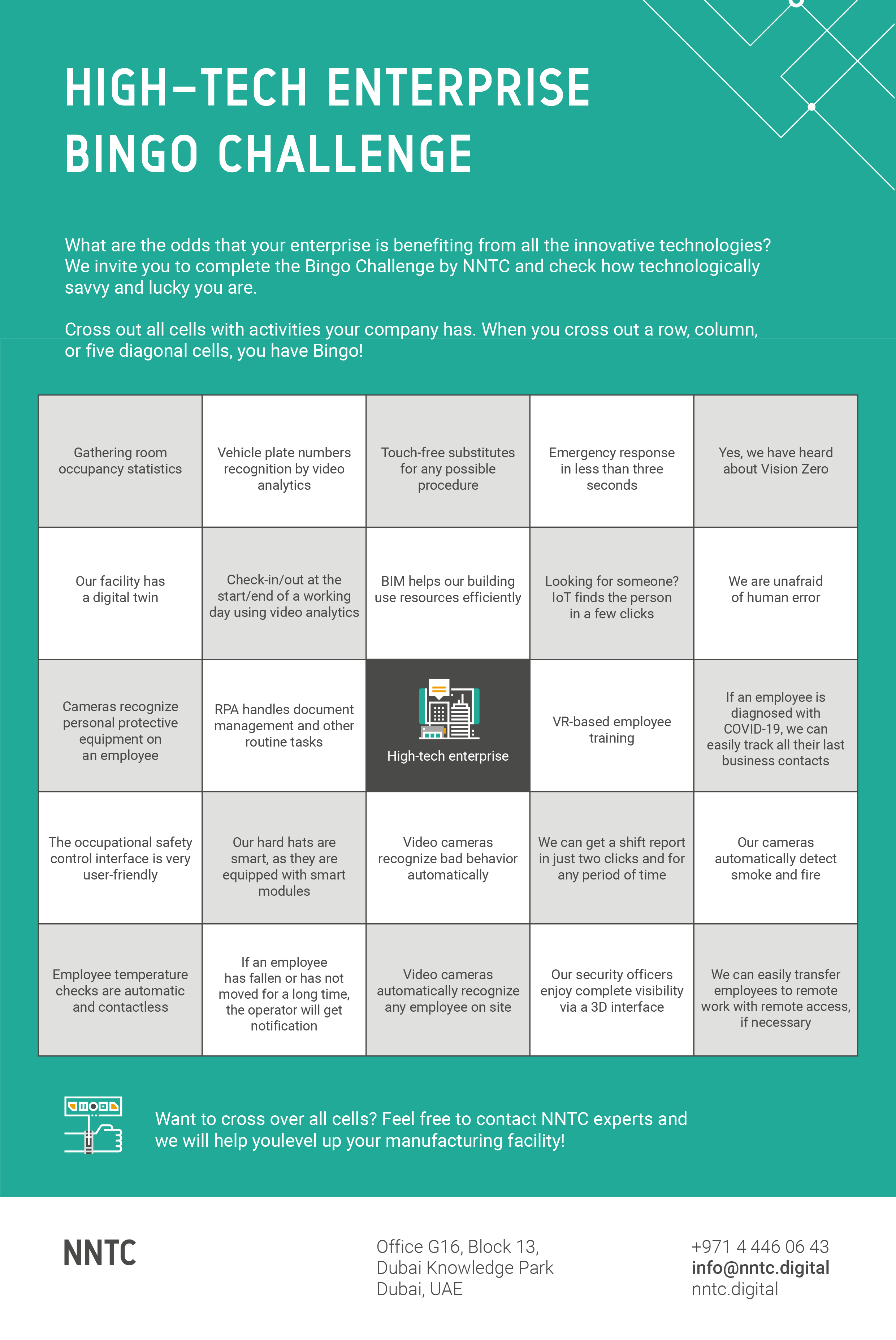
What are the odds that your enterprise is benefiting from all the innovative technologies? We invite you to complete the Bingo Challenge by NNTC and check how technologically savvy and lucky you are.

RULES: Cross out all cells with activities your company has. When you cross out a row, column, or five diagonal cells, you have Bingo!

High-tech bingo challenge

You can download this high-tech enterprise bingo challenge in full resolution and share it with your colleagues!

Read more

Time to become “AI Responsible”

Responsible AI

We have recently accepted the idea of omnipresent AI adoption, but new changes and technology reshaping are already on the doorstep. Have you heard of the Responsible AI concept? Let’s take a closer look at it, since it will soon become a mandatory tool to build business relationships.

Dmitry Doshaniy

Article by Dmitry Doshaniy, NNTC General Manager
LinkedIn | Mail

Proofs of Concept are in trend now

Enterprises usually struggle to develop AI pilots into production. Unfortunately, many solutions, when facing approval and development obstacles, never overgrow the “Proof of Concept” stage. You might encounter such a situation too. Being concerned about disruptive effect of innovations, most businesses just try them out in a few cases and do not go further. Thus, robots are trusted to make the first lead touch only, with all other steps being usually assigned to a human being. This is why such robots are not expected to do more than read, write, speak, and copy/paste.

In such circumstances, the value and business potential of AI cannot be unveiled and win the so much needed customer confidence. Meanwhile, AI-based solutions can completely change the approach to working, training employees, ensuring people safety, as well as dramatically speed up business processes. So where is the problem?

AI communication problems

The first communication problem arises between participants of the solution implementation process. Unfortunately, product developers and customers speak different languages and often focus on different features of the proposed solution. Due to such misaligned visions of AI and its potential, the technology capabilities are underutilized.

The second communication problem arises when a customer interacts with the final product and perceives it as something hostile or suspicious due to a lack of information about its benefits and functions. Let’s consider recruiting robots. HR people are more concerned about their jobs and afraid of robotic automation possibly causing lockouts rather than interested in studying the solution capabilities.

Responsible AI

How does the AI Responsible approach solve them?

It is simple. This approach assumes transparent unified communication with many target groups, and can be used by both AI-powered product developers and employees who are responsible for implementing artificial intelligence solutions in their companies.

AI-based decisions need to be explainable in order to be trusted. According to a recent PwC survey, 84% of CEOs agree with this statement. As well as buyers. Consumers want the convenience of services tailored to their needs, together with the peace of mind knowing that companies are not unknowingly biased against them — and that their government will protect them with laws regulating how their data can be used. As we can see, being just useful is not enough. It’s important to get clear, and we at NNTC go this way with each of our products.

The “AI Responsible” formula has five key components to identify AI responsibility:

  • GOVERNANCE will introduce clarity to AI objectives and tasks within an organization. Before developing or implementing a solution, assign and document the responsibility of each process participant. Then, align AI with the current business strategy and identify processes that need to be optimized using AI. What result should we expect? How will it manifest? Who will monitor the effectiveness and document problem areas? Can you give guarantees that the solution will be effective?
  • ETHICS AND REGULATION. AI-powered solutions must be developed in accordance with the established legislation and regulations of the organization, which should be morally responsible and ethically defensible. Notifying of compliance with the established guidelines will build confidence in AI.
  • INTERPRETABILITY AND EXPLAINABILITY. Let the user understand why a particular AI reached a particular decision. Explanations should be tailored to the different stakeholders, including regulators, data scientists, business sponsors, and end consumers: never leave them uninformed making your product into a mysterious black box for them.
  • ROBUSTNESS AND SECURITY. Eliminate all possible risks and flaws in your product, and timely release necessary updates and patches. Tell your customers what problems have been solved, quickly fix bugs, and listen to feedback.
  • BIAS AND FAIRNESS. Fight against discrimination and train your AI to perform its functions fairly and equitably.

Only those who are responsible will survive

The ability to develop AI responsibility is a cornerstone of its further development and recognition. In a world filled with a variety of solutions from styling photos like watercolor paintings to recognizing car license plates, the advantage will belong to a reasonable developer who explains algorithms and is ready for a dialog with users.

Read more

No more classrooms! VR for trainings and education

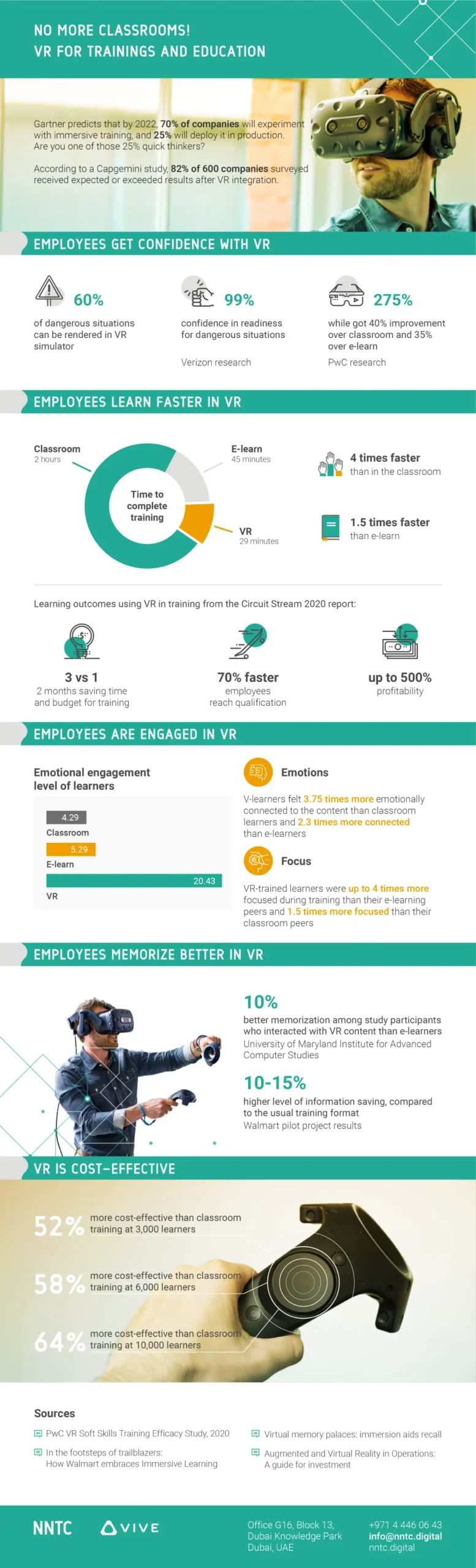
Gartner predicts that by 2022, 70% of companies will experiment with immersive training, and 25% will deploy it in production. Are you one of those 25% quick thinkers?

You can also download a full-resolution version of this infographic in PDF format:

Read more

How to win and retain customers after the Pandemic?

Consumers after COVID-19

In this year’s Global Consumer Insights Survey PwC polled city dwellers on their purchasing behavior in two separate studies, one before and one after the coronavirus outbreak. The survey resulted in certain insights that demonstrate new buying habits to emerge. How technologies can help save customers after COVID-19?

consumers after COVID-19

The COVID-19 situation has deeply affected urban consumers’ views on spending.

Before the outbreak, consumer confidence was sky-high. Almost half (46%) of PwC’s survey respondents said they expected to spend more in the next 12 months. After the outbreak had begun, the percentage of those who said they were going to spend less in the next few months almost doubled. The number who said they were going to spend more dropped by more than 10 percentage points.

Even in locations where lockdowns have been partially lifted, urban consumers are making fewer shopping trips, consuming more at-home entertainment. For consumers to feel confident enough to return to physical interactions with retailers, the first thing they need is solid assurance that places of business have a plan to make their customer experience as safe as possible.

Customer behavior after the Pandemic

COVID-19 outbreak reinforced the already growing trend of online shopping. People explore different ways to access products and services.

  • 86% of polled consumers are likely to continue to shop online/by phone when social distancing measures will be removed.
  • This trend shows a high popularity in the Middle East: 58% of customers after COVID-19 said they’ve started shopping more on mobile phones.

The survey data demonstrates emerging behavior patterns and new consumer preferences. We’re facing the importance of developing new ways to reach out to customers after COVID-19, and not taking them on a merry-go-round of hectic ads and irrelevant content. That’s why transactions deserve better security, especially those related to banking apps and online shopping. Wire payments grow in number (53% of respondents used mobile phones to make payments, and 90% are going to keep it this way).

Win customers with biometrics-based apps

Biometrics facilitates onboarding, helping app users to become your clients. We launched a biometric onboarding module for a mobile wallet app in Oman, leveraging video analytics to help people benefit from financial services without visiting a branch office. The app is a mobile wallet, where you can add a card issued by any bank and perform all necessary financial transactions. It is available to the general public in official app stores. Bank receives information about the interests and preferences of users to make special offers. It helps to convert app users into bank clients.

Reinforcing online operations protection

Hackers are skillful in capturing security codes from SMS or PUSH notifications. Digital signature for smartphones can really save the day if your clients prefer paying online. The private key can’t be captured by any hacker because it’s generated in the user’s smartphone and safely encrypted. According to PayConfirm, they provide client-server software for transaction confirmation that suits any digital channel. It includes online/mobile banking, one-time passwords, and works online and offline (even in airplane mode). This solution can prevent phishing, social engineering, data switching, and SIM-module switching attacks, which gained momentum during COVID-19.

Less shopping time with video analytics

video analytics for shops

Video analytics can be of use in creating personalized offers targeted at a specific audience.

Previously, customized points of sale (POS) used to recognize customers at the entrance and generate specially-for-you offers. This technology evolved during COVID-19. Now consumers can place an order in a personal account or set a rule for a particular POS. With this feature, visitors can automatically get a preferred type of coffee entering a cafe or pick a packaged order without excessive human contact. Video analytics will even recognize a customer wearing a medical mask.

Amazon has been working on biometric identification for a long time to enable face-initiated payments. Visitors take products they need and leave the store. Cameras recognize the products and the shopper to automatically charge their bank card. Shopping takes less time and involves fewer encounters – even eliminating contacts with salesmen – meanwhile ensuring a safe customer experience.

Temperature checks

In addition to facial recognition, a POS can be equipped with a temperature measuring tool and improve overall safety, retaining customers after COVID-19. One sick person at work can stop activities of an entire shopping mall or office and quarantine hundreds of people. We have developed a compact contactless solution for the timely detection of visitors with fever. It combines the thermal scanner functionality and face recognition accuracy. The scanner – a thin screen with a built-in camera – is installed at the entrance to scan visitors’ faces. It identifies them (successfully, if a visitor is in a customer’s database) and checks their temperature with up to 0.2-degree accuracy. If a person with high temperature enters a building, security personnel immediately gets notification.

The research and assessment of the pandemic impact on the world are still under way, revealing new interesting changes extending to every aspect of our everyday lives. The business faces a real challenge to respond to these changes as soon as possible by listening to consumers and meeting their new expectations of comfort, security, and service.

contact

Got a question?

Contact our experts via experts@nntc.digital

Now I see you! How polarization helps detect oil spills

Now I see you! How polarization helps detect oil spills

“You have to think like an oil spill to trace one”. But we do it using a down-to-earth and physics-based approach instead for oil spill detection. Article by Pavel Tatarintsev, NNTC R&D Head.

Oil spills – a global issue

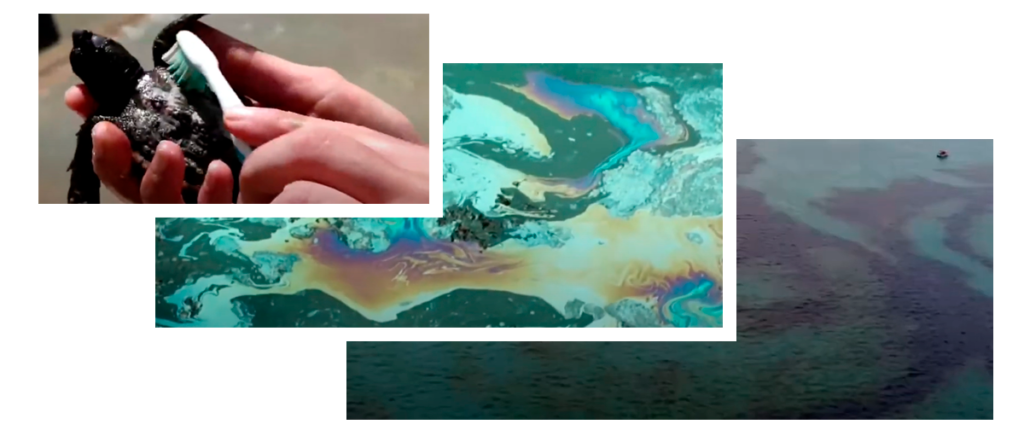
Oil spills are a problem that affects the global community. Statistics show that the total volume of oil lost to the environment recorded in 2019 only was approximately 1,000 tons. According to ITOPF research, in the period 1970 to 2019, 50% of large spills occurred while the vessels were underway in open water; allisions, collisions, and groundings account for 58% of the causes of these spills. These same causes account for an even higher percentage of spills (99%) when the vessels were underway in inland or restricted waters. A number of the incidents, despite their large size, necessitated little or no response as the oil has spilled some distance offshore and did not impact coastlines.

Fortunately, the number of large spills (>700 tons) has decreased significantly over the last few decades. Innovative technologies made an important contribution to oil spill management and accelerated response procedures to prevent ecology impact. Today’s post is dedicated to polarization, an innovation that helps trace and clean up oil leaks. All science needs is a little magic, and Pyxis solution just happens to have some.

Polarization in a nutshell

Taking light as a form of an electromagnetic wave, we can distinguish electric and magnetic fields there. Before polarization, we have unpolarized light emitted, for example, by the sun or a lamp.

Polarization means removing any electromagnetic waves from the beam, except for those being in a certain plane of polarization.

You don’t need smoke and mirrors to polarize a light wave. A polaroid filter will do. Moreover, you can see polarized light in your everyday life, when you wear glare-reducing sunglasses or use polaroid filters in cameras, for example. Actually, using these filters is the only way of taking a photo of any museum painting or exhibit protected by glass.

Now let’s trace some oil

Various methods are used to detect oil spills.

An ordinary camera. Unfortunately, it is sensitive only to a single FPA pixel. This is the most inconvenient and least accurate method. It is difficult to see a spill in the rolling sea because of oil movement, sun glares, and transparency of other liquids.

A thermal imaging camera can show temperature difference between an oil spill and water. Thermal imagers are capable of detecting rather thick oil spills. However, they fail if both liquids have the same temperature. On a good day, you can respond with a speed of light – OK, under 15-20 minutes – otherwise, the temperatures will even out.

A polarization camera. The only camera that has an eye for any chemical compounds on the water surface. Polarized light varies depending on the surface material reflecting it, especially when it comes to oil and diesel leaks.

polarization pixel

A polarization camera uses polarization-sensitive 2×2 super pixels to filter out all glares and identify the angle of polarization.

Light reflected from oil and water has different polarization angles. Gotcha! Now you see it. Special software can build both thermal and polarization images, as well as combined eTherm enhanced image.

The advantage of the solution is that it works day and night, in waves and calm water. It sees not only crude oil, but also refind oils.

Below you can see how these pictures look in real life. Thermal imaging combined with polarization shows the exact shape and location of an oil spill. It’s like playing hide-and-seek in the dark, but with a night-vision device.

Use cases for oil spill detection

Let’s talk about how we can use polarization to prevent oil spills.

  • Oil platforms can install polarization cameras to monitor the drilling process and oil leaks
  • Desalination plants can use polarization to prevent oil or other contaminants from flowing inside along with seawater and avoid engine damage
  • When loading docked tankers
  • When cleaning up spilled oil
  • Camera-equipped drones can patrol oil tankers whereabouts and monitor aquatic ecology

Innovative technologies are like a magic wand we use to make all environmental disasters disappear. If you believe that this oil and diesel spill detection solution will make your business safer, reduce environmental risks, and improve the quality of life in your region, please feel free to contact our experts at info@nntc.digital.

Read more

Ahoy, Sailor: How innovative technologies keep ports safe

Slicing through waves a jumbo ship is moving ahead full sail to the dock. People can’t take the eyes off of the ship waiting for the next captain’s move with bated breath. Is he a newbie? Did something go wrong? Are we looking at the reason for today’s overtime? Anyway, the overspeeding ship starts to turn clumsily ignoring port operator’s radio distorted screams and shouts, as inertia steers the ship and a big wave pounds on the mooring — kaboom! The ship kisses the concrete shore. The next thing you see is a loading metal crane gently hugging the ship.

All this could have been avoided, should a system similar to car parking sensors alerting the driver about obstacles – curb or garage walls – be installed on vessels to do the same job for the skipper. A video recorder would be useful for documenting all events as well, if scaled proportionally, of course, to the size of large ships and moorings. In fact, all ships have such equipment to video ships approaching the shore and mooring, but this is barely enough. What we really need here is the next level mooring assistant familiar with all marine peculiarities, since natural forces influence sea travel and mooring greatly, unlike ordinary parking.

The ship always hits the mooring. It is just possible that the mooring perfectly maintains and serves ten ships in a row, but can’t survive the eleventh and falls apart, thus triggering a series of unfortunate events and causing port to lose money.

  • Firstly, a mooring costs a lot. If pipes, port facilities, and loading cranes are damaged in an accident, costs grow proportionally.
  • Secondly, every ship is on a tight schedule, so it has a narrow window for docking – 30 hours, for example. If a port manages to maintain and serve a ship within the deadline or earlier (25 hours, for example), it receives a bonus from a shipowner. Delays may occur as well, which means that the port owes a penalty. A broken mooring causes a sea of changes in the port’s schedule, and service delays become inevitable.
  • Thirdly, the port has to prove to the insurance company that it is not guilty of messing everything up. How to prove it? Captains do not feel like providing records from their ship systems. In a worst-case scenario, the port loses more money paying for the damage.

Thus appeared MOORiNET, a solution for vessel mooring and berthing designed to prevent any massive accidents involving ports or moored ships. MOORiNET system warns about undesirable ship movement and possible collisions to prevent ship or dock damage, oil hose or loading arms breaking, spread of hazardous and noxious substances. Remember those car parking sensors? MOORiNET is its big brother: a marine garage-scale mooring sensor keeping it safe from crazy skippers. How do you like that, Elon Musk?

Port control over vessel maneuvers

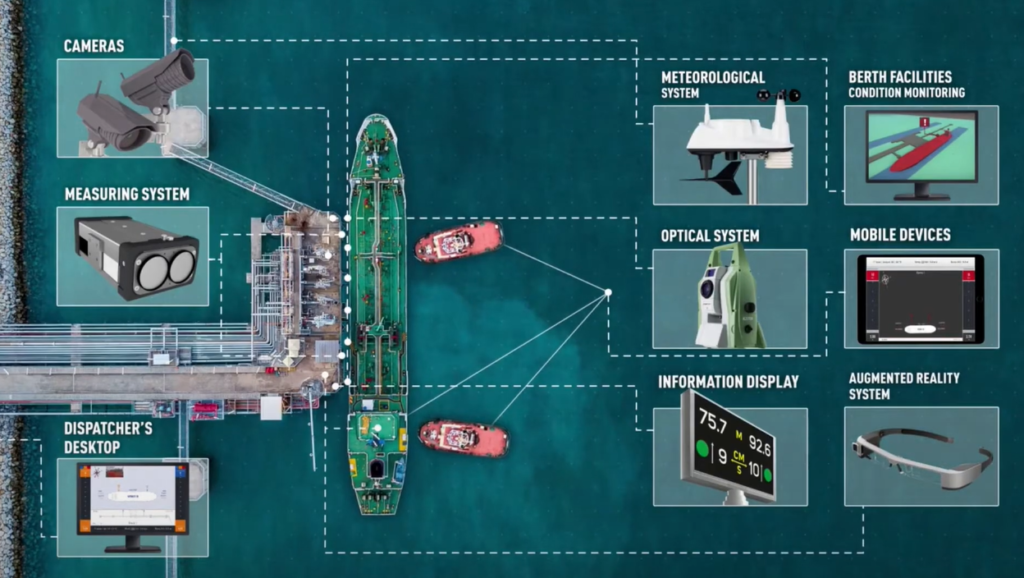
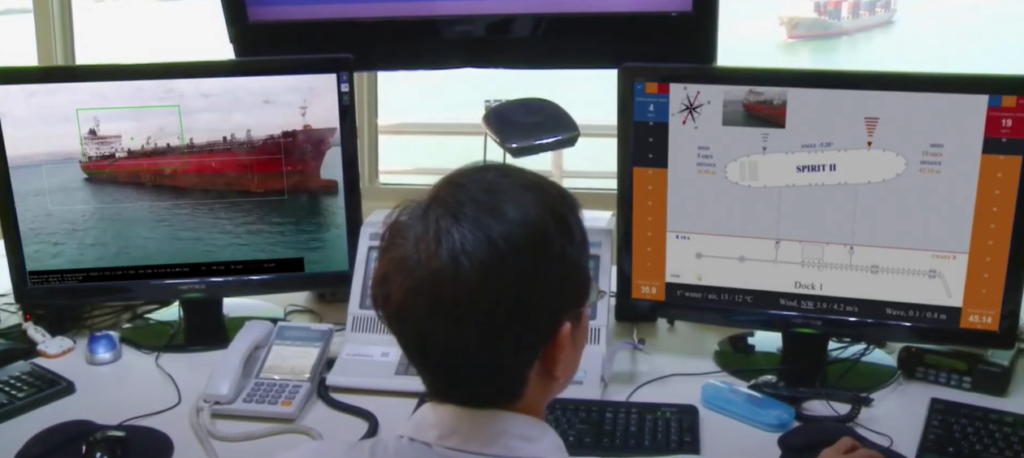
MOORiNET monitors where and how the ship is going and helps it to dock safely. The sensors detect various weather conditions and transmit the data to the port operator who supervises mooring rules. Weather sensors measure wind, wave, and visibility. A meteorological station monitors the outside temperature, atmospheric pressure, and the sea surface height. When a ship approaches, laser rangefinders and surveillance cameras automatically start monitoring the bow and stern using machine vision. The ship is captured from 300 meters, and the closer the ship gets, the more accurate the data are. The berth has a system that measures the impact during the mooring.

Therefore, an operator enjoys full port visibility. The ship’s speed is monitored as well in real time and displayed at the operator’s dashboard. Each vessel is highlighted with a color representing speed safety level range. In the case of any violations, the operator proactively warns the ship to take the situation under control. Should an accident happen, all sensor data records will be available to help investigate, whether a huge wave caused an accident or if the ship was violating mooring rules and overspeeding.

Loading accidents

There is a rule, and the rule says: Once the ship docks, the port is responsible for whatever happens to it then. Now, picture this: a moored ship is being loaded with oil. The vessel gets heavier with each new ton, and all this pressure goes down on the mooring… To keep the mooring from being depressed, load binders are used. These are automatically controlled metal devices to tighten chains holding the ship’s bow and stern fixed. Many ports shut them off, as they can loosen or tighten the ship too much. Usually, somebody controls load binders using nothing but natural intuition and experience. Sadly, either human errors caused accidents or the perfect storm occurred with all its wind, fog, sand in the face, the sun hurting the eyes, and heavy snowing in the northern countries. Chains break apart, the oil hose follows, and the hazardous chemical spills on the sea surface. Here is when oil spill detection solutions come in handy.

MOORiNET can be integrated with a load binders system. The algorithm uses video analytics and laser rangefinders to detect a slightest movement of the ship and automatically alert a person responsible, so that this person either loosens or tightens the chain. The same applies to the oil supply system.

Harbor pilot helper

There is a MOORiNET version designed specifically for harbor pilots. An Android app gives a pilot all necessary information such as the speed at the ship’s bow and stern and the weather. The app connects to the ship’s system via a connector and synchronizes data with the MOORiNET at the mooring, thus providing the port and the ship with consistent information for better safety.

Read more:

For more fresh news, subscribe to our newsletter

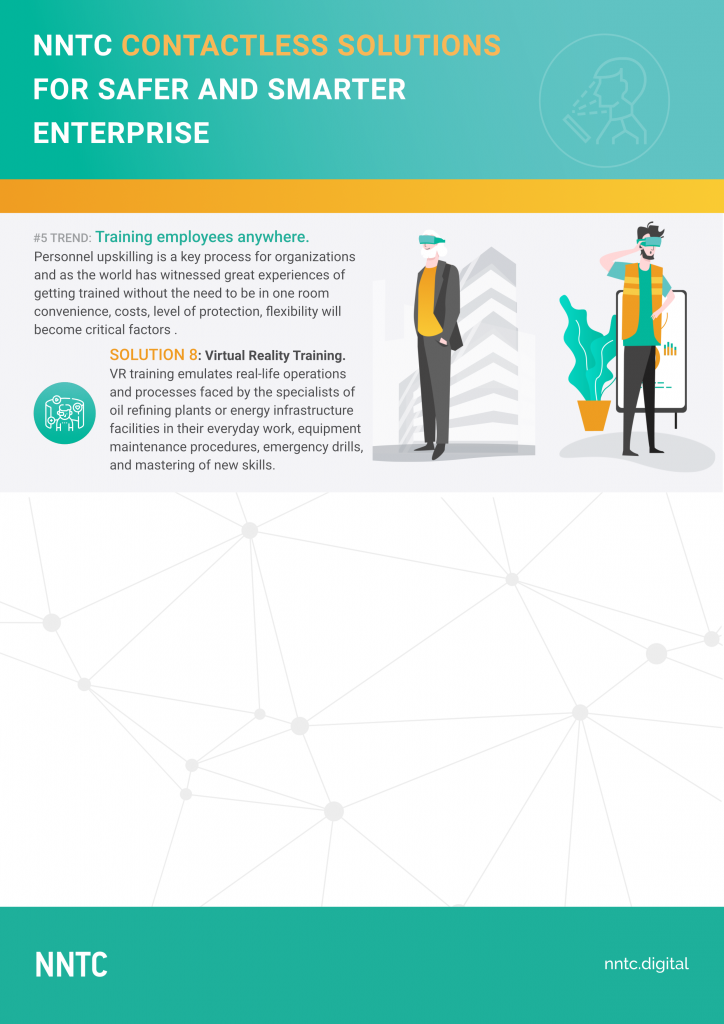
NNTC Contactless solutions for safer and smarter enterprise

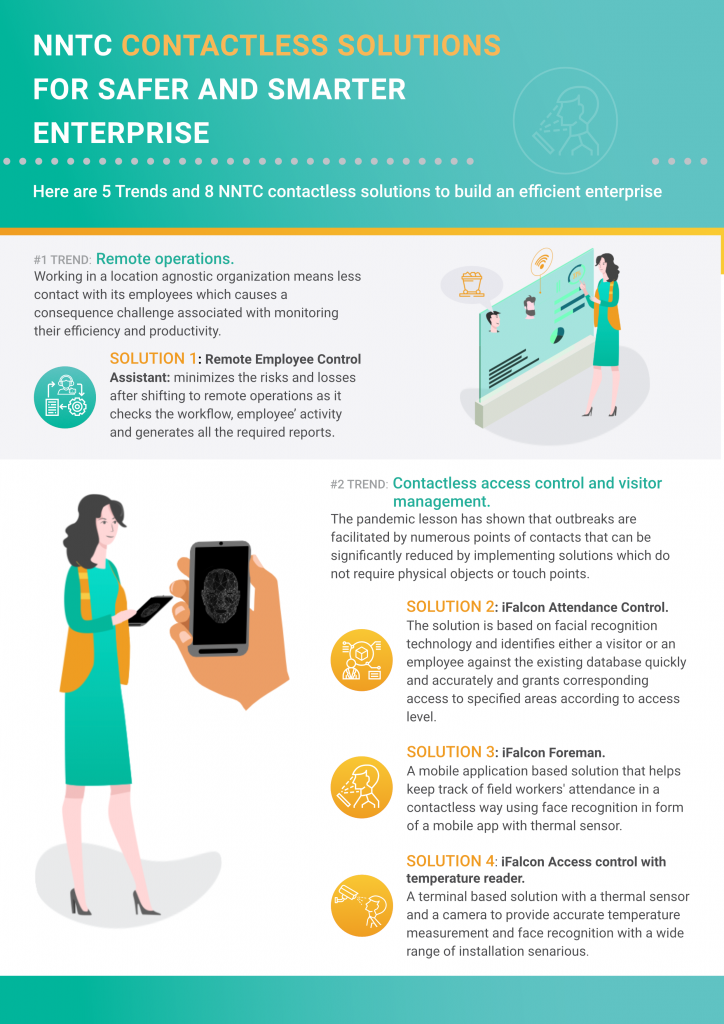
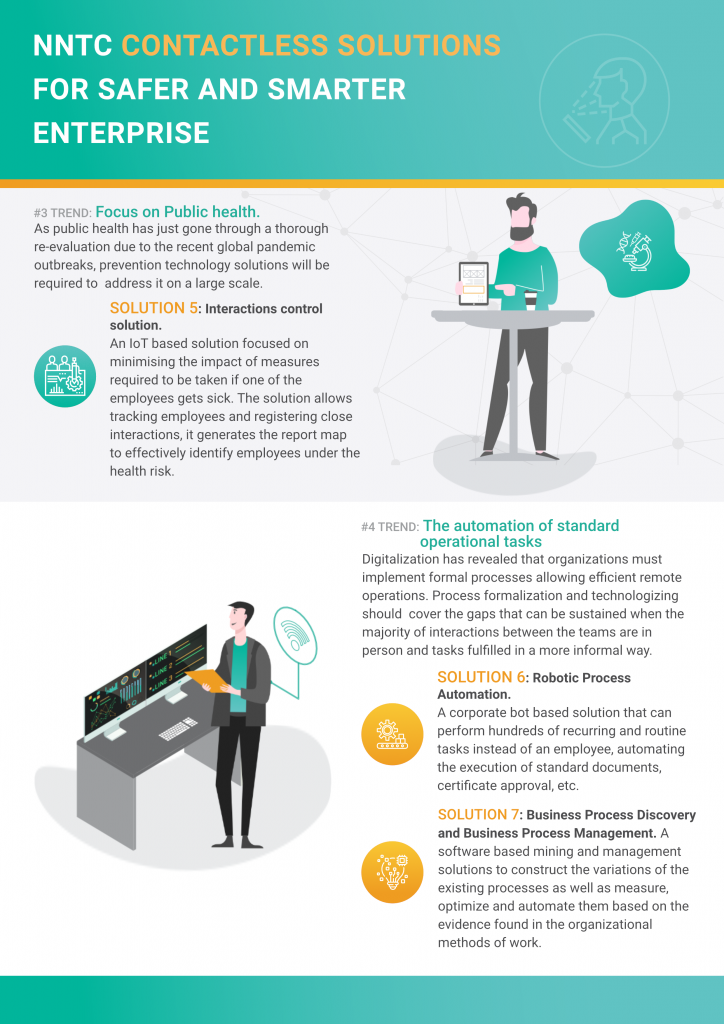
As the world is exiting the global pandemic crisis, technology providers have managed to demonstrate that the right solution is what it takes to work efficiently in a geo agnostic world. As much as a crisis-driven shift it has been, it accelerated most of the organizations to promptly adopt advantages of digitization.

The obvious success of remote working operations in many cases shows that this trend, as well as a few other technologies, can prevent potential virus outbreaks and build safer and smarter enterprises. For sure, it is expected to become a new normal in the post-pandemic world.

NNTC Online product launch: Technologies to protect your people from the 2nd wave

On April 29th our experts presented recent developments that help to minimize the current risks for the organization and its employees.

Timestamps:

01:55 – 21:22 – IoT-based contact tracing for labor-intensive industries
21:37 – 36:00 – Access control solution with face recognition and thermal sensors
36:15 – 49:15 – Contactless field worker attendance with a mobile app
49:27 – 01:03:26 – Time control and data leak prevention for office employees

For questions and requests, please contact info@nntc.digital