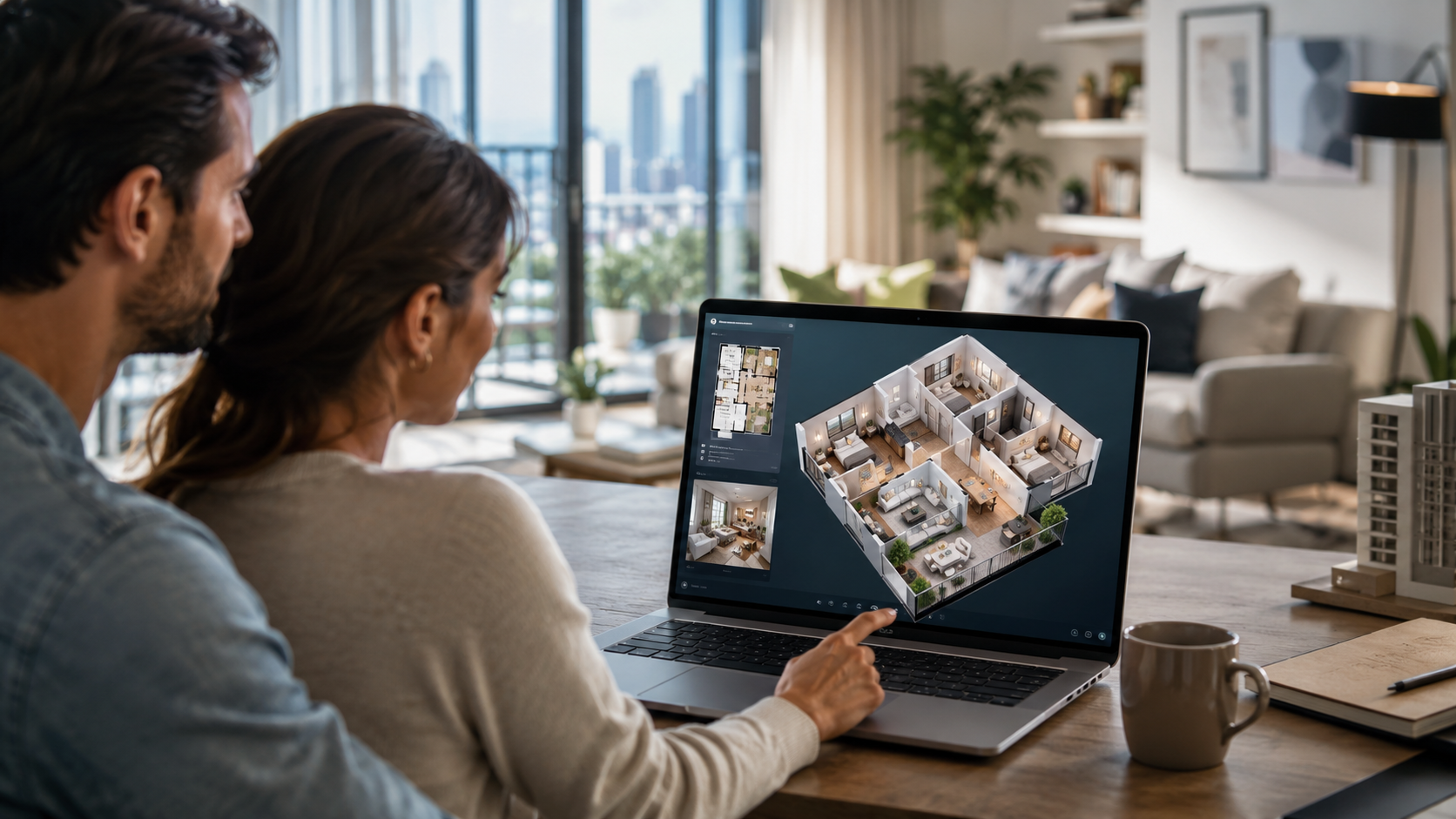
Learn how web-based 3D property tours help remote buyers explore properties clearly, compare options confidently, and move faster to a shortlist.
Remote buyers rarely drop off because they are not interested. They drop off because flat images, PDFs, and floor plans do not always help them understand the property clearly enough before visiting.
In Dubai, that matters because off-plan transactions accounted for 63% of all property sales in 2024, which means many buyers are evaluating projects before they physically exist.
A web-based 3D property tour helps close that gap by turning remote exploration into something more active, visual, and easier to evaluate. Buyers can explore the project from their browser, move through layouts, compare options, and return to the tour later with family or other decision-makers.
For property developers, better remote exploration shortens the path from first interest to shortlist and gives sales teams better-informed leads.
A 2024 study by Miremad Soleymanian and Yi Qian supports this point. Their NBER working paper, “From Novelty to Norm: Uncovering the Drivers of Virtual Tour Effectiveness in Real Estate Sales,” examines how virtual tours support real estate sales and digital marketing effectiveness.
What Is a Web-Based 3D Property Tour?
A web-based 3D property tour is an interactive online experience that lets buyers explore a property, development, or unit layout directly through a browser.
Unlike app-based tools, a web-based tour does not require buyers to download software or use special hardware. They can open the experience from a website, campaign link, email, QR code, or sales presentation.
Depending on the project, a 3D property tour can include:
- 3D building models
- Interactive floor plans
- Unit-by-unit navigation
- Views from different apartments
- Amenity exploration
- Surrounding area context
- Availability or pricing layers
- Sales centre integration
- Remote consultation support
The goal is not only to impress buyers visually. The real value is helping them understand the project faster and compare options with less guesswork.
Why Remote Buyers Struggle to Shortlist Properties Online
Shortlisting is a process of eliminating uncertainty. For remote buyers, that process slows down when renders, PDFs, 2D floor plans, and image galleries only answer part of the question.
These formats do not always help buyers understand flow, orientation, room relationships, or how one option compares with another. When buyers cannot answer those practical questions, they delay shortlisting and keep browsing.
That is why a web-based 3D property tour is not just a presentation tool. It helps remote buyers move from curiosity to a more confident shortlist.
Why a Web-Based 3D Property Tour Is More Useful Than Static Content
The main advantage is a better buyer understanding.
With renders, remote buyers only see what the marketer chooses to show. With a 3D tour, they can explore at their own pace, return to important details, and focus on the parts of the property that matter most to them. That makes the experience easier to understand and more useful when comparing options.
The UAE-market points in the same direction. Bayut says its 3D Live floor-plan experience helps property seekers gain a clearer perspective on layout from home, streamline their property search, and arrive at viewings with more informed questions.
This helps explain why interactive exploration is more useful than static content alone for remote buyers.
For remote buyers, the value is practical. They can check whether a layout makes sense, compare serious options earlier, and speak to sales with clearer preferences instead of basic clarification questions.
Key Features of an Effective Web-Based 3D Property Tour
Not every web-based 3D property tour creates the same value. The strongest ones are built to support actual buyer decisions, not just visual presentation.
That usually means the tour should include the following features:
- Browser-based access so buyers can start exploring immediately, without downloading an app or creating friction at the first step.
- Easy project navigation so buyers can move from the wider development to specific buildings or units without confusion. A 2024 study in Computers in Human Behavior by Maurizio Mauri, Gaia Rancati, Giuseppe Riva, and Andrea Gaggioli found that more immersive real estate experiences create a stronger sense of presence, stronger emotional response, and higher willingness to visit the property in person.
- Unit and layout exploration so space, flow, and room relationships make sense from the screen, not just in a brochure. This matters because immersive housing tools are most useful when they reduce information gaps and make evaluation easier.
- Views and surroundings so buyers understand context, including nearby landmarks, shared amenities, and how the property sits within its environment.
- Clear comparison support so buyers can move between units, layouts, or positions without losing clarity. That is especially important when the goal is faster shortlisting, not just better presentation.
- Cross-channel usability so the same experience can support website visits, showroom discussions, follow-up, and remote consultations rather than sitting in one touchpoint only. Research on immersive real estate experiences suggests the strongest effects come when the format improves presence and engagement, which makes it more useful across the wider buyer journey, not just in a single viewing moment.
Benefits of a Web-Based 3D Property Tour for Remote Buyers
For remote buyers, the value of a web-based 3D property tour is simple: better understanding leads to faster shortlisting.
When buyers can explore a property more actively, they do not have to rely only on renders, static floor plans, or follow-up explanations to make sense of what they are seeing. A strong interactive property tour helps remote buyers understand layout and flow more clearly, compare options with less guesswork, revisit the project later, and share shortlisted properties with family or other decision-makers.
That matters because richer digital exploration helps buyers evaluate properties more effectively.
Benefits of Web-Based 3D Property Tours for Sales Teams
Web-based 3D property tours are not only buyer-facing. They also improve how sales teams guide the buyer journey.
When buyers understand the project earlier, sales teams spend less time answering basic questions and more time helping buyers make real choices. That improves conversation quality, follow-up quality, and the overall pace of the sales process.
In practice, a web-based 3D property tour can help sales teams:
- Qualify interest earlier
- Guide buyers more effectively
- Reduce repetitive explanation
- Keep remote conversations more focused
- Support a more consistent sales journey across channels
That is also why this kind of experience works well as real estate sales centre technology. It is not only useful on the website. It can also strengthen showroom discussions, follow-up conversations, and remote consultations by giving sales teams a clearer, more interactive way to present the project.
What Property Developers Should Look For in a Web-Based 3D Property Tour
If the goal is faster shortlisting, not every web-based 3D property tour will do the job equally well. The strongest solutions are not only visually impressive. They are designed to help remote buyers understand the property quickly, compare options clearly, and continue the journey without friction.
For property developers, that usually means looking for a solution that can support real buyer decisions at every stage of the process, not just create a good first impression.
What Should Property Developers Look for in a 3D Tour?
- Easy to access in a browser
Buyers should be able to start exploring immediately, without downloading an app or going through extra setup.
- Strong on layout and space understanding
The tour should help buyers understand flow, scale, and room relationships, not just show polished visuals.
- Useful for comparison, not just visual impact
Buyers should be able to move between units, layouts, or positions without losing context.
- Relevant for remote buyers and showroom follow-up
The same experience should be useful before a call, during a consultation, and after the meeting when buyers want to revisit what they saw.
- Easy to update as the project evolves
If layouts, availability, or pricing change, the experience should stay aligned without becoming difficult to maintain.
- Usable across web, sales centre, and remote selling
The strongest tours do not sit outside the sales process. They become part of how the project is explained, explored, and followed up on.
In practice, that is what separates a useful interactive property tour from a purely visual one. The best solutions reduce friction for both buyers and sales teams, making it easier to shortlist, discuss, and move forward with confidence.
Better Remote Exploration Leads to Faster Shortlisting
A web-based 3D property tour gives remote buyers a clearer way to evaluate the property before they ever visit.
When buyers can explore more clearly, they shortlist more confidently. That reduces hesitation, improves the quality of follow-up conversations, and helps sales teams spend less time explaining the basics and more time helping buyers choose.
In a market where more property discovery happens remotely, that is not a visual upgrade. It is a sales advantage.
About NNTC:
NNTC helps property developers create web-based 3D walkthroughs, remote interactive sales tools, and digital twin solutions for off-plan sales.
Talk to NNTC about a 3D tour for your project.
You can also explore related solutions.
Read More:
FAQ: Web-Based 3D Property Tours
Are 3D property tours useful for off-plan property sales?
Yes. For off-plan projects, 3D tours help buyers visualize spaces that are not yet built, compare unit options, and understand the wider development more clearly.
Do buyers need special hardware to use a web-based 3D tour?
No. A browser-based 3D tour can usually be opened from a phone, tablet, laptop, or sales centre screen without special hardware.
How do 3D property tours help sales teams?
They reduce repetitive explanations, help buyers arrive with better questions, support remote consultations, and make project presentations more consistent across sales channels.
What should developers look for in a 3D property tour?
Developers should look for browser access, clear navigation, strong layout exploration, unit comparison, view context, easy updates, and usability across websites, sales centres, and remote sales calls.
