Future of Facial Recognition in the UAE

the-future-of-face-recognition

“The UAE Cabinet has announced a decision to allow use of facial recognition in certain sectors”, and this is big news for technology locally and globally. Where do we go and what’s coming? Dmitry Doshaniy, NNTC General Manager, shares his predictions and perspective on this exciting news in an interview below.

Article by Dmitry Doshaniy, NNTC General Manager
LinkedIn | Mail

It’s 2021 when the UAE has approved facial recognition. Why now?

Many government and private organizations have more or less got started adopting facial recognition for security reasons or routine operations. Individual users of certain devices or services know this technology well, for example, for unlocking most of iPhones. Many banks are introducing biometric authentication to improve both client experience and transactions security.

Facial recognition has become global, so one more app or solution on the market doesn’t impress anybody. The market has matured and is now ready to adopt this technology and create more space for it at the state level. Facial recognition has proven to be a reliable and practical tool that is now starting to move into the mainstream.

Another explanation for such a decision is, I think, the fact that both business and public services still have to be provided remotely. COVID-19 is a compelling reason for governments to work harder towards less crowded places and better public health situation. Of course, some procedures are available online, but many services require authentication due to personal data security matters.

How can one know that a particular facial recognition offering on the UAE market is mature?

There is a bunch of tests showing strong performance of the latest algorithms with up to 99.97% facial recognition accuracy. False recognition is next to impossible if an image of a person is of normal quality. There can be some trouble if comparing photos of one person at different ages (for example, with a ten-year gap between them), but it is not critical as well. Anyway, facial recognition outperforms an average desk clerk. This means that video analytics puts an end to scammers successfully faking their identity to get a loan and lying to clueless clerks how not having much sleep last night makes them look wildly different from the photo. Imagine a scammer trying to play that trick with a video camera – hilarious!

facial recognition

The Internet used to have a bad reputation for massive account hacks and identity theft in the past. Is it possible that future hackers will somehow lay their hands on facial recognition data to make a plastic surgery and break into all user accounts?

Facial recognition systems do not store any information that can be used for plastic surgery or making a realistic 3D-printed mask. In most cases, flat images or photos are processed into a number format, and the underlying algorithm doesn’t allow reconstruction of the source 2D image. The information conversion process is tricky. Just as you can’t use hashes to reverse engineer the hashed source data, a numeric form of a recognized face in a database is incomprehensible – you can’t even guess the appearance.

Suppose, someone manages to steal a facial recognition database, but translating and exploiting the content is impossible. You can’t come up to a stranger, take a picture and stay unnoticed, and then make a super-realistic mask out of that photo. Moreover, your identity is secured by your biometric data – voice, fingerprint, and eye retina; scammers have zero chance of success. The best practice is to use several identity indicators in a biometric authentication system. Diversity makes a perfect security system.

In your opinion, how long will the implementation of facial recognition take at the state level in the UAE?

This reminds me of a joke, that goes like: “Who is the driver of your digital transformation: CEO, CIO or COVID-19?” Some parts of human life have experienced change that could have been extended over decades, but instead it either happened in months or is planned to happen in the next year or two. Everything related to remote work, services, and authentication will be implemented really fast.

We witness some global experience already as other countries are working on legal framework to deploy and regulate facial recognition and video analytics. This experience can be adopted and customized locally. Face-initiated payments, travel by public transport, and overall routine surveillance are an everyday practice in China. Integration like this brings great benefits to citizens and the state by improving people’s safety and comfort.

People usually prescribe a number of gloomy properties to face recognition, including recalling “Big Brother”. However, many countries have developed regulations to control facial recognition use, and this experience can be enriched and adopted. I’m 100% sure, that the UAE has the brightest future using this wonderful technology.
Read more about facial recognition

4IR. How to exploit the Fourth Industrial Revolution

4IR

The majority of business leaders (63%) surveyed by PwC claimed that technologies of the Fourth Industrial Revolution (4IR) provide protection against an economic downturn. But how to find your way around this strange and seemingly unmanageable concept? Be brave, and I’ll show you a way in this blog!

What is 4IR?

4IR became a hot topic a few years back when the world realized how technologies impact everyday life and innovations skyrocketed, giving an optimistic view of the future coexistence of humans and machines.

4IR

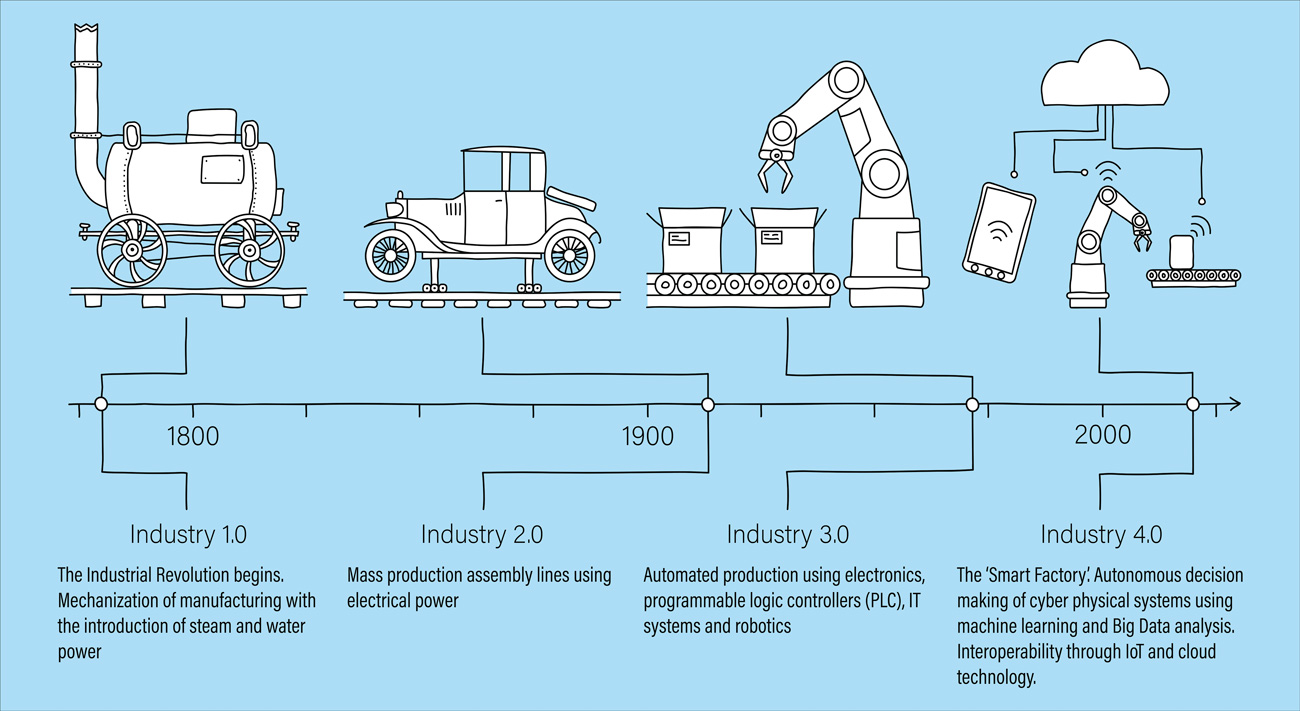
The Fourth Industrial Revolution is building on the Third, the digital revolution that has been occurring since the middle of the last century. It is characterized by a fusion of technologies that is blurring the lines between the physical, digital, and biological spheres.

said Klaus Schwab, Founder and Executive Chairman, World Economic Forum.

The main idea is that technologies do not replace, but rather gradually complement, humans, becoming a new “tool” in the hands of business. At the moment, businesses need to prepare for 4IR to survive amid the post-pandemic crisis. What’s more, companies that can keep up with the times and gain necessary skills in advance will win the race by leveraging the new tools.

4IR for business survival

Companies successfully deploying 4IR technologies now may actually emerge as stronger competitors during a recovery, and will likely be better prepared for a potential economic downturn in the future. 4IR benefits are evident: increased productivity, efficiency and quality of processes, as well as better staff safety, data-driven decision-making, and increased competitiveness thanks to developing customized products.

According to a recent PwC survey of CFOs, while the COVID-19 crisis has led 70% of companies to cut back or defer planned investments, just 22% said their companies are curbing investments in digital transformation. What does digital transformation actually entail?

Digital transformation means preparing an organization for 4IR solutions and then systematically adopting them in the most optimal way to minimize business risks. In fact, it is an organization-specific process which should be supervised by digital transformation specialists. This very approach will help you harness and exploit 4IR.

Stages of digital transformation:

  • Technology digitalization. Create advanced digital infrastructures and RPA-based systems to collect data and control processes.
  • Production digitalization. This stage requires the creation of a digital platform to collect, store, and process data, use some analytics tools (machine learning, digital twins), and engage production planning and management systems using the same models and data from the digital platform.
  • Digital services and apps. They are created on top of the rest to improve efficiency and performance. Data analytics tools allow for prompt and, ideally, automatic adjustment of production and technological processes, thus eventually raising product quality, reducing its cost, and improving other parameters.

How to start adopting 4IR?

As I already mentioned, each organization goes its own way here; however, there is a standard 4IR checklist.

Process automation. Whether at manufacturing facilities or in the office, process automation is one of the key success factors on the path to 4IR adoption. Process automation may include: RPA-based filling out of documentation, automated Big Data collection for subsequent analysis, automation of routine processes and procedures using artificial intelligence, video analytics, and IoT.

Big Data. All business processes are based on analytics. Indeed, data analytics helps determine a business development vector, predict critical situations, and optimize processes. A full-fledged data collection is only possible when information comes from all business process participants, from the production to the sales office or store.

Vision Zero and concern for people. Another pillar of the 4IR approach is personnel safety and care. Manufacturing enterprises adopt Vision Zero, which significantly improves occupational safety. Thus, VR drills fully immerse personnel in any possible scenarios to train them in dealing with emergencies without any risk, while Digital Worker solutions warn in advance about on-site hazards. There are also solutions to ensure office personnel safety and comfort. For example, BIM tools help adjust environmental conditions in the office, while contactless solutions prevent the spread of infections.

Business optimization. As a rule, the transition to 4IR goes along with certain internal restructuring and business optimization, which is unavoidable after adopting better and more cost-effective solutions that free up specialists time. As a result, companies can spur strategic development and planning or strengthen previously understaffed business units.

Read more

Technology boost for oil & gas

oil and gas

Falling demand and COVID-19 restrictions challenged the world economy in 2020, with the oil and gas industry being no exception. Expectations from 2021 are divided and it’s a tie score, generally speaking, as the tables can turn overnight. With this in mind, leading global oil and gas companies rather enthusiastically invest in technologies enabling faster response to fluctuant market and geopolitical situation.

AI-based production

Don’t know where to look first? For starters, it is worth to consider AI- and ML-based solutions – decision-making accelerators and best response advisers. Relying on qualitative KPIs, instead of quantitative ones, you increase oil production efficiency and profitability. Making much headway, AI can support business on many sides: security, profitability, production compliance control; even oil extraction can go faster.

Among other things, you can integrate AI-based solutions into logistics operations, since this technology has learned to detect oil spills at night as good as in daylight, being able to catch the sight of oil slick’s thermal image and reflected polarized light.

Learn how polarization technology helps rapidly recognize and identify oil spills with outstanding accuracy

Technology boost with lower production costs

Production costs reduction is also firmly on the agenda of oil extraction. IT can help automate multiple business processes and efficiently support productive capacity uptime with minimum human involvement.

For example, solutions to run diagnostics and avoid expensive equipment downtime. Some technologies even reduce the time it takes to gather information on equipment health, such as digital twins or drone-based industrial inspections. Let’s take an inspection of a huge oil pipe as an example. To inspect this monster, you need to build scaffolding first. To accomplish that, you need to stop pipe’s work, erect scaffolding against it, and only then people will use it for two weeks looking for some defects: peeled paint, rust or a missing piece of the build. Each inspection engineer has to document every detail of the detected defect. However, using industrial inspection drones with special software and machine learning algorithms, you will reduce costs by 5-10 times, with only one person and one drone being needed to involve.

Digital Enterprise – VR Project

Or let’s take a look at the Digital Factory concept. It describes an enterprise that leverages IT in its every aspect: automated manufacturing, optimized business processes, services, and product promotion. The concept implies a single information environment turning hectic data from multiple sources into a structured data-driven representation of the enterprise. Decisions of a company like this are guided by complete and constantly updated information.

Oil & gas industry and remote work

The reality surprised the industry with transition of many non-production employees to remote work. However, this move helped develop communication networks and solutions for collaboration.

Remote work requires the automation of standard operational tasks. A corporate bot can perform hundreds of recurring and routine tasks instead of an employee, automating the execution of standard documents, certificate approval, etc. The bot is also a universal tool that can call 200 employees per minute and obtain any necessary information. Here is one of our case studies: in the morning, the bot collects staff work plans for a day or a week, and in the evening, it receives interesting insights or identifies why tasks were not completed. The voice bot collects and transcribes all information, then draws up a unified report and submits it to a manager, with a report summary also being sent to group chats in messengers. This way, managers always keep track of the events in their departments and monitor all tasks being performed, while saving personnel time otherwise spent on preparing routine reports.

technology boost

Second example of such solution is a Remote Employees Control Assistant (RECA). It is an integrated system, which helps to ensure control over business processes, analyze staff activities, generate workflow reports and keep in touch with remote employees. It shows a detailed picture of each employee activities and prevents confidential information leaks.Gradual transformation of oil & gas production

Now is the most favorable time to benefit from investments in information technology. All it takes is a wise choice of implementation strategy and tactics, and relevant experts can help you make better choices to maximize the effect of your overall digital transformation.

Read more

What 2020 has taught us? NNTC’s focuses and strategies for 2021

2021

Dmitry Doshaniy, NNTC General Manager, summarized 2020’s results and determined development strategy for the next year. What 2020 has taught us and what strategy to follow in 2021? In today’s blog, we will share the main insights from Dmitry’s interview.

Article by Dmitry Doshaniy, NNTC General Manager
LinkedIn | Mail

2020’s online survival is 2021’s new normal

Online communication services, messengers, and platforms have won extra audience as a result of self-isolation and business events going online, which is the case for both B2C and B2B sectors. For example, we at NNTC also felt the need to enhance online communication with our audience. Thus, we held webinars for customers and partners, which was a great and rewarding experience for our team.

After 2020, it’s even easier for tech companies to sell online. If, for example, you sell software a customer doesn’t need to “touch and feel”, all you need to do is provide a demo version or deliver an online presentation, and then close the deal through Zoom. This was not possible before and has only recently turned into a common business practice, and we believe these changes also bring us business development opportunities. The fact that online business meetings have become a new normal can unlock new development opportunities and boost our geographic expansion.

Technology is a lifesaver – and 2020 has proved it

During the lockdown, society has become more technologically advanced. Even the most stagnant skeptics appreciated the importance of technology and learned how to use its benefits. This interest will continue after people return to the offices. We are happy with that, since NNTC sells its solutions to people who are not afraid of technology and strive to use it for good.

In addition, we will see growing investments in healthcare and infectious disease control solutions, both organizational and technological. Indeed, this year, Apple and Google have developed an API to track contacts with virus carriers. NNTC also already offers a solution for manufacturing and construction sites that detects social distancing violations and helps identify contacts with infected people, so that affected personnel can be promptly sent to quarantine and receive medical treatment. Indeed, technologies save people’s lives.

Make decisions wisely in 2021

2020 has been a good year to cultivate morale and find new ideas and approaches for business development. Moreover, our specialists had such a good practice in implementing ideas that they have reached a brand-new level of product development speed.

Now, it is time to adopt a more balanced and less opportunistic business approach. The year 2020 has shown that we need to carefully calculate and consider response time in advance. When a demand arises for a certain type of development, the temptation is to meet this demand as soon as possible using R&D resources. However, we need to look beyond and carefully consider the next steps to avoid wasting precious time and resources in pursuit of such demand. We need to be preparing for the post-crisis time right now and think long-term rather than short-term. We are actively reviewing our solution portfolios taking into account the company activities completed in 2020. From now on, our strategy involves fewer products and more active product development.

I try to be optimistic and believe that the next year will be better than 2020. Also, in 2021 we’ll face a very intense deferred demand, as after any crisis. After the pandemic, people will be even more eager to live better life, traveling, meeting with peers shopping, and completing professional projects.

2021

Read more

Building the Hospital of the Future

Hospital-of-the-future

The hospital of the future may look quite different from what we are used to. Rapidly evolving technologies, along with demographic and economic changes, are expected to transform hospitals worldwide. Building the digital hospital of the future requires investments in people, technologies, processes, and premises. Therefore, hospital management should not expect ROI right away. However, in the long run, digital technologies will improve care quality, operational efficiency, and patient and staff experience.

Thank you, doctors!

With the COVID-19 spreading, hospitals worldwide are working at full capacity, and healthcare workers are saving lives every day. We admire and thank those heroes for their commitment and hard work. We wish them to stay strong in this hard time!

Moving towards hospital of the future

There is a range of solutions to improve customer experience and make hospitals more comfortable for patients and personnel. It will become a new normal sooner or later.

Digital experience

Digital solutions improve patient experience by providing real-time access to medical knowledge. The best way for hospitals to establish good relations with their customers is to become open and user friendly. Digital and AI technologies streamline the process of making appointments with doctors and reduce the number of forms patients need to fill out, while analytics, machine learning, IoT solutions, and portable devices analyze patient health condition and suggest treatment procedures to doctors.

Healing and well-being

Wristbands for patients and doctors plus visitor badges with RFID tags ensure appropriate access levels, while CCTV cameras with AI features recognize faces to locate patients who look unwell and need help, and accelerate recovery. Moreover, AI-enabled video analytics solutions can identify threatening situations as, or even before, they occur.

Hospital healing and well-being
Hospital operational efficiency

Hospital operational efficiency

RPA (Robotic Process Automation) solutions automate hospital’s ancillary and back-office services, considerably reducing costs and personnel work effort and improving service reliability; AI systems and electronic health records populated with data from various sources improve decision-making; while cognitive analytics tools sort through and find the most important personalized data points, thus boosting work speed and quality.

Talent development

VR solutions help surgeons practice upcoming surgeries, while Learning Management Systems transcend geographical boundaries and reduce costs allowing them to share their surgery footage and specialized expertise with a larger audience of students and colleagues. Cognitive analytics and RPA solutions automate hospital personnel recruitment and study patient information and requirements to match patients with doctors having appropriate competencies.

Hospital talent development

Project: Mohammed Bin Khalifa Cardiac Center

Our team was lucky to take part in the joint project with our strategic partner NGN International (Bahrain). We provided general design, control, and implementation of the end-to-end technology infrastructure for the Mohammed Bin Khalifa Cardiac Center in Manama, Bahrain, under the patronage of His Excellency Lieutenant General Doctor Sheikh Mohammed bin Abdullah Al Khalifa, President of the Supreme Council of Health.

Hospital Mohammed Bin Khalifa Cardiac Center
Mohammed Bin Khalifa Cardiac Center

The Center has a floor space of 172,765 sq.m and one of the fastest-growing IT networks in the world. It uses a sophisticated technology to combine resources of physical and virtual servers and connect the entire work environment to the cloud.

In addition, Vocera Communications smart badges enable effective hands-free information exchange between doctors in real time. Data analysis and business intelligence solutions gather data from all systems of the Center and provide accurate results for better decision-making. Redundant IT systems ensure business continuity during various internal and external emergencies, effective data flow, and data availability anytime, anywhere.

Step by step

The hospital of the future is not built in a day. It requires consistent development and global expansion of innovations. Increasing healthcare investments and concerns about lives and health of patients and medical personnel will make hospitals more and more technologically advanced, which, we believe, will save and improve people’s lives.

Read more

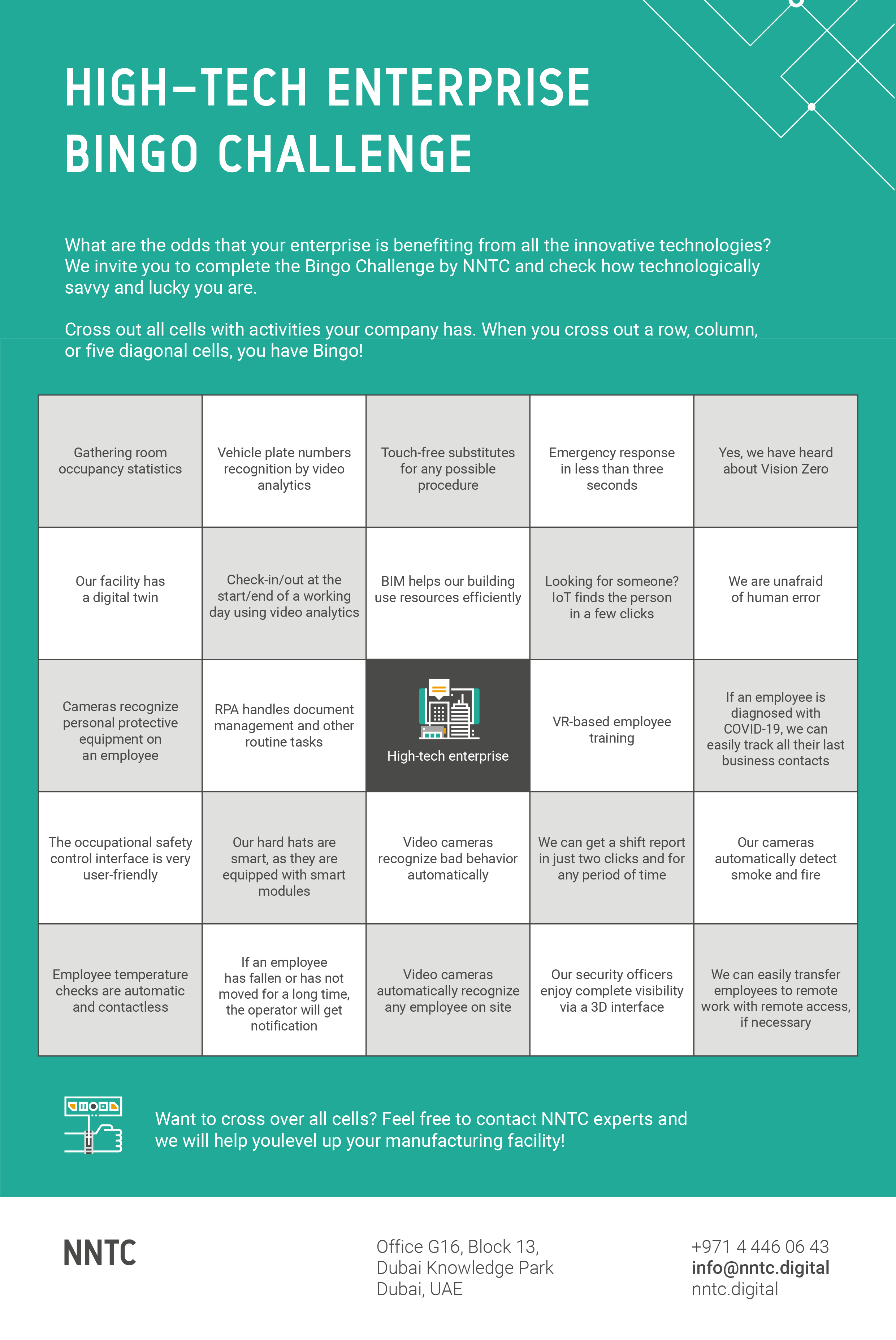
High-tech enterprise bingo challenge

Bingo challenge

What are the odds that your enterprise is benefiting from all the innovative technologies? We invite you to complete the Bingo Challenge by NNTC and check how technologically savvy and lucky you are.

RULES: Cross out all cells with activities your company has. When you cross out a row, column, or five diagonal cells, you have Bingo!

High-tech bingo challenge

You can download this high-tech enterprise bingo challenge in full resolution and share it with your colleagues!

Read more

How to win and retain customers after the Pandemic?

Consumers after COVID-19

In this year’s Global Consumer Insights Survey PwC polled city dwellers on their purchasing behavior in two separate studies, one before and one after the coronavirus outbreak. The survey resulted in certain insights that demonstrate new buying habits to emerge. How technologies can help save customers after COVID-19?

consumers after COVID-19

The COVID-19 situation has deeply affected urban consumers’ views on spending.

Before the outbreak, consumer confidence was sky-high. Almost half (46%) of PwC’s survey respondents said they expected to spend more in the next 12 months. After the outbreak had begun, the percentage of those who said they were going to spend less in the next few months almost doubled. The number who said they were going to spend more dropped by more than 10 percentage points.

Even in locations where lockdowns have been partially lifted, urban consumers are making fewer shopping trips, consuming more at-home entertainment. For consumers to feel confident enough to return to physical interactions with retailers, the first thing they need is solid assurance that places of business have a plan to make their customer experience as safe as possible.

Customer behavior after the Pandemic

COVID-19 outbreak reinforced the already growing trend of online shopping. People explore different ways to access products and services.

  • 86% of polled consumers are likely to continue to shop online/by phone when social distancing measures will be removed.
  • This trend shows a high popularity in the Middle East: 58% of customers after COVID-19 said they’ve started shopping more on mobile phones.

The survey data demonstrates emerging behavior patterns and new consumer preferences. We’re facing the importance of developing new ways to reach out to customers after COVID-19, and not taking them on a merry-go-round of hectic ads and irrelevant content. That’s why transactions deserve better security, especially those related to banking apps and online shopping. Wire payments grow in number (53% of respondents used mobile phones to make payments, and 90% are going to keep it this way).

Win customers with biometrics-based apps

Biometrics facilitates onboarding, helping app users to become your clients. We launched a biometric onboarding module for a mobile wallet app in Oman, leveraging video analytics to help people benefit from financial services without visiting a branch office. The app is a mobile wallet, where you can add a card issued by any bank and perform all necessary financial transactions. It is available to the general public in official app stores. Bank receives information about the interests and preferences of users to make special offers. It helps to convert app users into bank clients.

Reinforcing online operations protection

Hackers are skillful in capturing security codes from SMS or PUSH notifications. Digital signature for smartphones can really save the day if your clients prefer paying online. The private key can’t be captured by any hacker because it’s generated in the user’s smartphone and safely encrypted. According to PayConfirm, they provide client-server software for transaction confirmation that suits any digital channel. It includes online/mobile banking, one-time passwords, and works online and offline (even in airplane mode). This solution can prevent phishing, social engineering, data switching, and SIM-module switching attacks, which gained momentum during COVID-19.

Less shopping time with video analytics

video analytics for shops

Video analytics can be of use in creating personalized offers targeted at a specific audience.

Previously, customized points of sale (POS) used to recognize customers at the entrance and generate specially-for-you offers. This technology evolved during COVID-19. Now consumers can place an order in a personal account or set a rule for a particular POS. With this feature, visitors can automatically get a preferred type of coffee entering a cafe or pick a packaged order without excessive human contact. Video analytics will even recognize a customer wearing a medical mask.

Amazon has been working on biometric identification for a long time to enable face-initiated payments. Visitors take products they need and leave the store. Cameras recognize the products and the shopper to automatically charge their bank card. Shopping takes less time and involves fewer encounters – even eliminating contacts with salesmen – meanwhile ensuring a safe customer experience.

Temperature checks

In addition to facial recognition, a POS can be equipped with a temperature measuring tool and improve overall safety, retaining customers after COVID-19. One sick person at work can stop activities of an entire shopping mall or office and quarantine hundreds of people. We have developed a compact contactless solution for the timely detection of visitors with fever. It combines the thermal scanner functionality and face recognition accuracy. The scanner – a thin screen with a built-in camera – is installed at the entrance to scan visitors’ faces. It identifies them (successfully, if a visitor is in a customer’s database) and checks their temperature with up to 0.2-degree accuracy. If a person with high temperature enters a building, security personnel immediately gets notification.

The research and assessment of the pandemic impact on the world are still under way, revealing new interesting changes extending to every aspect of our everyday lives. The business faces a real challenge to respond to these changes as soon as possible by listening to consumers and meeting their new expectations of comfort, security, and service.

contact

Got a question?

Contact our experts via experts@nntc.digital

Now I see you! How polarization helps detect oil spills

Now I see you! How polarization helps detect oil spills

“You have to think like an oil spill to trace one”. But we do it using a down-to-earth and physics-based approach instead for oil spill detection. Article by Pavel Tatarintsev, NNTC R&D Head.

Oil spills – a global issue

Oil spills are a problem that affects the global community. Statistics show that the total volume of oil lost to the environment recorded in 2019 only was approximately 1,000 tons. According to ITOPF research, in the period 1970 to 2019, 50% of large spills occurred while the vessels were underway in open water; allisions, collisions, and groundings account for 58% of the causes of these spills. These same causes account for an even higher percentage of spills (99%) when the vessels were underway in inland or restricted waters. A number of the incidents, despite their large size, necessitated little or no response as the oil has spilled some distance offshore and did not impact coastlines.

Fortunately, the number of large spills (>700 tons) has decreased significantly over the last few decades. Innovative technologies made an important contribution to oil spill management and accelerated response procedures to prevent ecology impact. Today’s post is dedicated to polarization, an innovation that helps trace and clean up oil leaks. All science needs is a little magic, and Pyxis solution just happens to have some.

Polarization in a nutshell

Taking light as a form of an electromagnetic wave, we can distinguish electric and magnetic fields there. Before polarization, we have unpolarized light emitted, for example, by the sun or a lamp.

Polarization means removing any electromagnetic waves from the beam, except for those being in a certain plane of polarization.

You don’t need smoke and mirrors to polarize a light wave. A polaroid filter will do. Moreover, you can see polarized light in your everyday life, when you wear glare-reducing sunglasses or use polaroid filters in cameras, for example. Actually, using these filters is the only way of taking a photo of any museum painting or exhibit protected by glass.

Now let’s trace some oil

Various methods are used to detect oil spills.

An ordinary camera. Unfortunately, it is sensitive only to a single FPA pixel. This is the most inconvenient and least accurate method. It is difficult to see a spill in the rolling sea because of oil movement, sun glares, and transparency of other liquids.

A thermal imaging camera can show temperature difference between an oil spill and water. Thermal imagers are capable of detecting rather thick oil spills. However, they fail if both liquids have the same temperature. On a good day, you can respond with a speed of light – OK, under 15-20 minutes – otherwise, the temperatures will even out.

A polarization camera. The only camera that has an eye for any chemical compounds on the water surface. Polarized light varies depending on the surface material reflecting it, especially when it comes to oil and diesel leaks.

polarization pixel

A polarization camera uses polarization-sensitive 2×2 super pixels to filter out all glares and identify the angle of polarization.

Light reflected from oil and water has different polarization angles. Gotcha! Now you see it. Special software can build both thermal and polarization images, as well as combined eTherm enhanced image.

The advantage of the solution is that it works day and night, in waves and calm water. It sees not only crude oil, but also refind oils.

Below you can see how these pictures look in real life. Thermal imaging combined with polarization shows the exact shape and location of an oil spill. It’s like playing hide-and-seek in the dark, but with a night-vision device.

Use cases for oil spill detection

Let’s talk about how we can use polarization to prevent oil spills.

  • Oil platforms can install polarization cameras to monitor the drilling process and oil leaks
  • Desalination plants can use polarization to prevent oil or other contaminants from flowing inside along with seawater and avoid engine damage
  • When loading docked tankers
  • When cleaning up spilled oil
  • Camera-equipped drones can patrol oil tankers whereabouts and monitor aquatic ecology

Innovative technologies are like a magic wand we use to make all environmental disasters disappear. If you believe that this oil and diesel spill detection solution will make your business safer, reduce environmental risks, and improve the quality of life in your region, please feel free to contact our experts at info@nntc.digital.

Read more

How Face Recognition System Puts Things Right on Construction Site and Helps Contractor Avoid Penalty 7

A mess on a construction site is quite a common thing and can be tolerated to some extent if it is an organized mess. However, when this mess creeps into core processes, a construction site turns into a hurrah’s nest, and a developer faces risk of large penalties, downtime, and even death toll. In this blog, we’ll tell you how CROC, our strategic partner, implemented a face recognition system on a construction site.

One fine, sunny day, when the site was buzzing with activity and dozens of workers were moving around cheerful and positive, a former workman penetrated the site. He passed through a checkpoint, greeted a guard who knew him well (but did not know that he had been fired already), entered the territory, and went to his friends. Half an hour later, a fire was burning, with the workers drinking tea, resting, and enjoying their lives.

The problem was that they made the fire near two gas cylinders, one of which suddenly exploded. Neither warning nor alert. Just exploded, and that’s it! Fortunately, people were just shocked, not injured, but a police came to the site the same day and initiated an inspection, which revealed some unpleasant facts for a contractor:

  • Many workers used forged documents. In other words, one family member obtained necessary documents, got hired at the construction site, and then his brother went for work instead of him.
  • For each worker using forged documents, a fine of $7,600 or even more may be imposed, and the construction process may be suspended for 14 – 90 days with almost catastrophic consequences for a general contractor and customer.

That is why the contractor asked CROC for help.

How to solve a problem?

Initially, the construction site was equipped with just run-of-the-mill employee recognition systems:

  • Palm vein identification, which performs poorly even in clean offices if people eat some greasy food there. After eating, this vein pattern changes causing recognition errors.
  • Iris identification, which is more expensive and time consuming. It is hardly the best option when every morning buses arrive at a construction site and some 600 workers have to pass the checkpoint within one hour, from 7 to 8 a.m. It’s as slow as a snail!

Therefore, it was the time to try video analytics.

Each turnstile is equipped with two cameras: one aimed at incoming people, and the other, at outgoing.

There is a small cooled server room on site, having a rack with two servers and a switch. The first server receives video stream from cameras and identifies frames containing faces and being of the best quality. The second server receives these “clear” frames with faces and runs a recognition algorithm to find a match in a database.

If a frame contains only one face and this person is authorized to pass through, then the turnstile opens. Otherwise, a guard is alerted.

No Internet connection is needed for the system, just a copper cabling on site. However, if connected, the system allows for continuous monitoring, email reports, and remote second line support for operators.

The system runs perfectly in typical situations:

  • Using a pass card of another person to enter — an alerted guard stops a trespasser and investigates the incident.
  • A former employee attempts to enter the site — a guard does not let him in.
  • An employee attempts to enter the site in wrong time — a guard asks the employee to get a pass card at an access control office and then come back to the checkpoint.

In addition, every evening, executives get a report on how many people were scheduled for work and how many arrived actually. It is very important since contractor’s favorite trick is to schedule 50 workers, provide only 30, and then report on 50.

Moreover, this information — like 600 people scheduled, only 450 arrived — shows if a project is running out of time already. And you see it right now, but not a week or month later.

Outcome

Morning queues have almost disappeared. Instead, it takes one hour for two turnstiles to let 700 people in, even including guard intervention cases. The customer enjoys reports on the actual number of people arrived at the construction site, which was a sad news for some of the contractors. Neither a $7,600 penalty nor work suspension for 14 – 90 days is pending now, with the system itself costing less than this penalty.

NNTC actively partners with CROC and implements face recognition solutions in GCC countries. If you are interested in this technology, feel free to contact our consultants.

How Face Recognition System Puts Things Right on Construction Site and Helps Contractor Avoid Penalty 6

A mess on a construction site is quite a common thing and can be tolerated to some extent if it is an organized mess. However, when this mess creeps into core processes, a construction site turns into a hurrah’s nest, and a developer faces risk of large penalties, downtime, and even death toll. In this blog, we’ll tell you how CROC, our strategic partner, implemented a face recognition system on a construction site.

One fine, sunny day, when the site was buzzing with activity and dozens of workers were moving around cheerful and positive, a former workman penetrated the site. He passed through a checkpoint, greeted a guard who knew him well (but did not know that he had been fired already), entered the territory, and went to his friends. Half an hour later, a fire was burning, with the workers drinking tea, resting, and enjoying their lives.

The problem was that they made the fire near two gas cylinders, one of which suddenly exploded. Neither warning nor alert. Just exploded, and that’s it! Fortunately, people were just shocked, not injured, but a police came to the site the same day and initiated an inspection, which revealed some unpleasant facts for a contractor:

  • Many workers used forged documents. In other words, one family member obtained necessary documents, got hired at the construction site, and then his brother went for work instead of him.
  • For each worker using forged documents, a fine of $7,600 or even more may be imposed, and the construction process may be suspended for 14 – 90 days with almost catastrophic consequences for a general contractor and customer.

That is why the contractor asked CROC for help.

How to solve a problem?

Initially, the construction site was equipped with just run-of-the-mill employee recognition systems:

  • Palm vein identification, which performs poorly even in clean offices if people eat some greasy food there. After eating, this vein pattern changes causing recognition errors.
  • Iris identification, which is more expensive and time consuming. It is hardly the best option when every morning buses arrive at a construction site and some 600 workers have to pass the checkpoint within one hour, from 7 to 8 a.m. It’s as slow as a snail!

Therefore, it was the time to try video analytics.

Each turnstile is equipped with two cameras: one aimed at incoming people, and the other, at outgoing.

There is a small cooled server room on site, having a rack with two servers and a switch. The first server receives video stream from cameras and identifies frames containing faces and being of the best quality. The second server receives these “clear” frames with faces and runs a recognition algorithm to find a match in a database.

If a frame contains only one face and this person is authorized to pass through, then the turnstile opens. Otherwise, a guard is alerted.

No Internet connection is needed for the system, just a copper cabling on site. However, if connected, the system allows for continuous monitoring, email reports, and remote second line support for operators.

The system runs perfectly in typical situations:

  • Using a pass card of another person to enter — an alerted guard stops a trespasser and investigates the incident.
  • A former employee attempts to enter the site — a guard does not let him in.
  • An employee attempts to enter the site in wrong time — a guard asks the employee to get a pass card at an access control office and then come back to the checkpoint.

In addition, every evening, executives get a report on how many people were scheduled for work and how many arrived actually. It is very important since contractor’s favorite trick is to schedule 50 workers, provide only 30, and then report on 50.

Moreover, this information — like 600 people scheduled, only 450 arrived — shows if a project is running out of time already. And you see it right now, but not a week or month later.

Outcome

Morning queues have almost disappeared. Instead, it takes one hour for two turnstiles to let 700 people in, even including guard intervention cases. The customer enjoys reports on the actual number of people arrived at the construction site, which was a sad news for some of the contractors. Neither a $7,600 penalty nor work suspension for 14 – 90 days is pending now, with the system itself costing less than this penalty.

NNTC actively partners with CROC and implements face recognition solutions in GCC countries. If you are interested in this technology, feel free to contact our consultants.