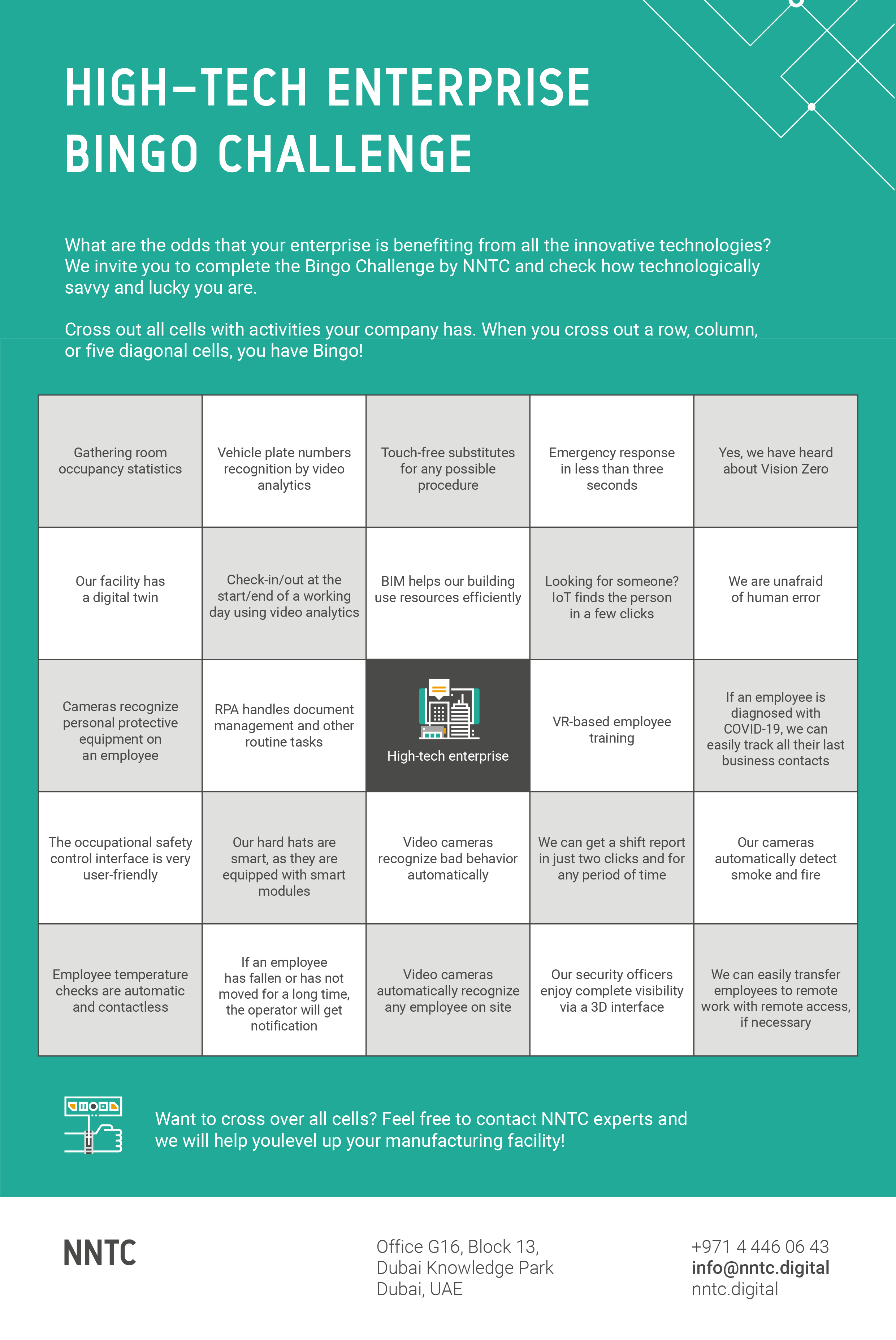
What are the odds that your enterprise is benefiting from all the innovative technologies? We invite you to complete the Bingo Challenge by NNTC and check how technologically savvy and lucky you are.
RULES: Cross out all cells with activities your company has. When you cross out a row, column, or five diagonal cells, you have Bingo!
You can download this high-tech enterprise bingo challenge in full resolution and share it with your colleagues!
We have recently accepted the idea of omnipresent AI adoption, but new changes and technology reshaping are already on the doorstep. Have you heard of the Responsible AI concept? Let’s take a closer look at it, since it will soon become a mandatory tool to build business relationships.
Article by Dmitry Doshaniy, NNTC General Manager LinkedIn | Mail
Proofs of Concept are in trend now
Enterprises usually struggle to develop AI pilots into production. Unfortunately, many solutions, when facing approval and development obstacles, never overgrow the “Proof of Concept” stage. You might encounter such a situation too. Being concerned about disruptive effect of innovations, most businesses just try them out in a few cases and do not go further. Thus, robots are trusted to make the first lead touch only, with all other steps being usually assigned to a human being. This is why such robots are not expected to do more than read, write, speak, and copy/paste.
In such circumstances, the value and business potential of AI cannot be unveiled and win the so much needed customer confidence. Meanwhile, AI-based solutions can completely change the approach to working, training employees, ensuring people safety, as well as dramatically speed up business processes. So where is the problem?
AI communication problems
The first communication problem arises between participants of the solution implementation process. Unfortunately, product developers and customers speak different languages and often focus on different features of the proposed solution. Due to such misaligned visions of AI and its potential, the technology capabilities are underutilized.
The second communication problem arises when a customer interacts with the final product and perceives it as something hostile or suspicious due to a lack of information about its benefits and functions. Let’s consider recruiting robots. HR people are more concerned about their jobs and afraid of robotic automation possibly causing lockouts rather than interested in studying the solution capabilities.
How does the AI Responsible approach solve them?
It is simple. This approach assumes transparent unified communication with many target groups, and can be used by both AI-powered product developers and employees who are responsible for implementing artificial intelligence solutions in their companies.
AI-based decisions need to be explainable in order to be trusted. According to a recent PwC survey, 84% of CEOs agree with this statement. As well as buyers. Consumers want the convenience of services tailored to their needs, together with the peace of mind knowing that companies are not unknowingly biased against them — and that their government will protect them with laws regulating how their data can be used. As we can see, being just useful is not enough. It’s important to get clear, and we at NNTC go this way with each of our products.
The “AI Responsible” formula has five key components to identify AI responsibility:
GOVERNANCE will introduce clarity to AI objectives and tasks within an organization. Before developing or implementing a solution, assign and document the responsibility of each process participant. Then, align AI with the current business strategy and identify processes that need to be optimized using AI. What result should we expect? How will it manifest? Who will monitor the effectiveness and document problem areas? Can you give guarantees that the solution will be effective?
ETHICS AND REGULATION. AI-powered solutions must be developed in accordance with the established legislation and regulations of the organization, which should be morally responsible and ethically defensible. Notifying of compliance with the established guidelines will build confidence in AI.
INTERPRETABILITY AND EXPLAINABILITY. Let the user understand why a particular AI reached a particular decision. Explanations should be tailored to the different stakeholders, including regulators, data scientists, business sponsors, and end consumers: never leave them uninformed making your product into a mysterious black box for them.
ROBUSTNESS AND SECURITY. Eliminate all possible risks and flaws in your product, and timely release necessary updates and patches. Tell your customers what problems have been solved, quickly fix bugs, and listen to feedback.
BIAS AND FAIRNESS. Fight against discrimination and train your AI to perform its functions fairly and equitably.
Only those who are responsible will survive
The ability to develop AI responsibility is a cornerstone of its further development and recognition. In a world filled with a variety of solutions from styling photos like watercolor paintings to recognizing car license plates, the advantage will belong to a reasonable developer who explains algorithms and is ready for a dialog with users.
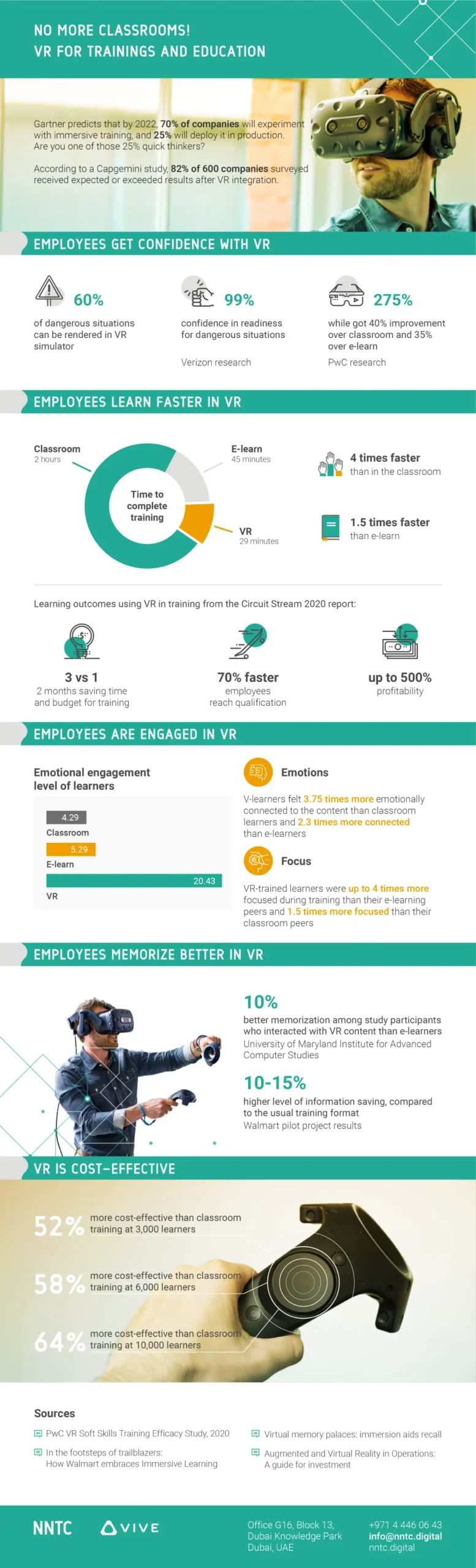
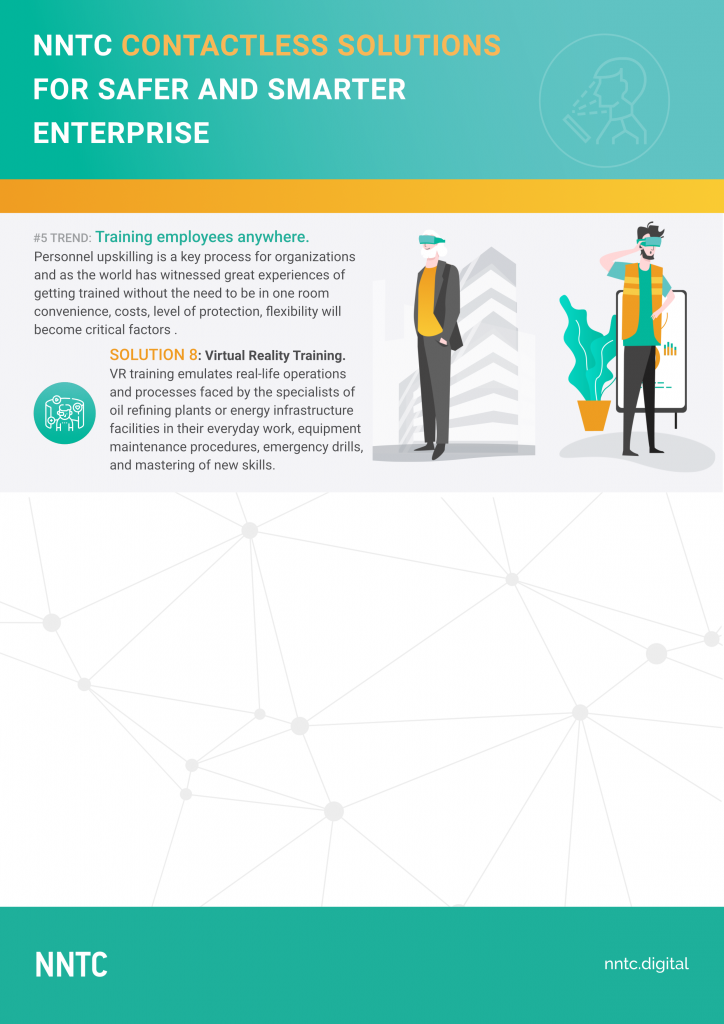
Gartner predicts that by 2022, 70% of companies will experiment with immersive training, and 25% will deploy it in production. Are you one of those 25% quick thinkers?
You can also download a full-resolution version of this infographic in PDF format:
In this year’s Global Consumer Insights Survey PwC polled city dwellers on their purchasing behavior in two separate studies, one before and one after the coronavirus outbreak. The survey resulted in certain insights that demonstrate new buying habits to emerge. How technologies can help save customers after COVID-19?
The COVID-19 situation has deeply affected urban consumers’ views on spending.
Before the outbreak, consumer confidence was sky-high. Almost half (46%) of PwC’s survey respondents said they expected to spend more in the next 12 months. After the outbreak had begun, the percentage of those who said they were going to spend less in the next few months almost doubled. The number who said they were going to spend more dropped by more than 10 percentage points.
Even in locations where lockdowns have been partially lifted, urban consumers are making fewer shopping trips, consuming more at-home entertainment. For consumers to feel confident enough to return to physical interactions with retailers, the first thing they need is solid assurance that places of business have a plan to make their customer experience as safe as possible.
Customer behavior after the Pandemic
COVID-19 outbreak reinforced the already growing trend of online shopping. People explore different ways to access products and services.
86% of polled consumers are likely to continue to shop online/by phone when social distancing measures will be removed.
This trend shows a high popularity in the Middle East: 58% of customers after COVID-19 said they’ve started shopping more on mobile phones.
The survey data demonstrates emerging behavior patterns and new consumer preferences. We’re facing the importance of developing new ways to reach out to customers after COVID-19, and not taking them on a merry-go-round of hectic ads and irrelevant content. That’s why transactions deserve better security, especially those related to banking apps and online shopping. Wire payments grow in number (53% of respondents used mobile phones to make payments, and 90% are going to keep it this way).
Win customers with biometrics-based apps
Biometrics facilitates onboarding, helping app users to become your clients. We launched a biometric onboarding module for a mobile wallet app in Oman, leveraging video analytics to help people benefit from financial services without visiting a branch office. The app is a mobile wallet, where you can add a card issued by any bank and perform all necessary financial transactions. It is available to the general public in official app stores. Bank receives information about the interests and preferences of users to make special offers. It helps to convert app users into bank clients.
Reinforcing online operations protection
Hackers are skillful in capturing security codes from SMS or PUSH notifications. Digital signature for smartphones can really save the day if your clients prefer paying online. The private key can’t be captured by any hacker because it’s generated in the user’s smartphone and safely encrypted. According to PayConfirm, they provide client-server software for transaction confirmation that suits any digital channel. It includes online/mobile banking, one-time passwords, and works online and offline (even in airplane mode). This solution can prevent phishing, social engineering, data switching, and SIM-module switching attacks, which gained momentum during COVID-19.
Less shopping time with video analytics
Video analytics can be of use in creating personalized offers targeted at a specific audience.
Previously, customized points of sale (POS) used to recognize customers at the entrance and generate specially-for-you offers. This technology evolved during COVID-19. Now consumers can place an order in a personal account or set a rule for a particular POS. With this feature, visitors can automatically get a preferred type of coffee entering a cafe or pick a packaged order without excessive human contact. Video analytics will even recognize a customer wearing a medical mask.
Amazon has been working on biometric identification for a long time to enable face-initiated payments. Visitors take products they need and leave the store. Cameras recognize the products and the shopper to automatically charge their bank card. Shopping takes less time and involves fewer encounters – even eliminating contacts with salesmen – meanwhile ensuring a safe customer experience.
Temperature checks
In addition to facial recognition, a POS can be equipped with a temperature measuring tool and improve overall safety, retaining customers after COVID-19. One sick person at work can stop activities of an entire shopping mall or office and quarantine hundreds of people. We have developed a compact contactless solution for the timely detection of visitors with fever. It combines the thermal scanner functionality and face recognition accuracy. The scanner – a thin screen with a built-in camera – is installed at the entrance to scan visitors’ faces. It identifies them (successfully, if a visitor is in a customer’s database) and checks their temperature with up to 0.2-degree accuracy. If a person with high temperature enters a building, security personnel immediately gets notification.
The research and assessment of the pandemic impact on the world are still under way, revealing new interesting changes extending to every aspect of our everyday lives. The business faces a real challenge to respond to these changes as soon as possible by listening to consumers and meeting their new expectations of comfort, security, and service.
“You have to think like an oil spill to trace one”. But we do it using a down-to-earth and physics-based approach instead for oil spill detection. Article by Pavel Tatarintsev, NNTC R&D Head.
Oil spills – a global issue
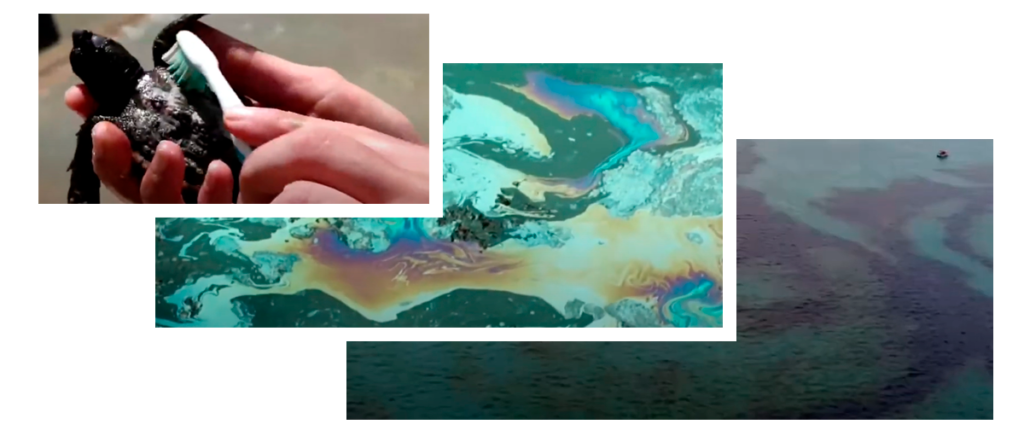
Oil spills are a problem that affects the global community. Statistics show that the total volume of oil lost to the environment recorded in 2019 only was approximately 1,000 tons. According to ITOPF research, in the period 1970 to 2019, 50% of large spills occurred while the vessels were underway in open water; allisions, collisions, and groundings account for 58% of the causes of these spills. These same causes account for an even higher percentage of spills (99%) when the vessels were underway in inland or restricted waters. A number of the incidents, despite their large size, necessitated little or no response as the oil has spilled some distance offshore and did not impact coastlines.
Fortunately, the number of large spills (>700 tons) has decreased significantly over the last few decades. Innovative technologies made an important contribution to oil spill management and accelerated response procedures to prevent ecology impact. Today’s post is dedicated to polarization, an innovation that helps trace and clean up oil leaks. All science needs is a little magic, and Pyxis solution just happens to have some.
Polarization in a nutshell
Taking light as a form of an electromagnetic wave, we can distinguish electric and magnetic fields there. Before polarization, we have unpolarized light emitted, for example, by the sun or a lamp.
Polarization means removing any electromagnetic waves from the beam, except for those being in a certain plane of polarization.
You don’t need smoke and mirrors to polarize a light wave. A polaroid filter will do. Moreover, you can see polarized light in your everyday life, when you wear glare-reducing sunglasses or use polaroid filters in cameras, for example. Actually, using these filters is the only way of taking a photo of any museum painting or exhibit protected by glass.
Now let’s trace some oil
Various methods are used to detect oil spills.
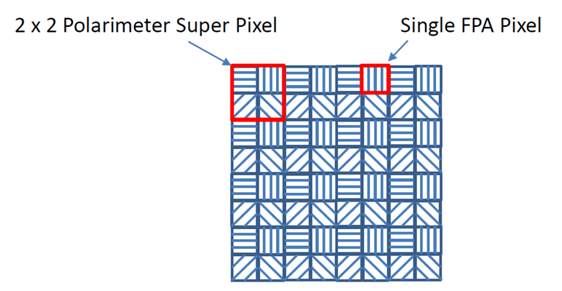
An ordinary camera. Unfortunately, it is sensitive only to a single FPA pixel. This is the most inconvenient and least accurate method. It is difficult to see a spill in the rolling sea because of oil movement, sun glares, and transparency of other liquids.
A thermal imaging camera can show temperature difference between an oil spill and water. Thermal imagers are capable of detecting rather thick oil spills. However, they fail if both liquids have the same temperature. On a good day, you can respond with a speed of light – OK, under 15-20 minutes – otherwise, the temperatures will even out.
A polarization camera. The only camera that has an eye for any chemical compounds on the water surface. Polarized light varies depending on the surface material reflecting it, especially when it comes to oil and diesel leaks.
A polarization camera uses polarization-sensitive 2×2 super pixels to filter out all glares and identify the angle of polarization.
Light reflected from oil and water has different polarization angles. Gotcha! Now you see it. Special software can build both thermal and polarization images, as well as combined eTherm enhanced image.
The advantage of the solution is that it works day and night, in waves and calm water. It sees not only crude oil, but also refind oils.
Below you can see how these pictures look in real life. Thermal imaging combined with polarization shows the exact shape and location of an oil spill. It’s like playing hide-and-seek in the dark, but with a night-vision device.
Use cases for oil spill detection
Let’s talk about how we can use polarization to prevent oil spills.
Oil platforms can install polarization cameras to monitor the drilling process and oil leaks
Desalination plants can use polarization to prevent oil or other contaminants from flowing inside along with seawater and avoid engine damage
When loading docked tankers
When cleaning up spilled oil
Camera-equipped drones can patrol oil tankers whereabouts and monitor aquatic ecology
Innovative technologies are like a magic wand we use to make all environmental disasters disappear. If you believe that this oil and diesel spill detection solution will make your business safer, reduce environmental risks, and improve the quality of life in your region, please feel free to contact our experts at info@nntc.digital.
Slicing through waves a jumbo ship is moving ahead full sail to the dock. People can’t take the eyes off of the ship waiting for the next captain’s move with bated breath. Is he a newbie? Did something go wrong? Are we looking at the reason for today’s overtime? Anyway, the overspeeding ship starts to turn clumsily ignoring port operator’s radio distorted screams and shouts, as inertia steers the ship and a big wave pounds on the mooring — kaboom! The ship kisses the concrete shore. The next thing you see is a loading metal crane gently hugging the ship.
All this could have been avoided, should a system similar to car parking sensors alerting the driver about obstacles – curb or garage walls – be installed on vessels to do the same job for the skipper. A video recorder would be useful for documenting all events as well, if scaled proportionally, of course, to the size of large ships and moorings. In fact, all ships have such equipment to video ships approaching the shore and mooring, but this is barely enough. What we really need here is the next level mooring assistant familiar with all marine peculiarities, since natural forces influence sea travel and mooring greatly, unlike ordinary parking.
The ship always hits the mooring. It is just possible that the mooring perfectly maintains and serves ten ships in a row, but can’t survive the eleventh and falls apart, thus triggering a series of unfortunate events and causing port to lose money.
Firstly, a mooring costs a lot. If pipes, port facilities, and loading cranes are damaged in an accident, costs grow proportionally.
Secondly, every ship is on a tight schedule, so it has a narrow window for docking – 30 hours, for example. If a port manages to maintain and serve a ship within the deadline or earlier (25 hours, for example), it receives a bonus from a shipowner. Delays may occur as well, which means that the port owes a penalty. A broken mooring causes a sea of changes in the port’s schedule, and service delays become inevitable.
Thirdly, the port has to prove to the insurance company that it is not guilty of messing everything up. How to prove it? Captains do not feel like providing records from their ship systems. In a worst-case scenario, the port loses more money paying for the damage.
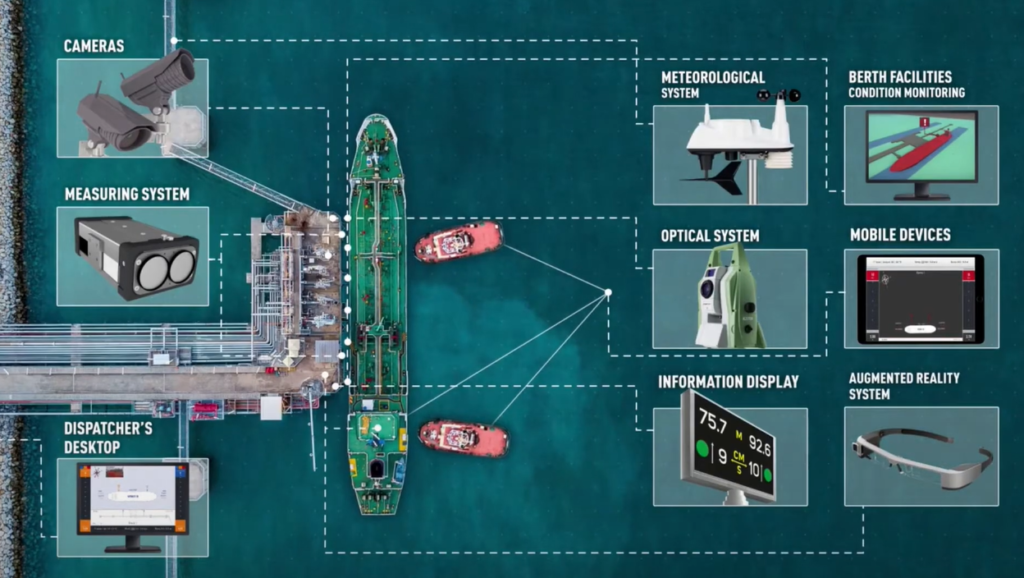
Thus appeared MOORiNET, a solution for vessel mooring and berthing designed to prevent any massive accidents involving ports or moored ships. MOORiNET system warns about undesirable ship movement and possible collisions to prevent ship or dock damage, oil hose or loading arms breaking, spread of hazardous and noxious substances. Remember those car parking sensors? MOORiNET is its big brother: a marine garage-scale mooring sensor keeping it safe from crazy skippers. How do you like that, Elon Musk?
Port control over vessel maneuvers
MOORiNET monitors where and how the ship is going and helps it to dock safely. The sensors detect various weather conditions and transmit the data to the port operator who supervises mooring rules. Weather sensors measure wind, wave, and visibility. A meteorological station monitors the outside temperature, atmospheric pressure, and the sea surface height. When a ship approaches, laser rangefinders and surveillance cameras automatically start monitoring the bow and stern using machine vision. The ship is captured from 300 meters, and the closer the ship gets, the more accurate the data are. The berth has a system that measures the impact during the mooring.
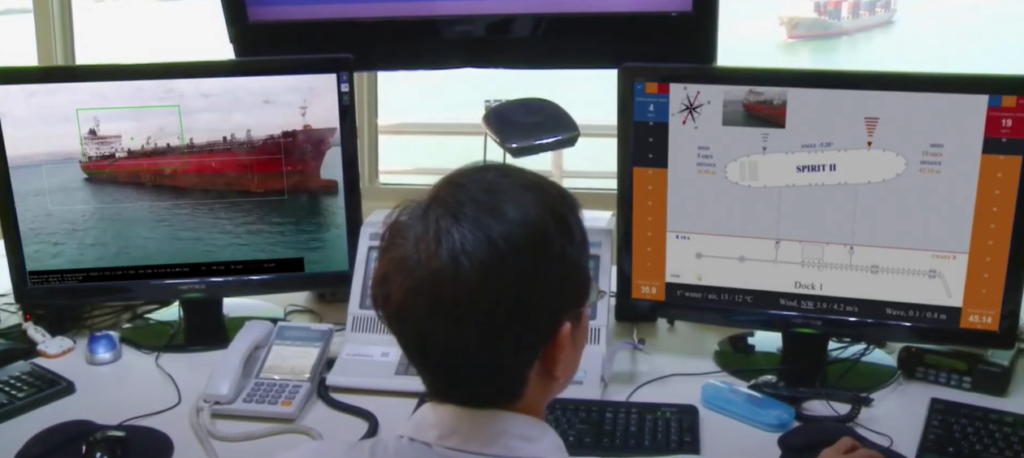
Therefore, an operator enjoys full port visibility. The ship’s speed is monitored as well in real time and displayed at the operator’s dashboard. Each vessel is highlighted with a color representing speed safety level range. In the case of any violations, the operator proactively warns the ship to take the situation under control. Should an accident happen, all sensor data records will be available to help investigate, whether a huge wave caused an accident or if the ship was violating mooring rules and overspeeding.
Loading accidents
There is a rule, and the rule says: Once the ship docks, the port is responsible for whatever happens to it then. Now, picture this: a moored ship is being loaded with oil. The vessel gets heavier with each new ton, and all this pressure goes down on the mooring… To keep the mooring from being depressed, load binders are used. These are automatically controlled metal devices to tighten chains holding the ship’s bow and stern fixed. Many ports shut them off, as they can loosen or tighten the ship too much. Usually, somebody controls load binders using nothing but natural intuition and experience. Sadly, either human errors caused accidents or the perfect storm occurred with all its wind, fog, sand in the face, the sun hurting the eyes, and heavy snowing in the northern countries. Chains break apart, the oil hose follows, and the hazardous chemical spills on the sea surface. Here is when oil spill detection solutions come in handy.
MOORiNET can be integrated with a load binders system. The algorithm uses video analytics and laser rangefinders to detect a slightest movement of the ship and automatically alert a person responsible, so that this person either loosens or tightens the chain. The same applies to the oil supply system.
Harbor pilot helper
There is a MOORiNET version designed specifically for harbor pilots. An Android app gives a pilot all necessary information such as the speed at the ship’s bow and stern and the weather. The app connects to the ship’s system via a connector and synchronizes data with the MOORiNET at the mooring, thus providing the port and the ship with consistent information for better safety.
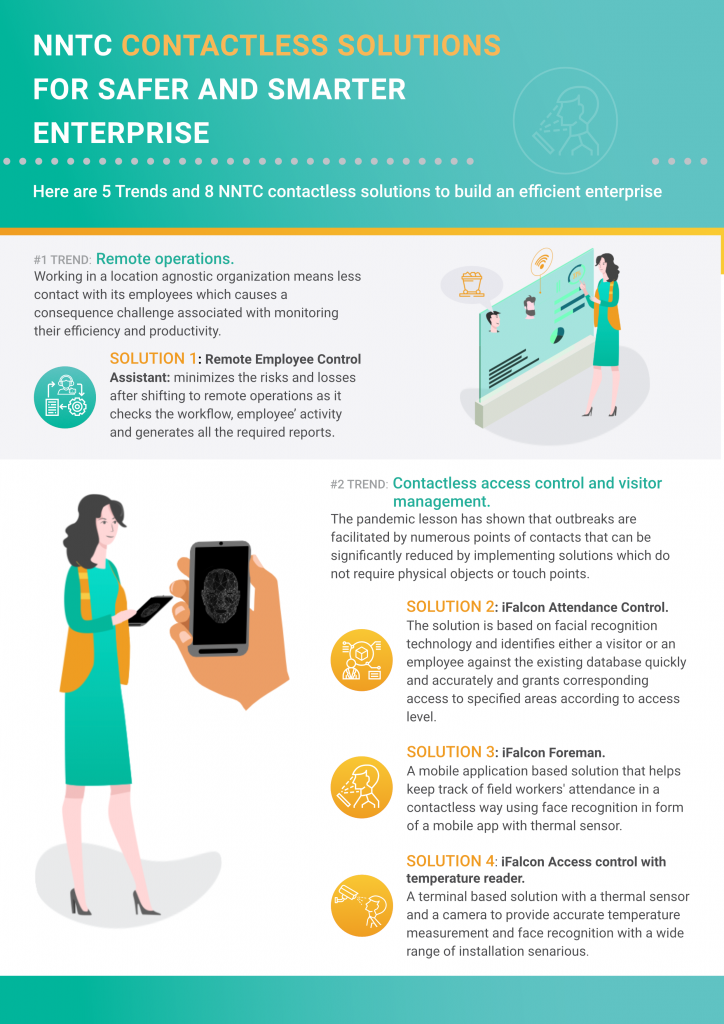
As the world is exiting the global pandemic crisis, technology providers have managed to demonstrate that the right solution is what it takes to work efficiently in a geo agnostic world. As much as a crisis-driven shift it has been, it accelerated most of the organizations to promptly adopt advantages of digitization.
The obvious success of remote working operations in many cases shows that this trend, as well as a few other technologies, can prevent potential virus outbreaks and build safer and smarter enterprises. For sure, it is expected to become a new normal in the post-pandemic world.
On April 29th our experts presented recent developments that help to minimize the current risks for the organization and its employees.
Timestamps:
01:55 – 21:22 – IoT-based contact tracing for labor-intensive industries 21:37 – 36:00 – Access control solution with face recognition and thermal sensors 36:15 – 49:15 – Contactless field worker attendance with a mobile app 49:27 – 01:03:26 – Time control and data leak prevention for office employees
Drones are modestly sized unmanned aerial vehicles making headline news and buzzing around. They are featured in spy action movies and video games playing the role of enemy technology or helping a protagonist to outplay enemies. Either way, this stunning fictional representation lures our minds into a trap of “the drone illusion”. To pierce this veil, let’s take a look from the engineering perspective.
Engineering considers aerodynamic efficiency of a drone design and numerous factors, including the laws of nature equally applying to everyone and everything.
We need a vehicle perfectly performing functional tasks, which, in our case, takes off at once, hovers steadily, and transports cargo over long distances. We need…a helicopter. During the last 50-60 years, the appearance of all helicopters remains virtually the same, in general, there are two main aerodynamic designs. Why so? Helicopter is the proven golden standard in fuel efficiency, agility, and effective load-carrying capability. Coaxial rotor helicopters, for instance, are the most fuel-efficient. (Coaxial rotors are a pair of helicopter rotors mounted one above the other, with the same axis, but rotating in opposite directions). Such a sophisticated machine design requires not one, not a dozen, but a huge task force that includes specialists highly qualified for the job.
As for drones, they are compact, lightweight, and easy to assemble – you don’t need an engineer’s degree to make such a flying device for yourself. And let’s make it clear: all drones are aerial vehicles, but not every drone is created by professional engineers specializing in aerodynamics. The industry has a few companies engaged seriously with drone designing. Though there are many young talents bubbling with enthusiasm to write an excellent code and solve challenges and, of course, impatient to field-test it. Sometimes, a team intentionally sacrifices aerodynamic efficiency in favor of easier and faster development. However, even if they installed a software masterpiece on such a drone, its power would still be limited by design. Plenty of original ideas remain untranslated into reality without a professional engineer in a team.
Drones come in a great number of shapes and sizes, but the majority has two weaknesses:
Low energy efficiency, as compared to helicopters, which limits both the flight time and load carrying capability
Poor flexibility and balance, as compared to the bigger brother
When it comes to business tasks, people start talking about drones and fall into the trap of their own illusions about drones. It goes like this: “We want you to develop for us a drone that can…blah-blah-blah”. Is it really a good way to solve a business problem?
Let me tell you one story about agricultural business. Thirty or so years ago, small helicopters were actively used to spray the fields. Since then, their market share has been slashed, while drones’ share has increased. Back to the business task: transportation of chemicals to spray the fields. To be more or less effective, a drone has to be capable of spraying 15-20 liters per flight. Before drones, the market supplied radio-controlled helicopters carrying 15-30 liters of chemicals, thus significantly dropping the cost of treating one hectare, as compared to conventional methods. Today, an agricultural drone – a bulky and barely transportable vehicle worth of $25,000 to 30,000 USD – can carry some 15-16 liters of liquid. Just compare: a modern helicopter with the same load carrying capacity costs $10,000 USD, but it flies faster and more flexibly, and its battery works longer. Moreover, it is easy to transport – you can fold the rotors and put its body in a car trunk. This is the trap of “the drone illusion”: helicopter costs less and works better, but drones grow in demand.
“The drone illusion” hurts the industry. In fact, the existing drone design simply can’t get better, as technology evolves evenly for all aerial vehicles. Should the drone battery improve, the helicopter’s will improve too. Thus, the developers with more experienced in-house engineers will have a competitive edge.
How to avoid “the drone illusion” trap? Actually, it’s easy. Drones can effectively solve certain tasks. Take logics to a new level: don’t try to adapt drones. Start searching for the right flying vehicle and consult with an engineer. This will help you save money, avoid hassle, and expand the technological capacity. Discover the richness of technology of the 21st century.
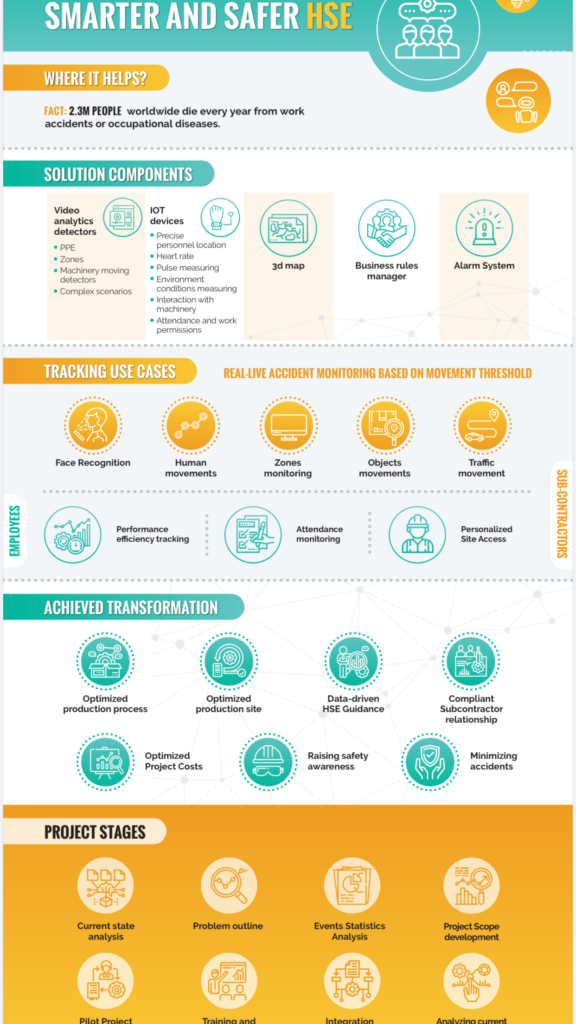
Everyone at work is entitled to be provided with an environment where risks of health and safety are professionally controlled. Employers carry primary responsibility for safe and accident-free working sites.
What are the key factors that have a direct impact on the number of accidents, people’s injuries, incurring unplanned costs and breaching projects’ timelines?
This list comprises but not limited to:
Processes inefficiency
Lack of visibility of specific areas in the processes and working sites
Human factors
Inefficiency in security and safety guidelines
Employees performance
NNTC’s Digital Worker is an IoT and video analytics-based platform that addresses these critical factors providing all required insights and allows to build a fully efficient, accident free industrial or construction site as well as eliminates breaches of projects’ scopes and timelines.