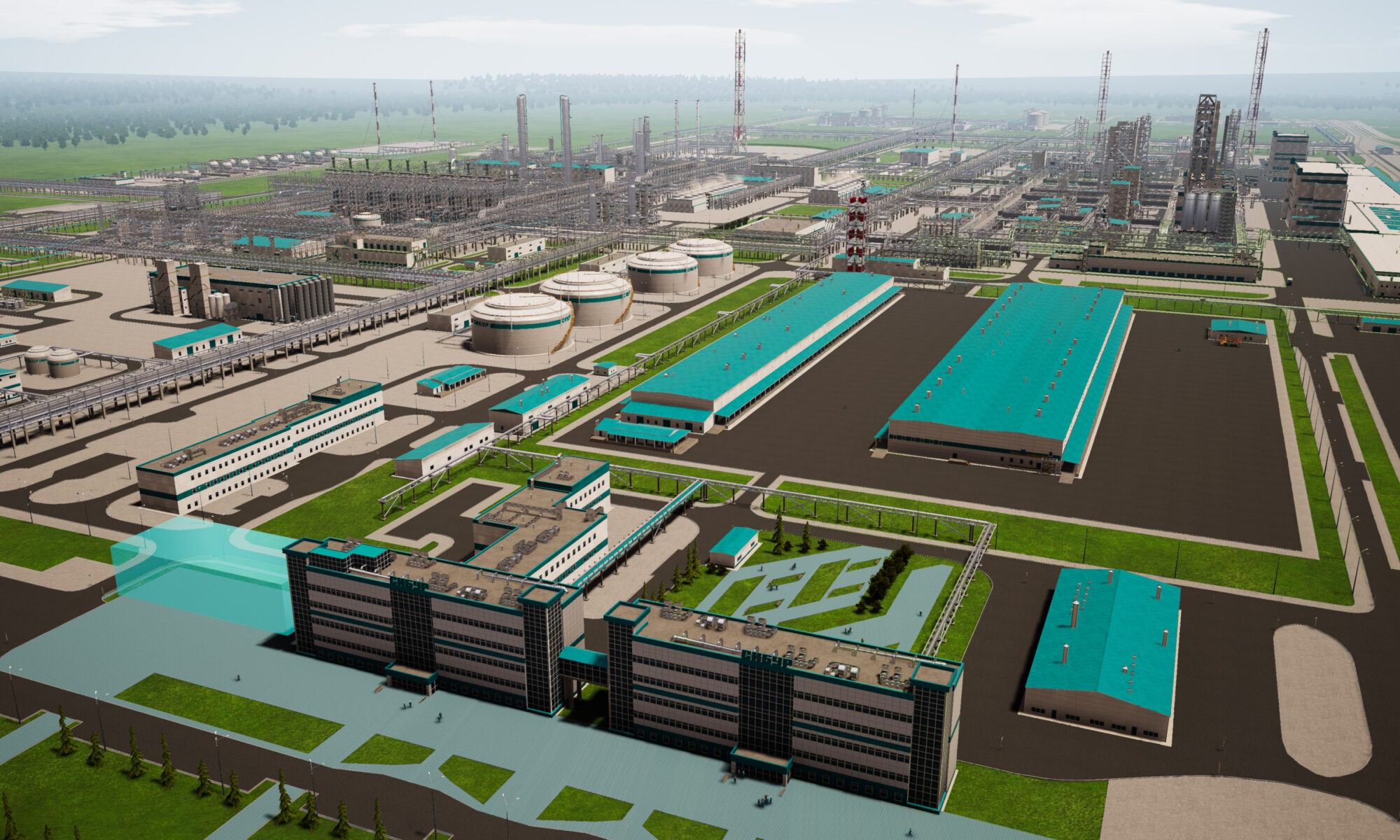
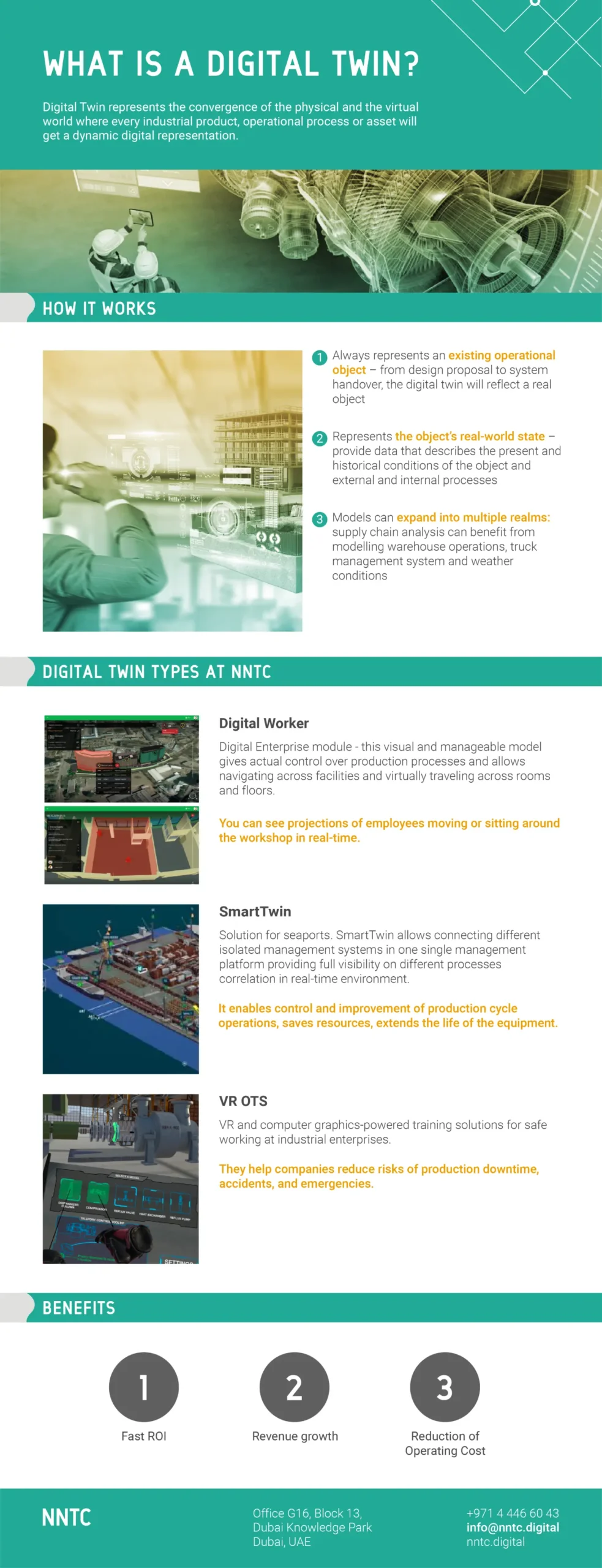
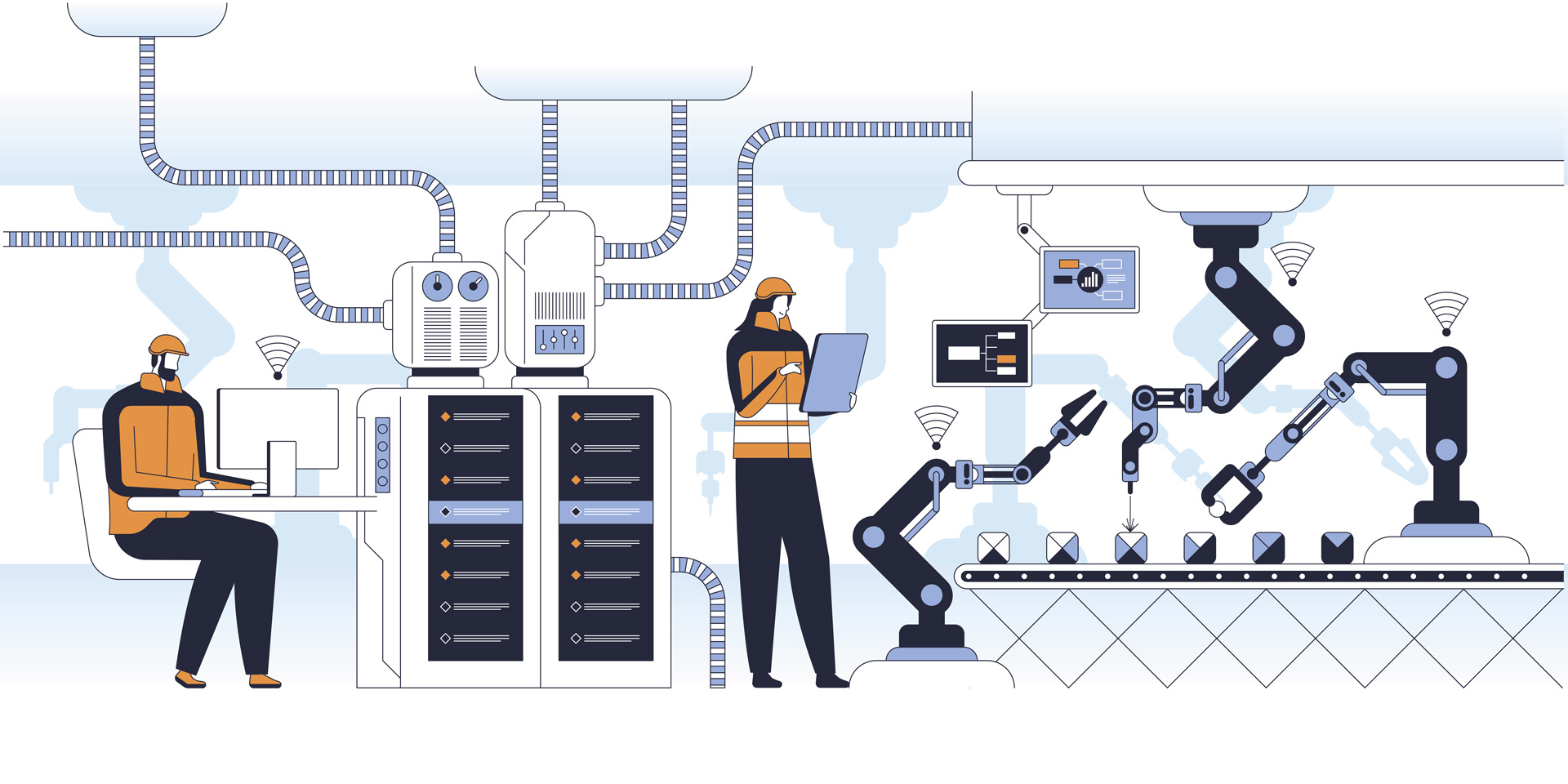
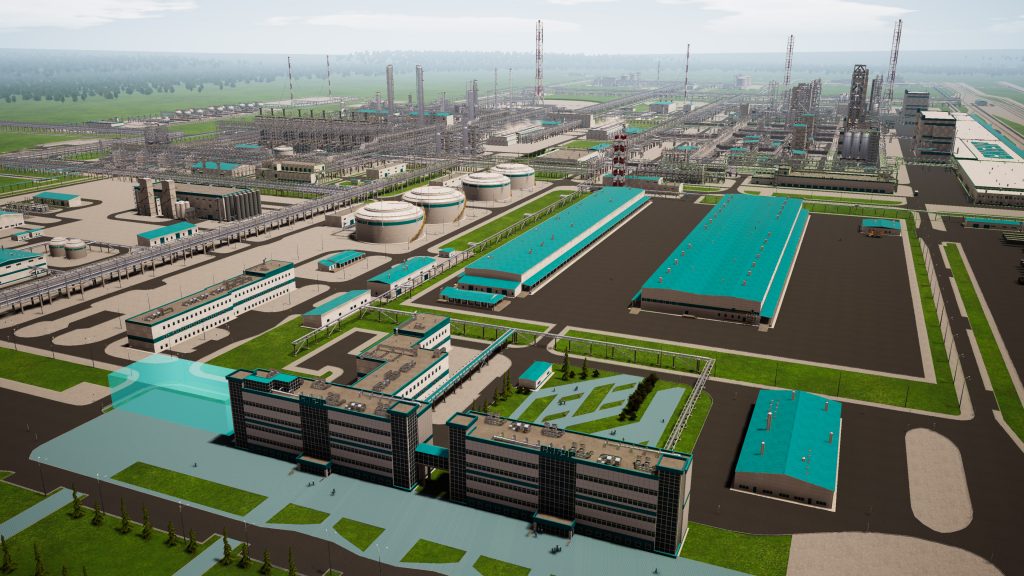
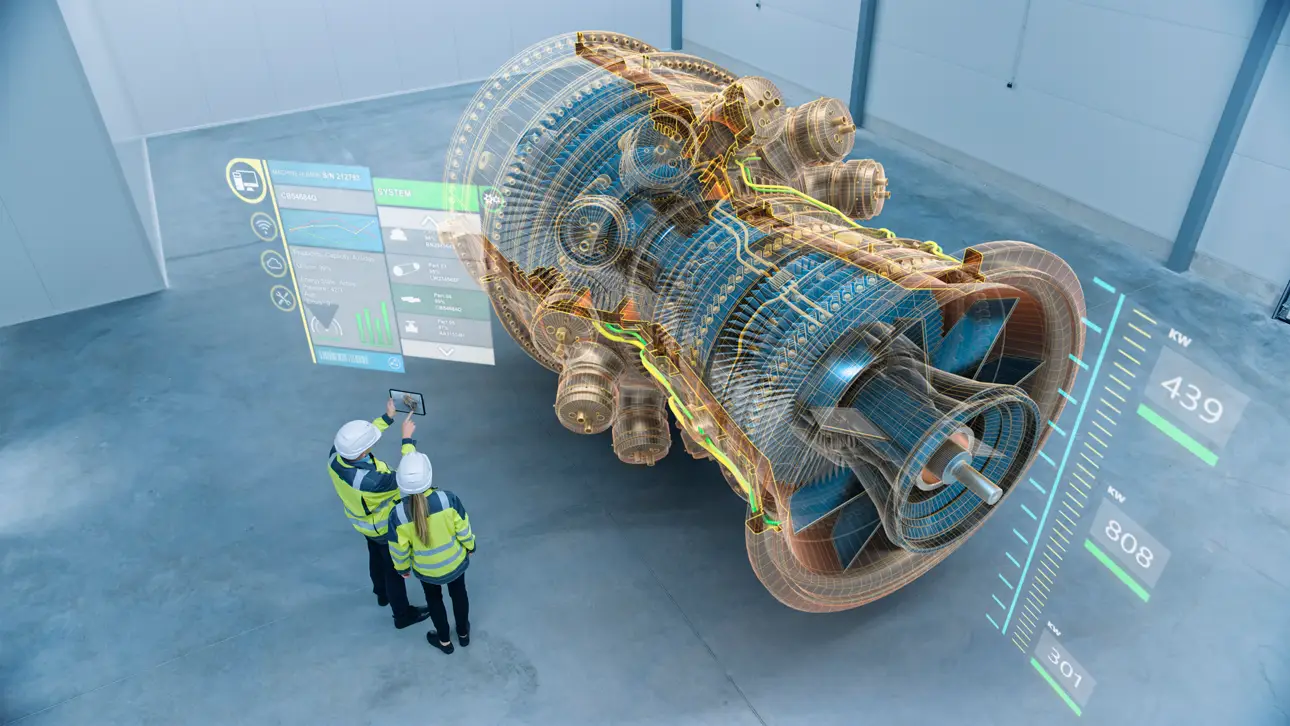
Digital Twin is one of the most exciting business optimization solutions. An exact copy of any building or territory is a set of data, which can be analyzed in real-time. Business processes can be predicted with this solution: from equipment depreciation to the production cycle operations. Read more in our today’s infographic.
See the best combination of cost of operations\min number of cranes or trucks\min required time
Digital Twin improves the efficiency of operations
Predicting work completion time, operating hours, downtime
Forecasting the machinery utilization, which allows the most efficient movements without queues
Assessment of the influence of factors on the machinery downtime, number of accidents, optimal routes, movements of railway/auto trains, distribution of works between cranes
Reducing cost for the equipment maintenance
Increasing business transparency and manageability
“The UAE Cabinet has announced a decision to allow use of facial recognition in certain sectors”, and this is big news for technology locally and globally. Where do we go and what’s coming? Dmitry Doshaniy, NNTC General Manager, shares his predictions and perspective on this exciting news in an interview below.
Article by Dmitry Doshaniy, NNTC General Manager LinkedIn | Mail
It’s 2021 when the UAE has approved facial recognition. Why now?
Many government and private organizations have more or less got started adopting facial recognition for security reasons or routine operations. Individual users of certain devices or services know this technology well, for example, for unlocking most of iPhones. Many banks are introducing biometric authentication to improve both client experience and transactions security.
Facial recognition has become global, so one more app or solution on the market doesn’t impress anybody. The market has matured and is now ready to adopt this technology and create more space for it at the state level. Facial recognition has proven to be a reliable and practical tool that is now starting to move into the mainstream.
Another explanation for such a decision is, I think, the fact that both business and public services still have to be provided remotely. COVID-19 is a compelling reason for governments to work harder towards less crowded places and better public health situation. Of course, some procedures are available online, but many services require authentication due to personal data security matters.
How can one know that a particular facial recognition offering on the UAE market is mature?
There is a bunch of tests showing strong performance of the latest algorithms with up to 99.97% facial recognition accuracy. False recognition is next to impossible if an image of a person is of normal quality. There can be some trouble if comparing photos of one person at different ages (for example, with a ten-year gap between them), but it is not critical as well. Anyway, facial recognition outperforms an average desk clerk. This means that video analytics puts an end to scammers successfully faking their identity to get a loan and lying to clueless clerks how not having much sleep last night makes them look wildly different from the photo. Imagine a scammer trying to play that trick with a video camera – hilarious!
The Internet used to have a bad reputation for massive account hacks and identity theft in the past. Is it possible that future hackers will somehow lay their hands on facial recognition data to make a plastic surgery and break into all user accounts?
Facial recognition systems do not store any information that can be used for plastic surgery or making a realistic 3D-printed mask. In most cases, flat images or photos are processed into a number format, and the underlying algorithm doesn’t allow reconstruction of the source 2D image. The information conversion process is tricky. Just as you can’t use hashes to reverse engineer the hashed source data, a numeric form of a recognized face in a database is incomprehensible – you can’t even guess the appearance.
Suppose, someone manages to steal a facial recognition database, but translating and exploiting the content is impossible. You can’t come up to a stranger, take a picture and stay unnoticed, and then make a super-realistic mask out of that photo. Moreover, your identity is secured by your biometric data – voice, fingerprint, and eye retina; scammers have zero chance of success. The best practice is to use several identity indicators in a biometric authentication system. Diversity makes a perfect security system.
In your opinion, how long will the implementation of facial recognition take at the state level in the UAE?
This reminds me of a joke, that goes like: “Who is the driver of your digital transformation: CEO, CIO or COVID-19?” Some parts of human life have experienced change that could have been extended over decades, but instead it either happened in months or is planned to happen in the next year or two. Everything related to remote work, services, and authentication will be implemented really fast.
We witness some global experience already as other countries are working on legal framework to deploy and regulate facial recognition and video analytics. This experience can be adopted and customized locally. Face-initiated payments, travel by public transport, and overall routine surveillance are an everyday practice in China. Integration like this brings great benefits to citizens and the state by improving people’s safety and comfort.
People usually prescribe a number of gloomy properties to face recognition, including recalling “Big Brother”. However, many countries have developed regulations to control facial recognition use, and this experience can be enriched and adopted. I’m 100% sure, that the UAE has the brightest future using this wonderful technology.
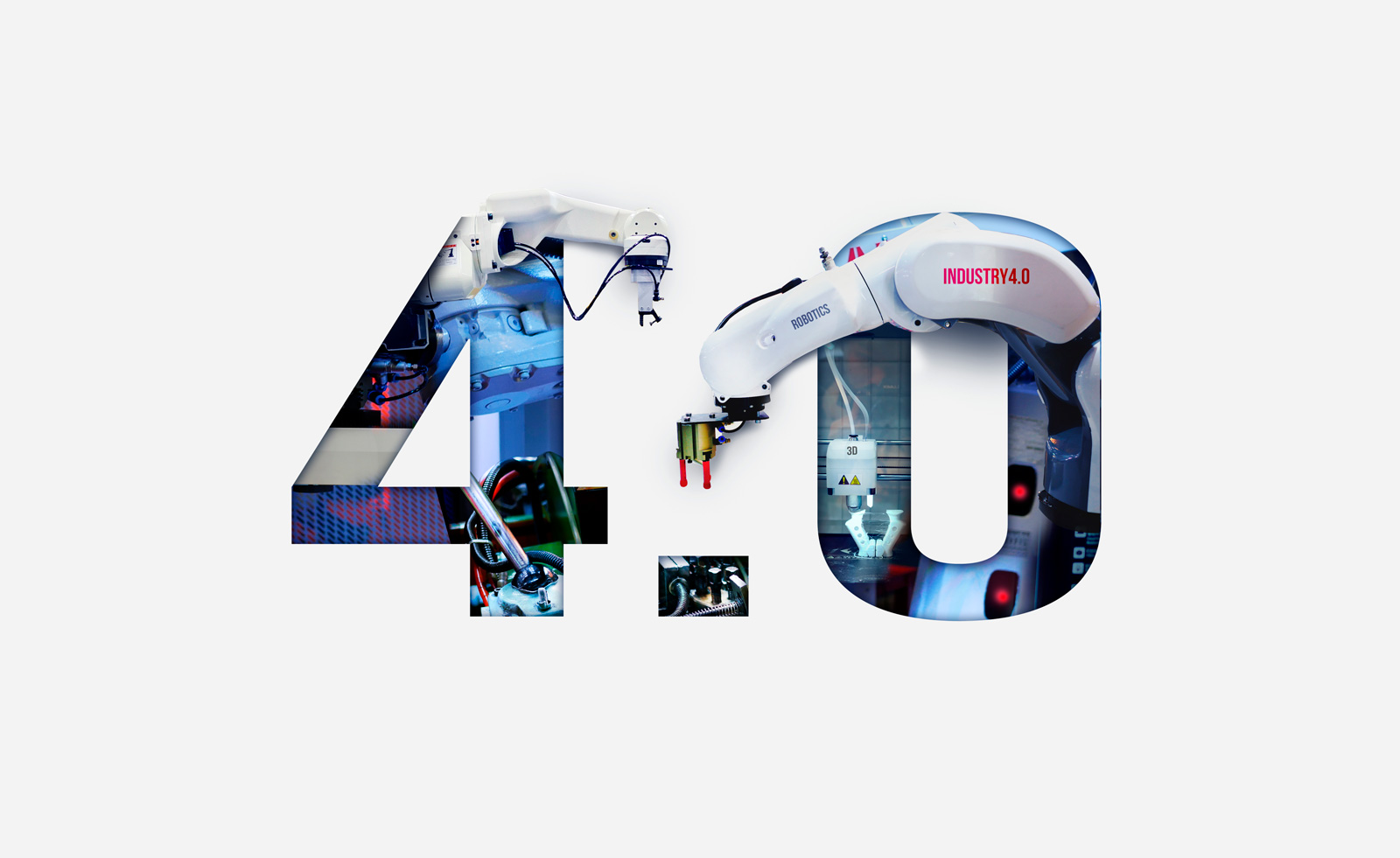
The majority of business leaders (63%) surveyed by PwC claimed that technologies of the Fourth Industrial Revolution (4IR) provide protection against an economic downturn. But how to find your way around this strange and seemingly unmanageable concept? Be brave, and I’ll show you a way in this blog!
What is 4IR?
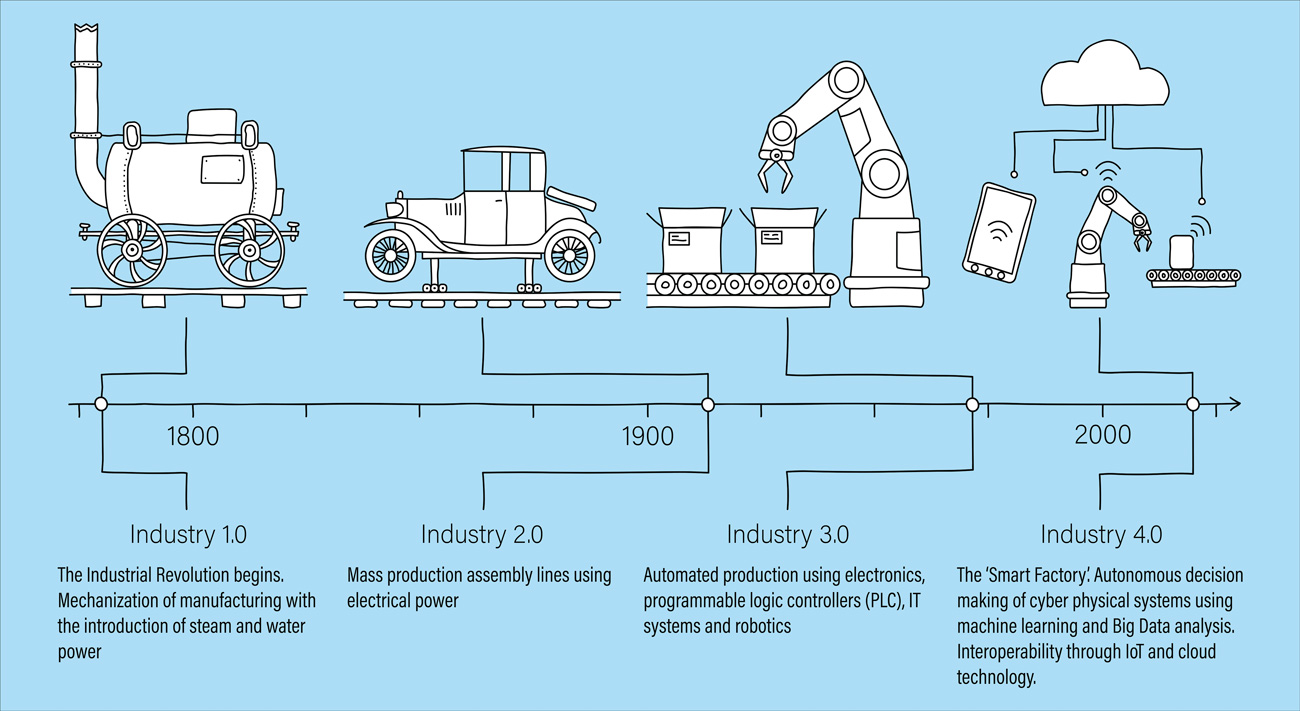
4IR became a hot topic a few years back when the world realized how technologies impact everyday life and innovations skyrocketed, giving an optimistic view of the future coexistence of humans and machines.
The Fourth Industrial Revolution is building on the Third, the digital revolution that has been occurring since the middle of the last century. It is characterized by a fusion of technologies that is blurring the lines between the physical, digital, and biological spheres.
said Klaus Schwab, Founder and Executive Chairman, World Economic Forum.
The main idea is that technologies do not replace, but rather gradually complement, humans, becoming a new “tool” in the hands of business. At the moment, businesses need to prepare for 4IR to survive amid the post-pandemic crisis. What’s more, companies that can keep up with the times and gain necessary skills in advance will win the race by leveraging the new tools.
4IR for business survival
Companies successfully deploying 4IR technologies now may actually emerge as stronger competitors during a recovery, and will likely be better prepared for a potential economic downturn in the future. 4IR benefits are evident: increased productivity, efficiency and quality of processes, as well as better staff safety, data-driven decision-making, and increased competitiveness thanks to developing customized products.
According to a recent PwC survey of CFOs, while the COVID-19 crisis has led 70% of companies to cut back or defer planned investments, just 22% said their companies are curbing investments in digital transformation. What does digital transformation actually entail?
Digital transformation means preparing an organization for 4IR solutions and then systematically adopting them in the most optimal way to minimize business risks. In fact, it is an organization-specific process which should be supervised by digital transformation specialists. This very approach will help you harness and exploit 4IR.
Stages of digital transformation:
Technology digitalization. Create advanced digital infrastructures and RPA-based systems to collect data and control processes.
Production digitalization. This stage requires the creation of a digital platform to collect, store, and process data, use some analytics tools (machine learning, digital twins), and engage production planning and management systems using the same models and data from the digital platform.
Digital services and apps. They are created on top of the rest to improve efficiency and performance. Data analytics tools allow for prompt and, ideally, automatic adjustment of production and technological processes, thus eventually raising product quality, reducing its cost, and improving other parameters.
How to start adopting 4IR?
As I already mentioned, each organization goes its own way here; however, there is a standard 4IR checklist.
Process automation. Whether at manufacturing facilities or in the office, process automation is one of the key success factors on the path to 4IR adoption. Process automation may include: RPA-based filling out of documentation, automated Big Data collection for subsequent analysis, automation of routine processes and procedures using artificial intelligence, video analytics, and IoT.
Big Data. All business processes are based on analytics. Indeed, data analytics helps determine a business development vector, predict critical situations, and optimize processes. A full-fledged data collection is only possible when information comes from all business process participants, from the production to the sales office or store.
Vision Zero and concern for people. Another pillar of the 4IR approach is personnel safety and care. Manufacturing enterprises adopt Vision Zero, which significantly improves occupational safety. Thus, VR drills fully immerse personnel in any possible scenarios to train them in dealing with emergencies without any risk, while Digital Worker solutions warn in advance about on-site hazards. There are also solutions to ensure office personnel safety and comfort. For example, BIM tools help adjust environmental conditions in the office, while contactless solutions prevent the spread of infections.
Business optimization. As a rule, the transition to 4IR goes along with certain internal restructuring and business optimization, which is unavoidable after adopting better and more cost-effective solutions that free up specialists time. As a result, companies can spur strategic development and planning or strengthen previously understaffed business units.
Falling demand and COVID-19 restrictions challenged the world economy in 2020, with the oil and gas industry being no exception. Expectations from 2021 are divided and it’s a tie score, generally speaking, as the tables can turn overnight. With this in mind, leading global oil and gas companies rather enthusiastically invest in technologies enabling faster response to fluctuant market and geopolitical situation.
AI-based production
Don’t know where to look first? For starters, it is worth to consider AI- and ML-based solutions – decision-making accelerators and best response advisers. Relying on qualitative KPIs, instead of quantitative ones, you increase oil production efficiency and profitability. Making much headway, AI can support business on many sides: security, profitability, production compliance control; even oil extraction can go faster.
Among other things, you can integrate AI-based solutions into logistics operations, since this technology has learned to detect oil spills at night as good as in daylight, being able to catch the sight of oil slick’s thermal image and reflected polarized light.
Learn how polarization technology helps rapidly recognize and identify oil spills with outstanding accuracy
Technology boost with lower production costs
Production costs reduction is also firmly on the agenda of oil extraction. IT can help automate multiple business processes and efficiently support productive capacity uptime with minimum human involvement.
For example, solutions to run diagnostics and avoid expensive equipment downtime. Some technologies even reduce the time it takes to gather information on equipment health, such as digital twins or drone-based industrial inspections. Let’s take an inspection of a huge oil pipe as an example. To inspect this monster, you need to build scaffolding first. To accomplish that, you need to stop pipe’s work, erect scaffolding against it, and only then people will use it for two weeks looking for some defects: peeled paint, rust or a missing piece of the build. Each inspection engineer has to document every detail of the detected defect. However, using industrial inspection drones with special software and machine learning algorithms, you will reduce costs by 5-10 times, with only one person and one drone being needed to involve.
Digital Enterprise – VR Project
Or let’s take a look at the Digital Factory concept. It describes an enterprise that leverages IT in its every aspect: automated manufacturing, optimized business processes, services, and product promotion. The concept implies a single information environment turning hectic data from multiple sources into a structured data-driven representation of the enterprise. Decisions of a company like this are guided by complete and constantly updated information.
Oil & gas industry and remote work
The reality surprised the industry with transition of many non-production employees to remote work. However, this move helped develop communication networks and solutions for collaboration.
Remote work requires the automation of standard operational tasks. A corporate bot can perform hundreds of recurring and routine tasks instead of an employee, automating the execution of standard documents, certificate approval, etc. The bot is also a universal tool that can call 200 employees per minute and obtain any necessary information. Here is one of our case studies: in the morning, the bot collects staff work plans for a day or a week, and in the evening, it receives interesting insights or identifies why tasks were not completed. The voice bot collects and transcribes all information, then draws up a unified report and submits it to a manager, with a report summary also being sent to group chats in messengers. This way, managers always keep track of the events in their departments and monitor all tasks being performed, while saving personnel time otherwise spent on preparing routine reports.
Second example of such solution is a Remote Employees Control Assistant (RECA). It is an integrated system, which helps to ensure control over business processes, analyze staff activities, generate workflow reports and keep in touch with remote employees. It shows a detailed picture of each employee activities and prevents confidential information leaks.Gradual transformation of oil & gas production
Now is the most favorable time to benefit from investments in information technology. All it takes is a wise choice of implementation strategy and tactics, and relevant experts can help you make better choices to maximize the effect of your overall digital transformation.
Dmitry Doshaniy, NNTC General Manager, summarized 2020’s results and determined development strategy for the next year. What 2020 has taught us and what strategy to follow in 2021? In today’s blog, we will share the main insights from Dmitry’s interview.
Article by Dmitry Doshaniy, NNTC General Manager LinkedIn | Mail
2020’s online survival is 2021’s new normal
Online communication services, messengers, and platforms have won extra audience as a result of self-isolation and business events going online, which is the case for both B2C and B2B sectors. For example, we at NNTC also felt the need to enhance online communication with our audience. Thus, we held webinars for customers and partners, which was a great and rewarding experience for our team.
After 2020, it’s even easier for tech companies to sell online. If, for example, you sell software a customer doesn’t need to “touch and feel”, all you need to do is provide a demo version or deliver an online presentation, and then close the deal through Zoom. This was not possible before and has only recently turned into a common business practice, and we believe these changes also bring us business development opportunities. The fact that online business meetings have become a new normal can unlock new development opportunities and boost our geographic expansion.
Technology is a lifesaver – and 2020 has proved it
During the lockdown, society has become more technologically advanced. Even the most stagnant skeptics appreciated the importance of technology and learned how to use its benefits. This interest will continue after people return to the offices. We are happy with that, since NNTC sells its solutions to people who are not afraid of technology and strive to use it for good.
In addition, we will see growing investments in healthcare and infectious disease control solutions, both organizational and technological. Indeed, this year, Apple and Google have developed an API to track contacts with virus carriers. NNTC also already offers a solution for manufacturing and construction sites that detects social distancing violations and helps identify contacts with infected people, so that affected personnel can be promptly sent to quarantine and receive medical treatment. Indeed, technologies save people’s lives.
Make decisions wisely in 2021
2020 has been a good year to cultivate morale and find new ideas and approaches for business development. Moreover, our specialists had such a good practice in implementing ideas that they have reached a brand-new level of product development speed.
Now, it is time to adopt a more balanced and less opportunistic business approach. The year 2020 has shown that we need to carefully calculate and consider response time in advance. When a demand arises for a certain type of development, the temptation is to meet this demand as soon as possible using R&D resources. However, we need to look beyond and carefully consider the next steps to avoid wasting precious time and resources in pursuit of such demand. We need to be preparing for the post-crisis time right now and think long-term rather than short-term. We are actively reviewing our solution portfolios taking into account the company activities completed in 2020. From now on, our strategy involves fewer products and more active product development.
I try to be optimistic and believe that the next year will be better than 2020. Also, in 2021 we’ll face a very intense deferred demand, as after any crisis. After the pandemic, people will be even more eager to live better life, traveling, meeting with peers shopping, and completing professional projects.
Today’s business leaders have a greater awareness of the need for all-in digitalization and industrial safety solutions. Moreover, experts have no doubts that long-established industries, such as oil and gas, mining, metallurgy, and metal working, can experience a significant performance boost only through engaging information technologies. So how is it going? Well, let me use classical literature to explain.
Article by Alexander Belyaev NNTC Technical Director LinkedIn | Mail
Do you remember the notorious Frankenstein’s monster?
He was a sophisticated work of science and engineering meant to be a fully functional human ability to comprehend, think, move, and talk. Modern manufacturing is the same: it’s built from vital parts, which consistently solve given tasks. However, making a separate part digitally driven is the same as trying to bring only one limb – let’s say, a hand – of Frankenstein’s monster to life What’s the point if the rest doesn’t function?
Intelligent digitalization works like the lightning discharge that raised Frankenstein’s creature from the dead and started quite a thrilling story. You would even find yourself throwing hands up in the air and screaming “It’s alive! It’s alive!”, if you transformed an entire enterprise in an insightful way into a single information environment with correct data collection. So, this will be the main focus of today’s post, where I will also talk about how to coordinate transformation stages.
Make it digital
Information technologies keep penetrating into all business processes and directly impact workforce productivity. Bridging the gap between IT and business expertise results into synergy and provides business with solutions to digitalize multiple production processes.
For example, solutions to run diagnostics and avoid expensive equipment downtime. Some technologies even reduce the time it takes to gather information on equipment health, such as digital twins or drone-based industrial inspections. Environmental monitoring matters as well, so we can find solutions that forecast unplanned emissions, thus allowing us to minimize them and use the data as evidence in disputes with supervisory authorities.
And what if all these tasks could be solved comprehensively? What if we could put all technological achievements together, season it with new e-services, and build a unique environment, a digital ecosystem? Ladies and gentlemen, I proudly present the digital factory concept.
Digital factory vs. digital twin
Digital twin is a replica of a certain process, a digital model of a physical asset, process, or technology. Companies can have digital twins of numerous things: wind turbines, wells and deposits, or production lines. The digital twin provides both design details and the dynamics of how something operates, thus allowing to anticipate its wear and tear and optimize operation. Despite everything, these are small replicas of certain parts that can’t make business truly digital.
A digital twin of a factory
Digital factory is a wider concept. It describes an enterprise that leverages IT in its every aspect: automated manufacturing, optimized business processes, services, and product promotion. The concept implies a single information environment turning hectic data from multiple sources into a structured data-driven representation of the enterprise. Decisions of a company like this are guided by complete and constantly updated information.
Digital worker: industrial safety solution and business value for the digital factory
Industrial enterprises are overwhelmed with information. Let me tell you about Digital Worker IoT platform for industrial safety, one of our solutions, to illustrate. This platform integrates global and local positioning, video surveillance, video analytics, access control and management, and pre-shift examination systems, as well as smart devices. Integrated systems enable you to detect threats or HSE and occupational safety violators in real time; for example, those who misuse personal protective equipment (PPE). An event log keeps all records of hazardous situations.
The solution logs information about tens of thousands of actions and each can be analyzed to make forecasts. For example, a recurring error allows you to conclude that personnel should take additional training to master certain skills. It would be useful to share such information with HR department. And this is just analytics from one solution designed to ensure occupational safety. Business and production data flows can be combined to bring transparency in every single enterprise production process at all levels. Digital factory is an enterprise that seizes every IT opportunity.
Step-by-step digital transformation guide for enterprise
Step #1. Technology digitalization. Create advanced digital infrastructures and RPA-based systems to collect data and control both equipment and technological processes. It should be noted that already at this stage enterprise performance goes through the roof, although big changes are yet on their way. Our occupational safety services, particularly the above Digital Worker, are well-tuned and implemented in some real manufacturing facilities.
Step #2. Production digitalization. This stage requires the creation of a digital platform to collect, store, and process data, use some analytics tools (machine learning, digital twins), and engage production planning and management systems using the same models and data from the digital platform. Production meets technology here to give you a clear vision of technological processes and equipment health to manage business. A good example here is using RFID tags to label product components.
Stage #3 (Final). Digital services and apps are to be created on top of the rest to improve efficiency and performance. Data analytics tools allow for prompt and, ideally, automatic adjustment of production and technological processes, thus eventually raising product quality, reducing its cost, and improving other parameters (e.g. efficiency improvement services using digital prototypes or digital twins).
As for digital transformation project for a particular customer, it’s always a client-centric story since every project focuses on each company’s individual strategy to the maximum possible extent. A customer sets the goal, and our task is to help achieve it using digital tools. We unlock the full potential for automation and digitalization and advise the customer on the most economically beneficial technologies. The most important thing in our work is to ensure synergy so that each newly implemented service multiplies the business effect.
How do you know that enterprise has become a digital factory?
A unified information environment is a game-changer you won’t miss. According to different estimates, today, some 80% of decision-making time is spent on collecting and verifying data. Unified environment will optimize all this and dramatically accelerate decision-making.
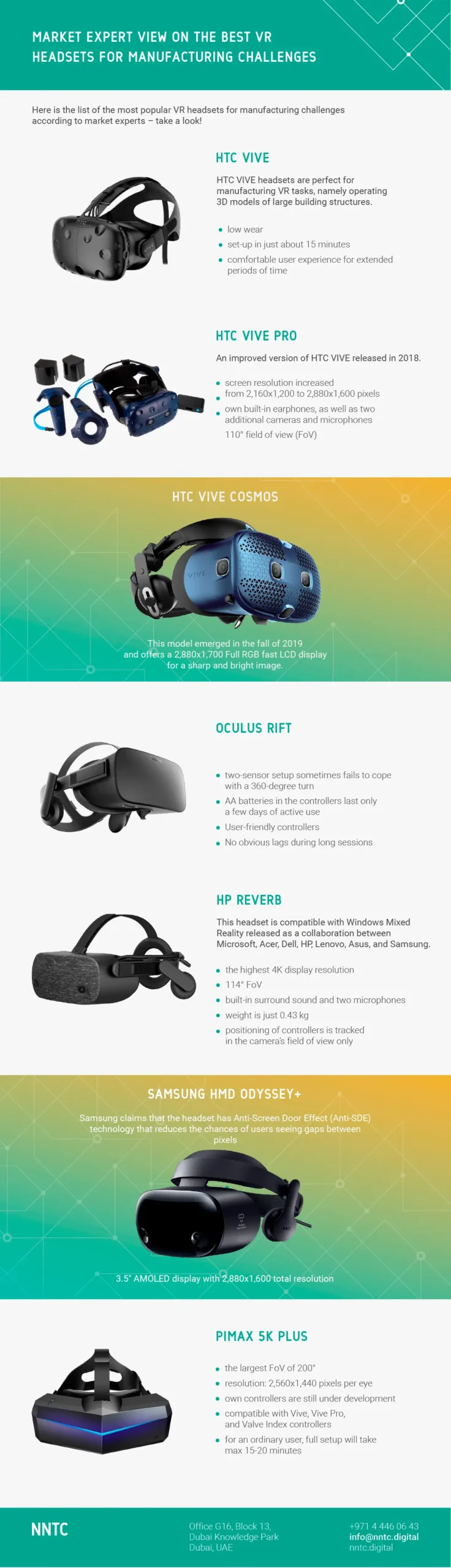
Today we have prepared for you a visualization of analytics from market experts about VR headsets comparison. Which VR hardware is best for your needs? The infographics will clearly describe the strengths and weaknesses of the different helmets, so make sure to spot an ideal helmet for VR safety training.
The hospital of the future may look quite different from what we are used to. Rapidly evolving technologies, along with demographic and economic changes, are expected to transform hospitals worldwide. Building the digital hospital of the future requires investments in people, technologies, processes, and premises. Therefore, hospital management should not expect ROI right away. However, in the long run, digital technologies will improve care quality, operational efficiency, and patient and staff experience.
Thank you, doctors!
With the COVID-19 spreading, hospitals worldwide are working at full capacity, and healthcare workers are saving lives every day. We admire and thank those heroes for their commitment and hard work. We wish them to stay strong in this hard time!
Moving towards hospital of the future
There is a range of solutions to improve customer experience and make hospitals more comfortable for patients and personnel. It will become a new normal sooner or later.
Digital experience
Digital solutions improve patient experience by providing real-time access to medical knowledge. The best way for hospitals to establish good relations with their customers is to become open and user friendly. Digital and AI technologies streamline the process of making appointments with doctors and reduce the number of forms patients need to fill out, while analytics, machine learning, IoT solutions, and portable devices analyze patient health condition and suggest treatment procedures to doctors.
Healing and well-being
Wristbands for patients and doctors plus visitor badges with RFID tags ensure appropriate access levels, while CCTV cameras with AI features recognize faces to locate patients who look unwell and need help, and accelerate recovery. Moreover, AI-enabled video analytics solutions can identify threatening situations as, or even before, they occur.
Hospital operational efficiency
RPA (Robotic Process Automation) solutions automate hospital’s ancillary and back-office services, considerably reducing costs and personnel work effort and improving service reliability; AI systems and electronic health records populated with data from various sources improve decision-making; while cognitive analytics tools sort through and find the most important personalized data points, thus boosting work speed and quality.
Talent development
VR solutions help surgeons practice upcoming surgeries, while Learning Management Systems transcend geographical boundaries and reduce costs allowing them to share their surgery footage and specialized expertise with a larger audience of students and colleagues. Cognitive analytics and RPA solutions automate hospital personnel recruitment and study patient information and requirements to match patients with doctors having appropriate competencies.
Project: Mohammed Bin Khalifa Cardiac Center
Our team was lucky to take part in the joint project with our strategic partner NGN International (Bahrain). We provided general design, control, and implementation of the end-to-end technology infrastructure for the Mohammed Bin Khalifa Cardiac Center in Manama, Bahrain, under the patronage of His Excellency Lieutenant General Doctor Sheikh Mohammed bin Abdullah Al Khalifa, President of the Supreme Council of Health.
Mohammed Bin Khalifa Cardiac Center
The Center has a floor space of 172,765 sq.m and one of the fastest-growing IT networks in the world. It uses a sophisticated technology to combine resources of physical and virtual servers and connect the entire work environment to the cloud.
In addition, Vocera Communications smart badges enable effective hands-free information exchange between doctors in real time. Data analysis and business intelligence solutions gather data from all systems of the Center and provide accurate results for better decision-making. Redundant IT systems ensure business continuity during various internal and external emergencies, effective data flow, and data availability anytime, anywhere.
Step by step
The hospital of the future is not built in a day. It requires consistent development and global expansion of innovations. Increasing healthcare investments and concerns about lives and health of patients and medical personnel will make hospitals more and more technologically advanced, which, we believe, will save and improve people’s lives.
Here, we’ll answer the hottest questions about the technology company partnership with technology companies and talk about the NNTC partnership program in simple words. Everything you wanted to know but did not dare to ask.
Why partnering with technology and innovation companies?
Creating value for customers is a must-do in the business world. Sometimes a customer wants to have a new idea implemented, which requires more development effort and fast action. This makes partnerships valuable, especially when you have partner developers ready to pack and deliver everything on demand.
Smaller companies also benefit from partnerships with technology companies. Partnership opens the door to larger resources: marketing, sales, legal, technology, and HR support. A vast selection of out-of-the-box products – even if made by partners only – gives a company a strong competitive edge in a crowded market.
What is more, infrastructure solutions are increasingly harder to sell to end customers. However, when they combine with a partner’s ready-to-use service they bring value to both IT director and business users.
How does it affect the partners’ business?
Partnership gives access to numerous resources that allow your company to enrich its business portfolio. Besides products and services, partnerships contribute to networking among business peers, thus feeding your market power. Partnerships lavish private events, innovation presentations or access to particularly valuable documents on its members. Remember though, that your business will experience positive effect if a partnership is aligned with your company’s strategic goals. Interestingly, there are companies using artificial intelligence to identify the most beneficial business partners.
Why partnering with NNTC?
NNTC partnership will give you access to an expert team that serves some of the largest government entities in the UAE and actively implements projects and innovations with partners around the globe. NNTC is a part of the large international IT Group with a huge customer base and wide knowledge of different IT solutions. We aim at competence exchange, IT solution portfolio expansion, and implementation of joint projects to reduce costs of customers operating across different regions of the Middle East. With our agile mindset and focus on each customer, we can easily customize most of our products in line with a specific task or certain conditions.
Another important thing: thanks to our large in-house Product Development Team and huge investments in R&D, when you work with NNTC you and your customer will always get a tailored product.
Furthermore, our partners enjoy the following extra benefits:
NNTC Deal Registration Program that rewards partners for bringing new customer opportunities and providing value selling by educating customers and prospects about NNTC solutions.
NNTC marketing development funds (MDF) on the accrual basis to support NNTC partners’ marketing and business development activities that generate demand for NNTC solutions. MDFs are calculated at the end of each quarter and available for use within the following one.
Partner demo equipment: affordable, robust, and portable demo kits to showcase NNTC products.
End-users can access NNTC Partner locator at nntc.digital website.
What options does NNTC offer to its partners? What is included in the partner program?
Our program is simple, supportive, friendly, and free of complicated specializations, huge investments or boring and useless actions. All that we kept in the program are tools that help our partners grow, protect investments, and guide them to new deals or customers. NNTC partner program features three membership levels: Diamond, Gold, and Silver. Partners qualify for a single membership level based on previous and planned achievements.
SILVER members are interested in taking the first steps in starting a relationship with NNTC. There are a few very simple requirements that will help the partner to get basic knowledge and skills to focus on opportunities where NNTC products could be used.
GOLD members are experienced in delivering NNTC solutions. They achieved significant sales performance and a high level of customer satisfaction. Gold Partners enjoy enhanced benefits designed to enable sales and technical competency to meet the needs of our mutual customers and to increase revenue growth.
DIAMOND members deliver the highest value to their customers. They demonstrate sales and technical expertise across all NNTC solutions. They consistently achieve revenue targets while attaining high levels of customer satisfaction. Diamond level membership provides partners with the richest program benefits.
What solutions does the program include now? Will the program expand?
Authorized NNTC partners have access to our entire product portfolio, including detailed documentation and NNTC sales enablement materials. The program includes the most demanded solutions. For example, Digital Worker or the iFalcon Control solution set powered by facial recognition technology.
What are the NNTC technology company partnership requirements?
NNTC partners are companies that offer vendor products to their current or potential customers and add value by providing greater expertise or integration with business processes or third-party products.
All partners sign a Partner Agreement. When a partner initially enters the program, they have 30 days to attain certification requirement. All pre- and post-sales certifications are valid for two years from the certification date. Members shall renew certifications before the expiration date to enjoy the full range of NNTC partnership benefits.