IoT Systems Integration in Industrial Metaverse Solutions

IoT Systems Integration in Industrial Metaverse Solutions

A New Era of Smart Infrastructure Management with Industrial Metaverse Solutions

In today’s rapidly-evolving digital landscape, there is a growing demand for innovative solutions that can optimize infrastructure management, increase efficiency, and reduce costs. One emerging technology that holds significant promise in this area is Industrial Metaverse, a virtual replica of a physical asset that can be used to monitor, analyze, and optimize its performance. While Industrial Metaverse have been around for some time, the integration of IoT systems is taking this technology to a whole new level. By leveraging IoT sensors and devices, Industrial Metaverse can capture real-time data about a physical asset’s performance, enabling advanced analytics and predictive maintenance.

Daniil Gudkov,
Technology expert | Industrial Metaverse
Book consultation

IoT systems integration in Industrial Metaverse solutions allows for a comprehensive, real-time view of an asset’s performance. By combining data from multiple sources, including sensors, machine learning algorithms, and predictive analytics, organizations can gain a deeper understanding of their infrastructure, and make informed decisions that can drive efficiency, cost savings, and operational improvements.

For example, in the field of smart buildings, Industrial Metaverse solutions can help building owners and operators optimize energy consumption, reduce maintenance costs, and improve occupant comfort. By integrating IoT sensors and devices, building management systems can collect data on factors like temperature, humidity, air quality, and occupancy, allowing for real-time monitoring and optimization of building performance.

Similarly, in the field of smart manufacturing, Industrial Metaverse solutions can help improve production efficiency, reduce downtime, and optimize maintenance schedules. By integrating IoT sensors and devices, manufacturers can capture real-time data on equipment performance, and use this data to predict and prevent failures, and optimize production processes.

The benefits of IoT systems integration in Industrial Metaverse solutions are clear. By combining the power of Industrial Metaverse with the insights generated by IoT devices, organizations can gain a comprehensive, real-time view of their infrastructure, and make data-driven decisions that drive operational efficiency, cost savings, and performance improvements.

As the IoT continues to evolve, and Industrial Metaverse technology becomes more sophisticated, we can expect to see even more innovative applications of this powerful combination. From smart cities to transportation, healthcare, and beyond, IoT systems integration in Industrial Metaverse solutions is paving the way for a new era of smart infrastructure management.

Are you ready to take advantage of the power of digital twins and IoT systems integration? Contact us today to learn more about how our innovative solutions can help you optimize your infrastructure, reduce costs, and drive performance improvements.

Read more

How do warehouse inventory drones think?

drone warehouse

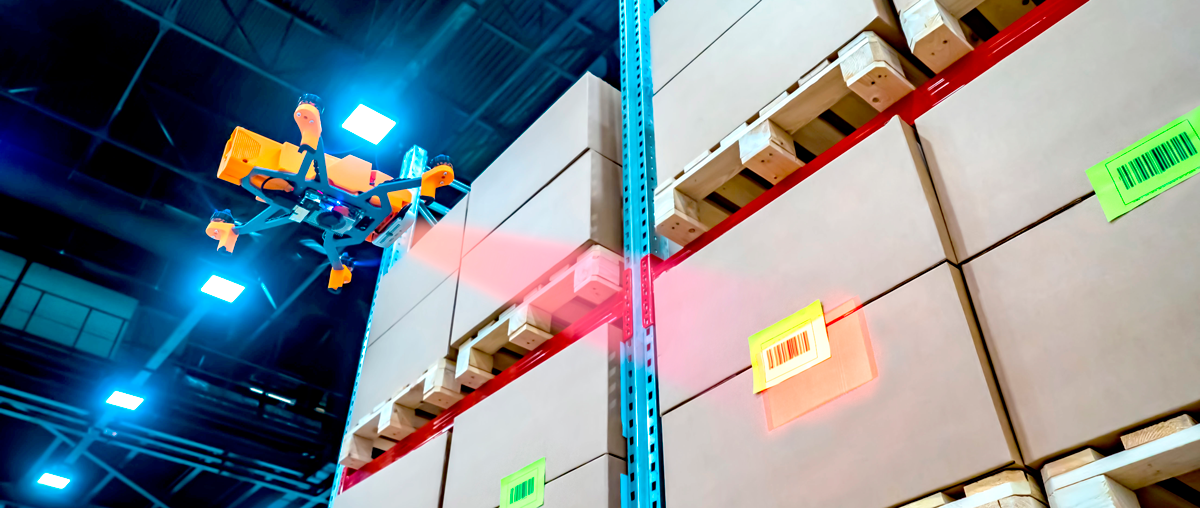
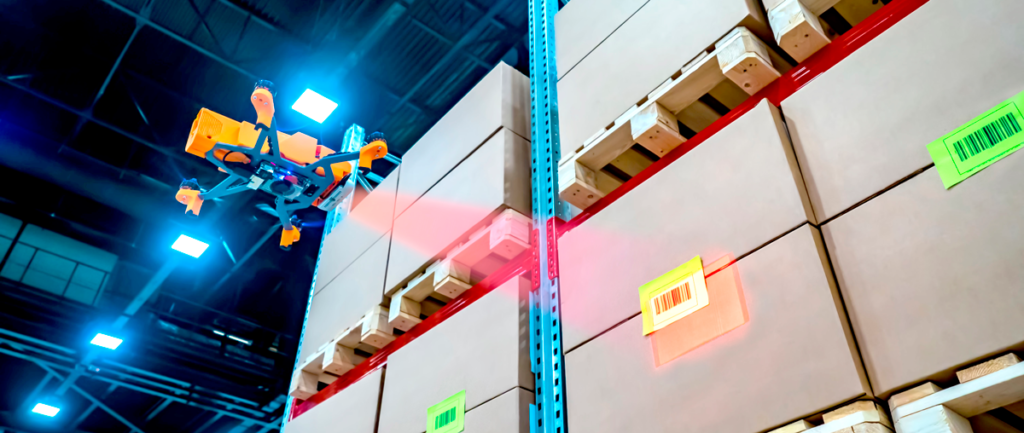
Let’s talk about inventory drones, their “brains” and capabilities, how all this stuff works, and how drones can have your back in the case of wrong pallet marking.

Kirill

Kirill Bondarenko | Technology Expert
Book consultation

From our previous posts about drone-based inventory, you already know that drones cannot fully replace humans since they cannot handle tricky non-standard cases, but, at the same time, they show unprecedented accuracy and careful record taking.

Today, I will tell you how UVL Robotics solution helps detect possible errors and inaccuracies during standard warehouse inventory.

Pallet scanning with no duplication

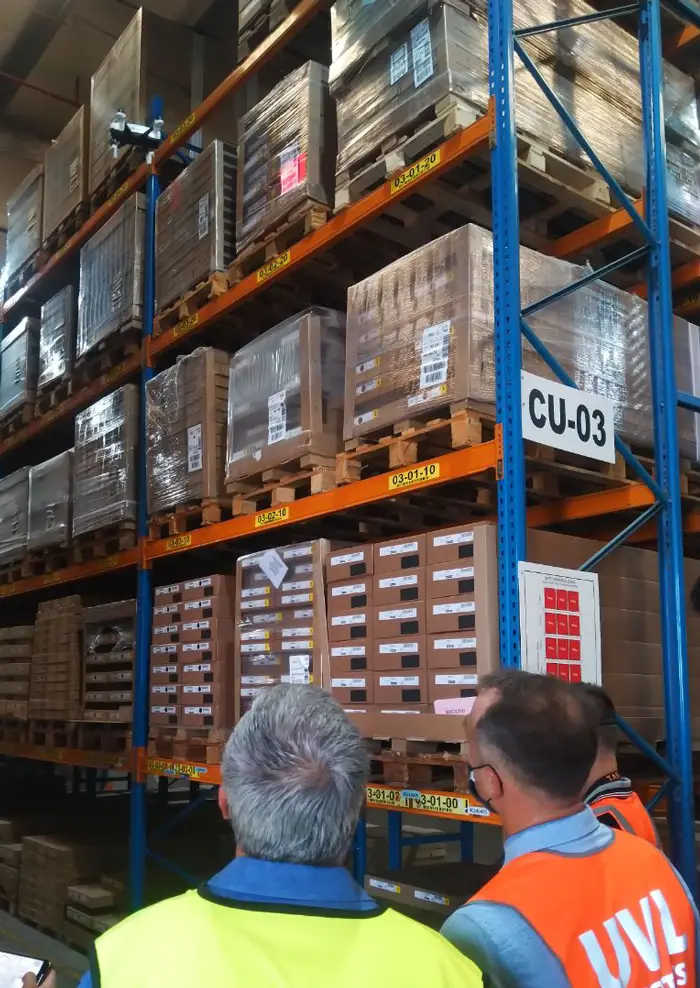
Every pallet is marked with a unique barcode that will be recorded in the accounting system to track the pallet location and keep the warehouse records. Unfortunately, sometimes an employee may lose count and scan the same pallet twice, which leads to accounting errors or even rack double-checks.

UVL Robotics software has an embedded specialized filter that prevents barcode duplication and creation of repeated pallets. In other words, if a drone scans the same pallet with the same code assigned, the algorithm considers it a duplication and reports an error. Therefore, this helps avoid errors emerging by accident or inattention.

In rare cases, the same barcodes can be assigned to different pallets, which happens either by mistake or in line with the customer’s preferences. In this situation, the filter reads this error up to three times. After the third reading, the counter is set to zero and the barcode can be reregistered as another pallet, which might take a little more time. Statistics can be collected manually as the UVL Robotics solution allows you to switch to manual mode and flexibly adapt to specifics of tricky marking.

Putting every pallet in place with inventory drones

Every pallet has its own unique barcode is assigned to a particular warehouse location, to a particular cell.

Drones scan pallets rightwards and downwards, moving along the warehouse racks. The inventory drone pilot watches the drone-scanned cells highlighted in the warehouse layout via tablet. It’s like reading a book where a rack is a page and pallets are words.

drone warehouse

The table accumulates not only pallet numbers and their barcodes, but also their locations. The report you get displays all deviations from the ideal pallet location. If there is an error or products are not in their cells, this problem is easily detected and handled.

Universal logic and adaptable report

The process can be customized. If you want to solve an unconventional task, we can easily adapt the tool to your business. However, considering the previous solution demonstrations and implementations, I can tell that customization is often left unrequired as the drone boasts all the necessary functionality to accelerate inventory taking and create user-friendly reports.

warehouse inventory

We can also prepare reports in a format familiar to the customer, as well as configure the filters to detect additional marking. For example, a drone can be set to scan multiple barcodes assigned to the same pallet with a further display of this data in the report; this is easy to do and usually negotiated before the works start.

If you got interested in this solution, learn more about it on our website or get a consultation with our experts.

Read more

Who’s a better stocktaker: pilot or autonomous drone?

pilot autonomous drone

Trying to decide on how to integrate innovative technologies into business in the most beneficial way, managers oftentimes find themselves asking a reasonable question: “Which course is better: to rely entirely on technology or let humans retain control over the majority of functions?”

Your answer to this question will determine areas of responsibility and, what’s more, it may make the difference between the stunning success and total failure of a particular innovation. Why so? Because it’s crucial to consider your business context and conditions when adopting a new technology.

Kirill Bondarenko | Technology Expert
Book consultation

With that in mind, today we will try to provide an insight into how to choose a better warehouse stocktaker. When is it worth training AI to send the autonomous drone on the preset courses? When is it reasonable to hire a professional to pilot a drone manually? How not to come off a loser and invest in the right approach?

When a professional pilot is a good choice

  • Poor GPS signal. A GPS signal struggles to get through the walls indoors, making it impossible to use any basic drone. Pilots, however, can use a built-in independent positioning system to navigate around, without any need to rely on satellite connection.
  • Fast result. Autonomous drones can’t be rushed: their moves are slow and steady. If you can’t wait to get the job done, the pilot will help. Pilots are well acquainted with drone racing, have a trained eye, and know how to navigate through small spaces at high speed.
  • Frequently rearranged warehouses. An autonomous solution uses a custom warehouse layout, which works for the warehouses that haven’t changed its structure for years. If, however, a warehouse is often restructured and the logic of pallet storage drastically changes, it will cost a fortune to train a drone to navigate a new storage system each time. In this case, a pilot is a better option, since no expensive AI training is required.
  • Service model. Taking it as a service means that you invite a pilot with a drone on a convenient day, agree on the area to be inventoried, and enjoy the result in a few hours.

Remember that using a drone requires specific professional skills. Usually, all professional pilots have experience in drone racing, like that colleague I worked with at a demo in the UAE, who knows both piloting and engineering. Stocktaking is not a big deal with these skills. Once you have learned how to ride a mountain bike and jump over rocks just like that, an ordinary ride in the park becomes easy stuff, if not a dull routine.

UVL robotics

Autonomous drone for the warehouse

If you like an idea of having a company drone at your service, consider the following conditions to make this new solution a success:

  • Strong GPS signal. It’s just a nice thing to have, because it will save you a lot of headache.
  • Patience and readiness to train the drone. To finally see a drone carefully flying around your warehouse on autopilot and doing tasks all by itself, you will have to be patient, because it takes time for a drone to learn your warehouse layout. Read more about training autonomous drones in our post “How stores can get the most from innovative technologies by using drones at warehouses and robots in shopping areas”. But remember that a drone on autopilot simply can’t operate as fast as one controlled by a pilot.
  • Warehouse has a permanent layout. In this case, a custom navigation system is created for the warehouse, with a dataset collected, warehouse model designed (to help the drone track its location), and grid reference provided. Reference points can be established by sticking tags across the warehouse or embedding those into a layout model. If the layout or pallet location changes, repeat the procedure to update the drone with the most recent information.
  • Project framework. It takes two month to deploy a solution with an autonomous drone (may vary depending on the complexity of the warehouse), which includes data collection, neural network training, solution testing, and fine-tuning.

Note that deploying autonomous drones is a full-fledged project, which will also require a team of specialists. Collecting a dataset is just the beginning, as you also need to train the drone and make it understand that the task is to search for barcodes and find them.

autonomous drone warehouse

How much does it all cost?

An autonomous drone might cost you more, because of the effort required to implement this solution. However, it will pay off, if implemented in specific warehouses: hazardous chemicals storage, oxygen-free, or extremely cold rooms.

For a common warehouse, the service model is more cost-effective, when a pilot visits the site on a certain day and conducts inventory. At the end of the day, you get the final report matched to your system, while enjoying cost savings as well, since you haven’t had to halt the operation of an entire warehouse for several days of stocktaking. Speed, accuracy, and resource savings are worth the price.

If you are interested in trying drones at your warehouse, please feel free to make an appointment and ask any questions you may have.

Read more

Dispelling myths about inventory drones – warehouse demo matters

Tailoring innovation to customer’s specific task or business process has always been a second nature to our team. When cutting-edge technologies are integrated into any business process, many questions arise. Addressing them, we sometimes even dispel myths about some solutions and their functionality during a demo. Today, we will give answers to the most frequently asked questions about a drone-based & AI inventory solution for warehouse inventory by UVL Robotics.

Kirill Bondarenko | Technology Expert
Book consultation

Technology is like a set of versatile tools. Any problem can be solved with it, if you know how it all works at a fundamental level. In fact, innovation derives from a few pieces of technology successfully combined, thus creating a new product to get a particular job done effectively. The idea of a sci-fi future inhabited with smart robots and flying cars in a Blade Runner esthetics is a certain inspiration for us, like for all others. This is fantastic, but the primary goal of technology is to solve relevant problems using twenty-first-century tools.

Drone-as-a-service is a user-friendly solution to streamline warehouse inventory. It helps warehouses promptly handle inventories without extra time or money investment – read our previous post to learn more. Today, we will dive deep into solution functionality, what it can and can’t do.

Myths about drones and warehouses

Myth #1. Tricky when open

“Is it possible to count the exact number of boxes/products in an open pallet with this solution?”

That depends on the type of your pallet: a full or a mixed one. A full pallet is a completely sealed package with a certain amount of products inside and a barcode and other product information stuck outside.

Our drone-based solution is better at counting full pallets, as it scans the code from the sticker and sends the information to the server. Now, we need to know the number of boxes in one sealed pallet to easily calculate the total on the rack and at the warehouse.

It is not uncommon that somebody opens these pallets to pick up and deliver a few products to customers, which turns full pallets into mixed ones. Technically, our solution can scan the barcodes on such pallets and take a picture of a mixed pallet on the shelf, but it will be difficult to determine the exact number of whatever is inside. Products might be taken from the middle of the pallet (the rest forms something like a “well”) or from the side, which – should the pallet be turned – will face a wall and remain undetected at the time of inventory.

warehouse demo

Here is what we can offer: a drone will both scan pallets and take pictures to report on each pallet in a warehouse. Each picture will be linked to the scanned barcode in the report. In addition, pallets can be labelled as mixed or full, so if there are a few mixed ones, the products inside can be counted manually or using a picture taken earlier.

Myth #2. Wrong stickers

“What if our employee puts a sticker on a pallet with the wrong barcode? Would you be able to fix it during warehouse demo?”

A drone is sadly unable to make it right. Perhaps a day might come when we can fully rely on machine intelligence and the drone’s commitment to a company, but not today. Currently, a drone only scans barcodes and records the pallet’s condition and location without carefully reflecting on what it is doing.

Myth #3. Any drone can take warehouse inventory

“Why do you use custom drones when there are plenty of common ones that you can easily make fly?”

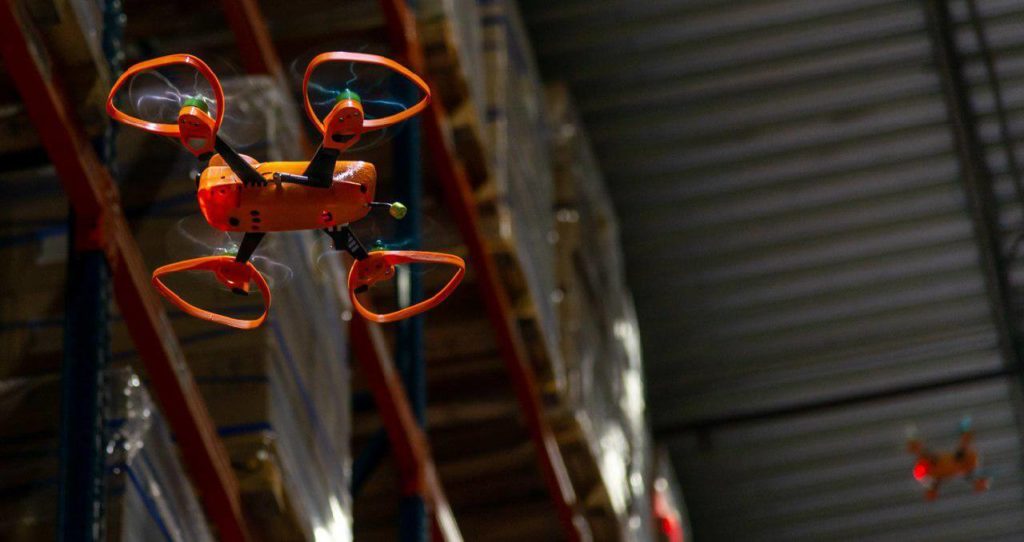
It’s not that simple. In case of warehouse inventory, a standard drone, which can be piloted by almost anyone, is unlikely to take stock indoors, because such a drone is using GPS. It is challenging for signals from a satellite to pass through metal structures and thick walls of a warehouse, so a standard drone will be less than useless.

drone for warehouse inventory

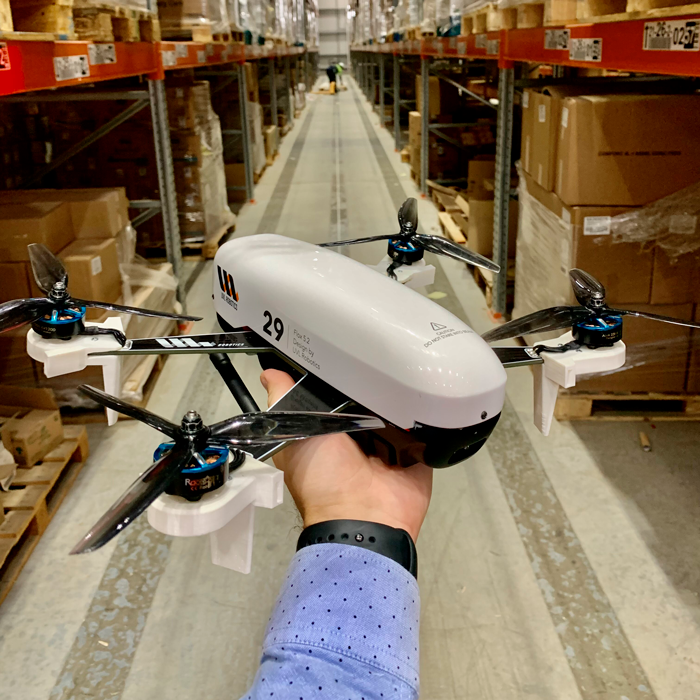
We use a custom drone with a built-in navigation system to dodge between racks without help from the GPS. Our experienced pilot can skillfully navigate the drone, which is yet another booster that helps complete the job fast.

Why warehouse demo matters

A demo at a warehouse is an efficient way to bury myths and see solution benefits in a real-life situation. After all, like I said, a product is created to solve a specific problem, and a demo will help you understand whether this solution makes sense to your business.

demo UVL Robotics

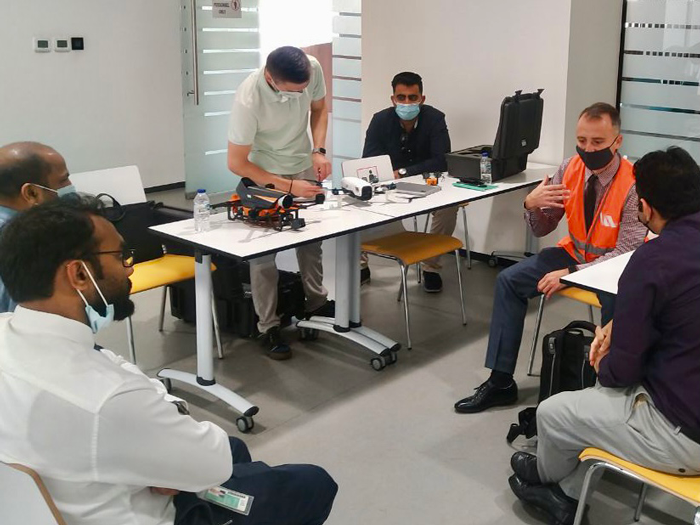
Our team has given demos for eight major warehouses in the UAE so far, including Abu Dhabi Ports. The demo includes the following:

  1. A brief presentation to describe essential points of the solution and its main advantages (fast stocktaking, cost-efficiency, no heavy equipment involved, no warehouse downtime, etc. – my previous post covers everything in detail).
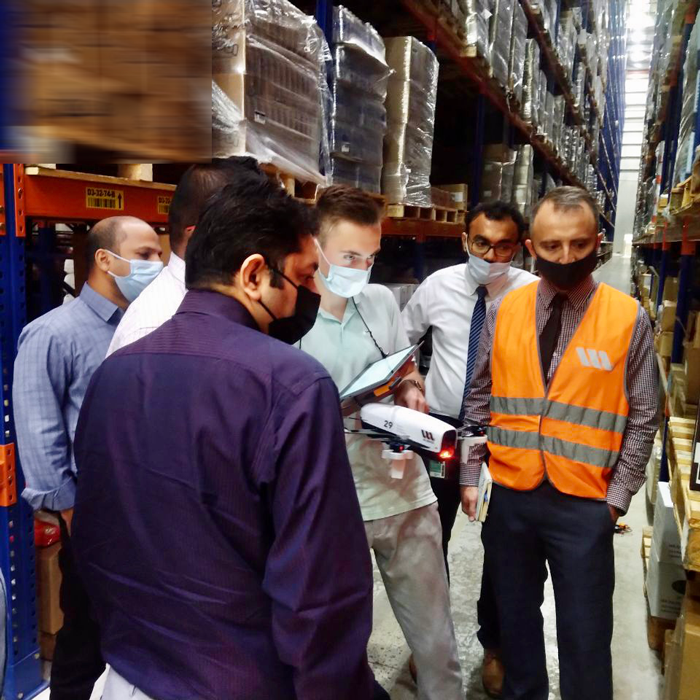
  2. Moving on, a pilot has an assembled drone ready to demonstrate how the solution works. The drone flies between the racks and scans the pallets. A tablet allows you to watch and control scanning, as the scanned areas are highlighted on a warehouse model.
  3. When information is collected, we export the report in an Excel file for you to review and study it carefully.
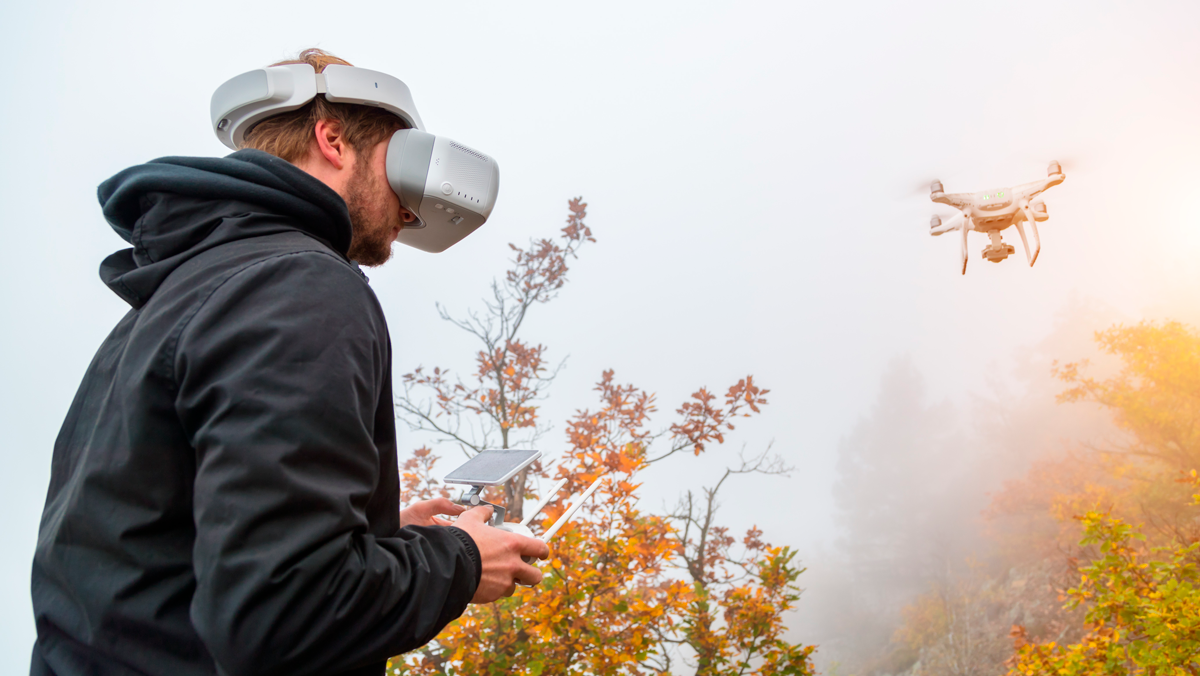
  4. Finally, there is a Q&A session and a small amusement. Anyone can try on our pilot’s VR headset and enjoy the first-person view of the flying and scanning process.

We’ll be happy to give you a warehouse demo. Just answer a few organizational questions (to let us know the type of your warehouse) and choose a day convenient for a demo. No additional documentation is required. We are always ready to go.

Read more

New on the market: Drone-based & AI-driven solution to warehouse inventory

warehouse-inventory

Warehouse inventory can oftentimes lead to huge bills, so we approached third-party logistics (3PL) providers directly to learn more about their struggles.

Kirill Bondarenko | Technology Expert
Book a meeting

The survey revealed that they generally experience similar problems:

  1. Invest a lot of time in inventory (3-5 days)
  2. Take pains to arrange unscheduled inventories (find a free time slot, select people for work, and reallocate resources)
  3. Stop other work if inventory is urgent, get people in on a weekend, and pay overtime, with the warehouse being unable to generate profits during the inventory
  4. Spend on equipment (a high reach forklift, for example): An inventory taking involves expensive equipment, which comes with a rent fee, delivery term, or other trouble.

Interestingly, only one in eight respondents considered using innovative technology to address the challenges above. Furthermore, we’ve had 50 meetings yet, and only one in six customers has considered a possibility of leveraging drones for inventories in the future. Although this idea is conceptually simple, it presents a serious challenge in practice. The core problem is to integrate an existing technology into an established task pipeline while having no experienced programmer, engineer, pilot or time/budget to get a proof of concept.

drone warehouse

The good news is that we offer a user-friendly solution to streamline warehouse inventory: the first ever product on the market featuring customized drones that can promptly handle inventories without extra time or money investment.

A drone-based warehouse inventory

  1. One operator is enough to control a drone that uses a 2D scanner to capture information from barcodes on pallets at any height (If you are interested in using this solution on a regular basis, AI-based automatic recognition can be integrated).
  2. A ground control station (a set of ground-based hardware and software) matches scanned data against warehouse layout.
  3. The results are forwarded to WMS/ERP.

The data processing is so fast that one drone can deal with 10,000 pallets in an hour in a standard warehouse, ensuring almost 100% recognition accuracy.

This solution is even more advantageous being provided as a service and saving training time and equipment costs. You only pay for the service; the rest is up to a drone piloting professional. The skilled pilot visits your site and gets an inventory done quickly and efficiently within the specified time using their own drone and VR headset. Warehouse inventory schedule can be drafted in advance when signing an agreement.

How do I know that my warehouse would benefit from such a solution?

The UVL Robotics solution can be an answer to any problems with warehouses that:

  • Do not use mixed pallets as their main sets (you don’t have to unpack the pallet and count everything item by item when taking inventory), but a full pallet (one pallet is an SKU with one barcode). After all, a drone can’t get into a pallet and count the number of boxes inside. But a drone is extremely good at flying around tall storage shelves and scanning barcodes on the pallets there.
  • Operate 5,000+ pallets; and working with warehouses with a capacity of 20,000-50,000 pallets is a special kind of fun. The more the better! A larger scale helps appreciate the impact of this technology in action.

3PL providers and FMCG companies are to benefit the most from the technology

From a 3PL provider perspective, warehouse inventory drones will make unscheduled inventories smoother and easier and save time that could be wasted on ordering special equipment, reallocating workers, and figuring out a least expensive option. Now, when a customer requests an urgent inventory, you can simply call in one pilot with a drone for a half-day visit to count the pallets on site.

This solution might be interesting for the FMCG sector, as numerous 2020-2021 surveys illustrate the importance of digital business transformation in response to the pandemic, which disrupted and exposed vulnerabilities in supply chains. Plant closures and changes to operating procedures, including socially distancing workers, have contributed to reduced production and labor output. Companies will need to re-examine their supply chains to develop a deeper understanding of risk in terms of sourcing and potential disruptions, and they might need to build in redundancies and alternative sourcing practices that promote resilience (PwC).

Outsourcing is another trending method. It helps your business focus on what you do best. Instead of having equipment, people or other resources as fixed expenses, you can outsource these to a third-party partner who has the expertise and can fully focus on the outsourced tasks to deliver best results. Assigning marketing and logistics tasks to an experienced and trusted partner helps business to focus on product innovation and quality improvement.

UVL Robotics

Adopting innovative solutions in business processes wisely might play a crucial role in surviving uncertain times. To learn more, download our survey results here:

If you have any questions to ask or issues to discuss, you can book a meeting!

Read more

Drone sensors: enhanced vision to see underground and spot the invisible

Drone sensors: enhanced vision to see underground and spot the invisible

What’s usually attached to a drone? A video camera, of course. It is quite popular to mount it on the drone and lift as far above the ground as the connection reaches and catch a panoramic breathtakingly beautiful view on that camera. This is, however, a mere 9% of what you can do with this machine. Besides, there are a lot more interesting toys to mount on drones, and, in today’s post, I’ll tell you all about drone sensors.

Article by Pavel Tatarintsev, NNTC R&D Head
LinkedIn | Mail

Sensors. There are a great many sensors one can attach to drones. You can give them a keen magic power to see things and solve business problems faster, and I’m excited to share the most impressive cases with you: oil spill detection and ground penetrating radar (GPR).

Drone sensors and oil spill detection

This drone sensor is a specific type of a thermal imager (looks like a tiny cube with an opaque black mirror lens) that can measure polarized light. Taking light as a form of an electromagnetic wave, we can distinguish electric and magnetic fields there. Before polarization, we have unpolarized light emitted, for example, by the sun or a lamp. Polarization means removing any electromagnetic waves from the beam, except for those being in a certain plane of polarization. Light reflected from oil and water has different polarization angles. Gotcha! Now you see it.

An on-board computer connects the drone and the sensor and processes data in real time. The camera receives two video streams: thermal radiation and the polarized (reflected) light in each pixel of the image. Both streams combined to allow for detecting hydrocarbons on the water surface (gas, diesel, oil, and kerosene).

Here is my recommendation regarding the best drone for such an industrial inspection. The choice, however, depends on the environment. For example, a kilometer-long and 0.5 kilometer-wide coastline inspection is a job for DJI M-200 and M-300 drones. If you need to monitor an area of at least 10 by 40 kilometers, then consider flying machines that look more like planes, as they can stay in the air longer (3-6 hours) and travel farther.

drone sensors oil spill

If a refinery is tasked with tracking oil spills in its waters, this sensor will be an essential asset, being able to detect the tiniest spills right away and avert a disaster. In addition, this sensor is more user-friendly than bulky marine radars and its polarization camera sees oil spills in calm waters, unlike the radar. Finally, you can schedule drone flights around the area to get updates on the state of the water around the production area.

Drones and GPR

Loosely speaking, GPR is a radar that can see underground. This drone sensor has a couple of commercial applications.

drone sensors GPR
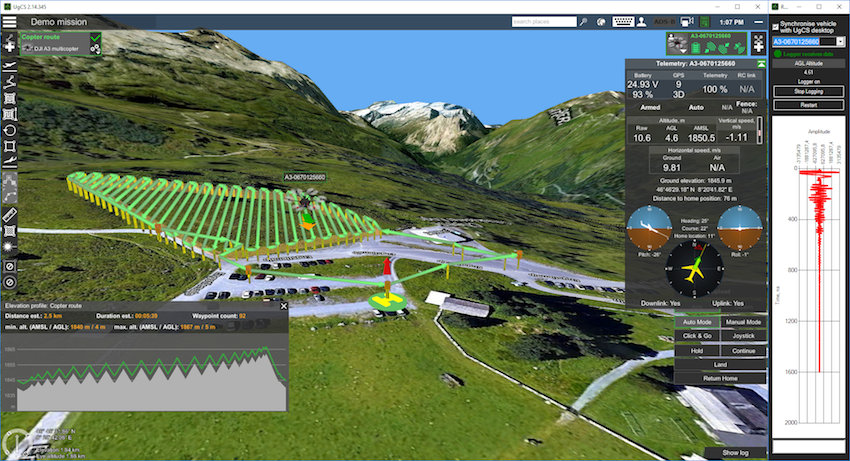
UgCS ground control software displaying GPR status

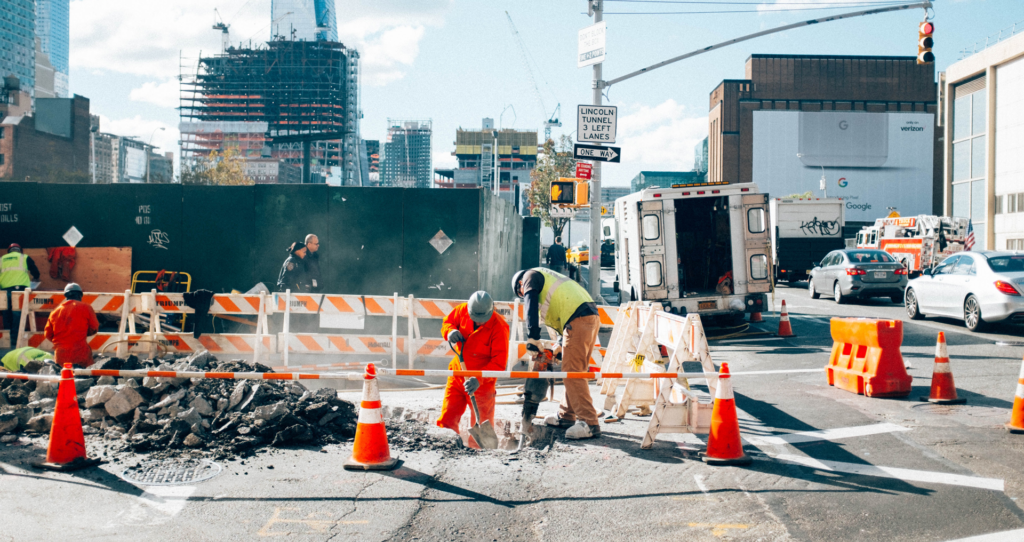
One of the most common and practical use cases is to locate pipes and other utility lines in urban areas. City development usually takes time and not always sticks to an initial plan, like in case of underground utility systems. Reasons differ. The original drawings could be lost and then recreated from memory or georeferencing wasn’t around until quite recently, while works were carried out some 30-40 years ago. Anyway, it’s a common thing when a drawing says that a water pipe is under the sidewalk, but, in fact, the pipe runs three meters away from there under the road.

Such discrepancies greatly complicate the planning of utility systems repair or installation. Just fancy that you need to lay new fiber-optic cables in an old city. You take the drawings, study them, and decide to lay a new pipe under the roadway. There you are: the traffic is blocked, roads are closed, concrete is broken up, and workers are digging. Two months and thousands of cubic meters later, they hit the pipe. To say it is a surprise might be an understatement.

drone sensors for cities

GPR drone sensors can save you from such an oopsie. It detects the reflected signals from subsurface structures, but the material must have enough density to reflect these waves. I’ll give you an example. We are trying to survey a sandy area. There is a pipe two meters beneath the surface. The sand is quite transparent for radio waves. Having reached the pipe, the radio wave is reflected back to you, so the GPR can receive it and show you the location of the metal material under the sand. However, you won’t see anything under the pipe, because the radio wave has already been reflected back. Clay, metal, reinforced concrete and water (especially soil and salt water) reflect waves well. This radar is especially useful when you look for a perfect site to build a skyscraper.

There are high and low-frequency GPRs. The higher frequency, the more detailed image, but the less the vision depth is. In other words, at a higher frequency, you will see smaller objects more accurately. For example, a 100 MHz GPR will show you a metal pipe being one meter in diameter and laid three meters underground. But it will be blind to a pipe with a diameter of ten centimeters – such a small object requires a radar of higher frequency. However, depending on the ground, low-frequency GPRs can locate objects at the depth of 30, 40, and even 100 meters. SPH Engineering, for example, discovered a whole plane in a glacier in Greenland buried 130 meters under ice, which is made of distilled water and thus remains transparent for radio waves.

SPH Engineering helps locate aircraft buried under Greenland ice with GPR

Drone sensors – a tool for every job

You can select a perfect sensor for the job when you set the objectives. Say, you need to find a metal object under the layer of the salt sand that doesn’t allow waves through. Use a magnetometer. If so required, you can put an ultrasonic sensor to use. But that’s another story to tell sometime later.

To conclude, technologies have a wide range of applications to solve any task of any complexity. Think out of the box and you’ll find the way.

Read more

DRONE BUILDERS: NEW EMPLOYEE AT YOUR CONSTRUCTION SITE

Drones perform multiple functions and can be used virtually in any industry. Goldman Sachs forecasts a $100 billion market opportunity for drones as powered by growing demand from the commercial and civil government sectors: $45 billion (infrastructure), $32 billion (agriculture), $13 billion (transport), and $10 billion (security). Drone use by builders is rather promising as drones can be introduced at any construction and development stage.

What can drones do at a construction site? Drones can optimize the construction process in various unexpected ways. Let’s talk about the following three functions:

1. Construction progress control
2. Assessment of emergencies
3. Building Information Modeling

Construction progress control helps to acquire information on construction site changes over specific period and compare current status with planned construction documentation. Drone flies around the construction site in an automated mode, while also taking photos and making orthophoto-, 3D- and landscape maps. The accumulated data goes to a private web portal accessible to responsible persons and construction stakeholders only, thus contributing to fast and streamlined communication between construction participants, as well as easier control over staff performance.

Drones also provide ad-hoc monitoring of the location of construction machinery, construction materials and temporary facilities. Small-sized drones can approach hard-to-reach engineering components.

Assessment of emergencies. In case of emergency, a drone flies on site to take photos and shoot videos, with all information being sent online to a situation center for prompt issue resolution. In addition, drones can perform live broadcasting.

Building Information Modeling. Drone photogrammetry makes it possible to not only match a certain construction stage with the plan but also then deliver an eye-catching site presentation in 3D. Once construction is over, a drone flies around the completed site and collects data to be then transformed into a precise 3D model of the facility. Such a model can be easily presented on a holographic table, a new presentation tool for real estate segment. 

Drones are compatible with various advanced technologies (e.g. video analytics, BIM, drone show software and security solutions) and thus can be used almost in any sector.

Your personal AI for efficient and fast industrial inspection: ATLAS, drone, and desert bush counting

Your personal AI for efficient and fast industrial inspection: ATLAS, drone, and desert bush counting

Any industrial inspection solves three main tasks: data collection (photos of objects), analysis (identifying defects and abnormalities), and reporting. Today, Pavel Tatarintsev will talk about ATLAS – image analysis and automatic reporting system that covers the most labor-intensive industrial inspection tasks.

Article by Pavel Tatarintsev, NNTC R&D Head
LinkedIn | Mail

Naturally, ATLAS is not the first solution on the market that analyzes photos and automates reporting, but its unique easily trainable AI module makes it a truly handy and unparalleled tool.

How I taught ATLAS to find bushes in the desert

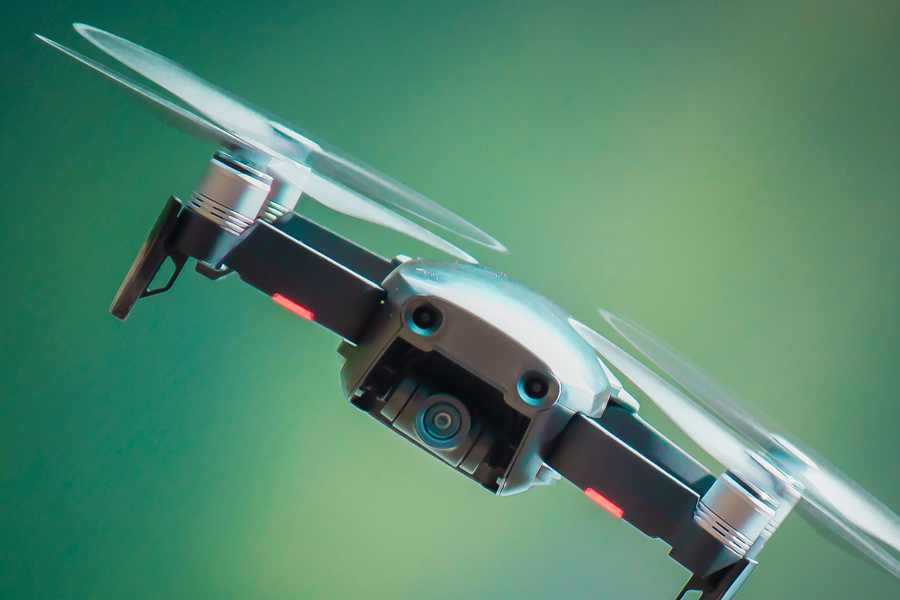
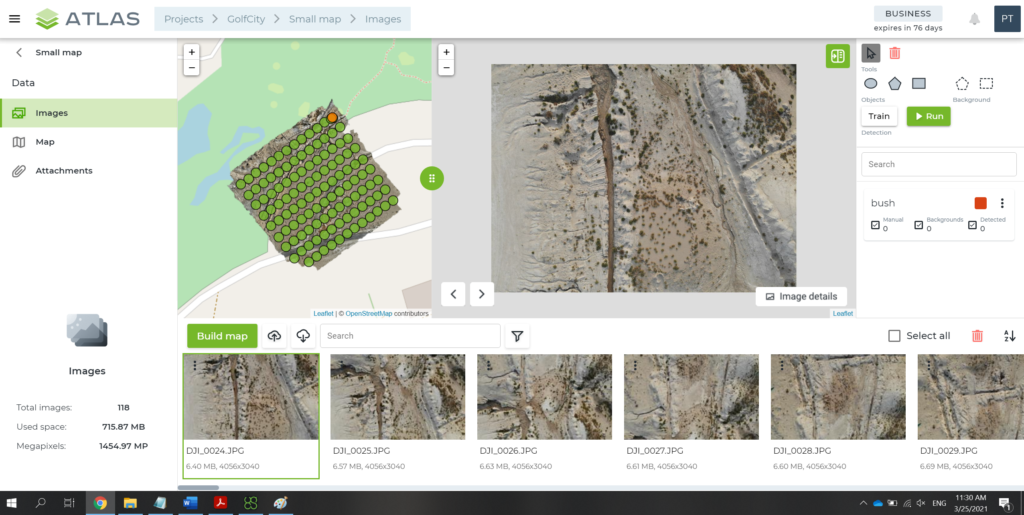
I will describe the module operation using my own user experience as an example. One weekend, I decided to go to the desert and, just for fun, teach my ATLAS to recognize bushes. It was an easy, interesting, and clear process. I used a standard laptop with installed UgCS and ATLAS software, as well as a 400g DJI Mavic Air drone with a built-in wide-angle camera. This is a small, quite popular and affordable drone.

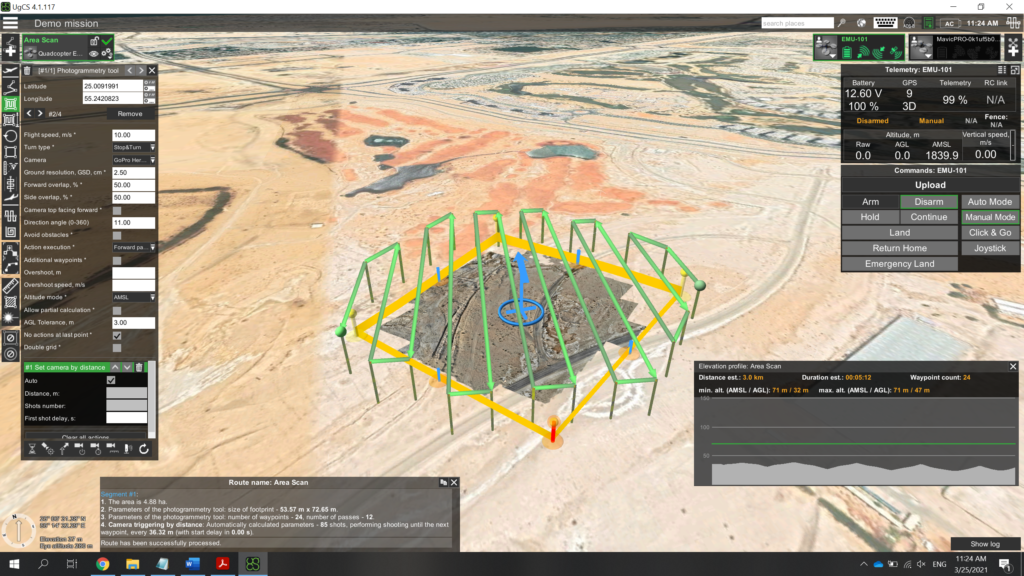
First, an engineer needs to draw a route for a drone in UgCS (below is the screenshot of my drone’s route). I set the frequency of taking photos and the following parameters. It took my drone 15 minutes to fly around three hectares.

drone industrial inspection

As a result, I got approximately 100 photos for analysis.

industrial inspection

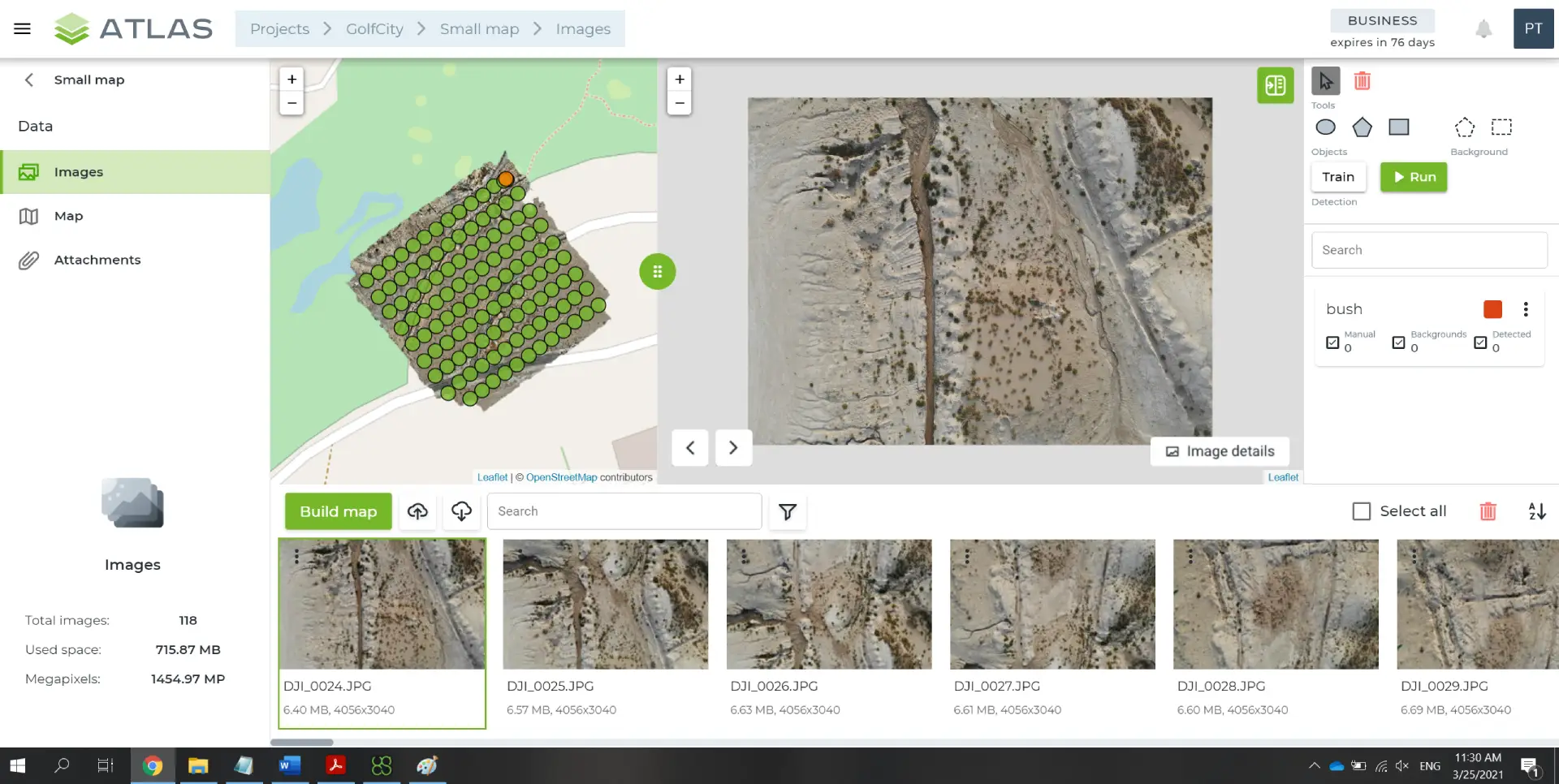
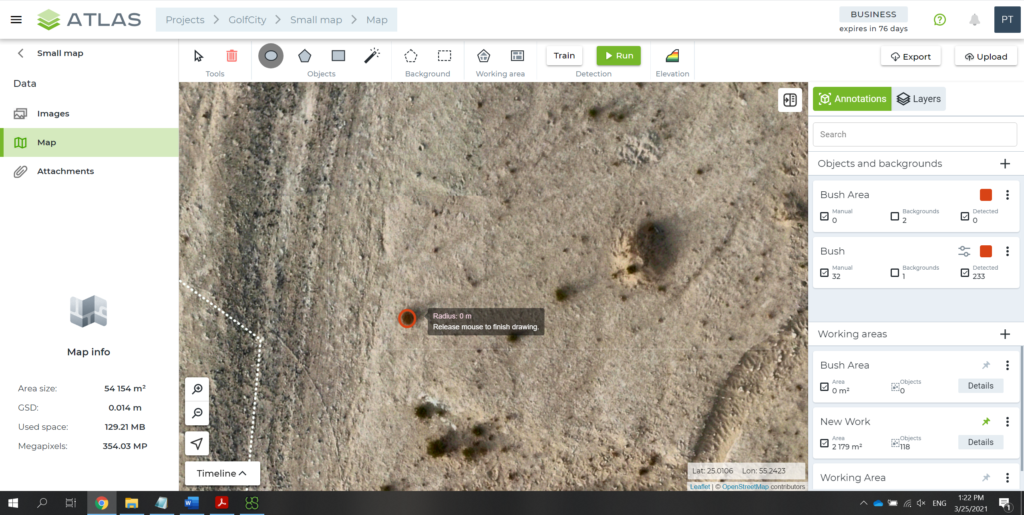
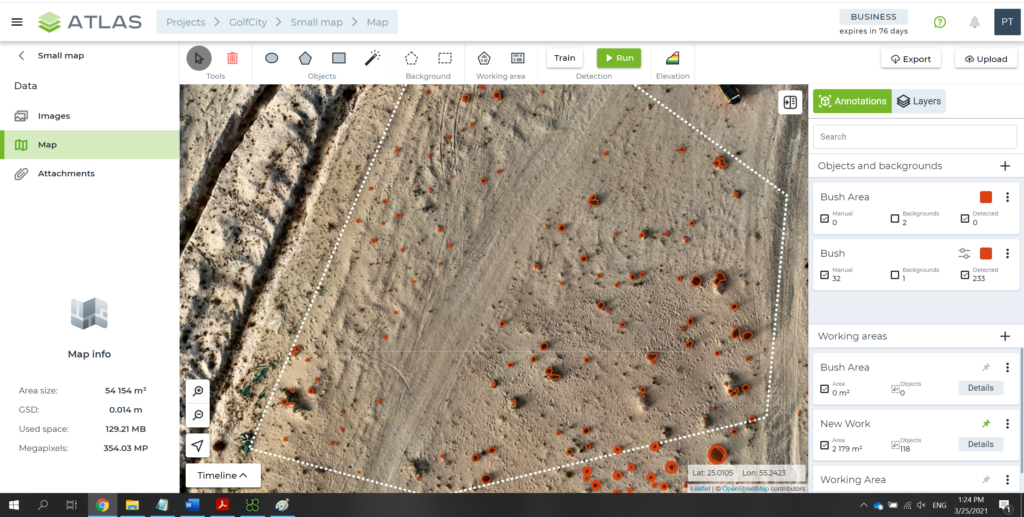
I uploaded the photos to ATLAS, which, in 5 minutes, created an area map with the relief. As I wanted ATLAS to learn how to find bushes, I then used a marker to outline the bushes on some 20-30 photos and launched a search by photos.

In 20 minutes (including AI training and photo search), I got my result. The program managed to count not only the number of bushes, but also (if needed) the total area covered by them. Indeed, you can set any parameters and reporting targets for this flexible and intelligent solution.

ATLAS

It is efficient, isn’t it? I believe very much so. Now imagine that the solution can find not only bushes, but also cracks on roads, rust on metal structures (for example, rusty spots on ships), oil spills, and any other things or flaws that the built-in AI can learn.

Is it easy to teach ATLAS AI for drone industrial inspection? Depends on what you want it to learn. When it comes to rusty spots on the pipe surface, all it takes is just a few photos with outlined spot examples. But if you need AI to find a green car in the green leaves, it’s more challenging and the system will need more examples for training.

ATLAS and industrial inspection tasks

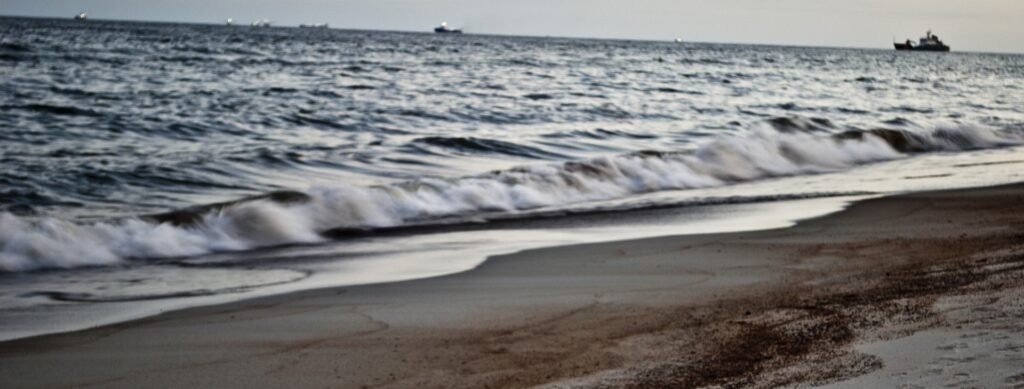
Let me tell you the story of one of our customers (without mentioning its name). Our customer bought a ‘fixed-wing’ drone (a plane-like model that can fly continuously over long distances, collecting necessary data) and had a camera installed on it to shoot the sea surface. The drone flew and brought back 12,000 photos to be analyzed for oil spills. Just imagine how long it would take to manually analyze and document all these photos. Plus, oil film is often very difficult for the human eye to see on the waves. Nevertheless, the customer successfully addressed the challenge opting for ATLAS that was taught by an engineer to promptly find oil spills on photos.

oil spill industrial inspection

This solution is also used to fly around and inspect the condition of oil pipes and production facilities, survey vegetation, as well as scan object surfaces, soil, and asphalt. The solution can be easily applied virtually in any sector and for any task. You can even set it the task to not only looking for defects but also rank them by hazard.

This is how artificial intelligence facilitates inspections and ensures control over the safety of both facilities and the environment. All you need to do is ‘explain’ ATLAS what task you want it to solve.

If you have any questions about drone industrial inspection, please go to the solution page on our website, subscribe to my blog, or message me on LinkedIn.

Read more

“THE DRONE ILLUSION” FROM THE ENGINEERING PERSPECTIVE

Drones are modestly sized unmanned aerial vehicles making headline news and buzzing around. They are featured in spy action movies and video games playing the role of enemy technology or helping a protagonist to outplay enemies. Either way, this stunning fictional representation lures our minds into a trap of “the drone illusion”. To pierce this veil, let’s take a look from the engineering perspective.

Engineering considers aerodynamic efficiency of a drone design and numerous factors, including the laws of nature equally applying to everyone and everything.

We need a vehicle perfectly performing functional tasks, which, in our case, takes off at once, hovers steadily, and transports cargo over long distances. We need…a helicopter. During the last 50-60 years, the appearance of all helicopters remains virtually the same, in general, there are two main aerodynamic designs. Why so? Helicopter is the proven golden standard in fuel efficiency, agility, and effective load-carrying capability. Coaxial rotor helicopters, for instance, are the most fuel-efficient. (Coaxial rotors are a pair of helicopter rotors mounted one above the other, with the same axis, but rotating in opposite directions). Such a sophisticated machine design requires not one, not a dozen, but a huge task force that includes specialists highly qualified for the job.

As for drones, they are compact, lightweight, and easy to assemble – you don’t need an engineer’s degree to make such a flying device for yourself. And let’s make it clear: all drones are aerial vehicles, but not every drone is created by professional engineers specializing in aerodynamics. The industry has a few companies engaged seriously with drone designing. Though there are many young talents bubbling with enthusiasm to write an excellent code and solve challenges and, of course, impatient to field-test it. Sometimes, a team intentionally sacrifices aerodynamic efficiency in favor of easier and faster development. However, even if they installed a software masterpiece on such a drone, its power would still be limited by design. Plenty of original ideas remain untranslated into reality without a professional engineer in a team.

Drones come in a great number of shapes and sizes, but the majority has two weaknesses:

  • Low energy efficiency, as compared to helicopters, which limits both the flight time and load carrying capability
  • Poor flexibility and balance, as compared to the bigger brother

When it comes to business tasks, people start talking about drones and fall into the trap of their own illusions about drones. It goes like this: “We want you to develop for us a drone that can…blah-blah-blah”. Is it really a good way to solve a business problem?

Let me tell you one story about agricultural business. Thirty or so years ago, small helicopters were actively used to spray the fields. Since then, their market share has been slashed, while drones’ share has increased. Back to the business task: transportation of chemicals to spray the fields. To be more or less effective, a drone has to be capable of spraying 15-20 liters per flight. Before drones, the market supplied radio-controlled helicopters carrying 15-30 liters of chemicals, thus significantly dropping the cost of treating one hectare, as compared to conventional methods. Today, an agricultural drone – a bulky and barely transportable vehicle worth of $25,000 to 30,000 USD – can carry some 15-16 liters of liquid. Just compare: a modern helicopter with the same load carrying capacity costs $10,000 USD, but it flies faster and more flexibly, and its battery works longer. Moreover, it is easy to transport – you can fold the rotors and put its body in a car trunk. This is the trap of “the drone illusion”: helicopter costs less and works better, but drones grow in demand.

“The drone illusion” hurts the industry. In fact, the existing drone design simply can’t get better, as technology evolves evenly for all aerial vehicles. Should the drone battery improve, the helicopter’s will improve too. Thus, the developers with more experienced in-house engineers will have a competitive edge.

How to avoid “the drone illusion” trap? Actually, it’s easy. Drones can effectively solve certain tasks. Take logics to a new level: don’t try to adapt drones. Start searching for the right flying vehicle and consult with an engineer. This will help you save money, avoid hassle, and expand the technological capacity. Discover the richness of technology of the 21st century.

by Pavel Tatarintsev, NNTC R&D Head

DRONE SHOW: WHO’S PULLING THE STRINGS?

Sorry, fireworks, it’s been a pleasure looking at you, but you are out. We are looking for something else to take our breath away. Dancing drones is a new trendy thing, giving people a thrill of fresh experience – same sparkling lights, but smart. But how does it work? Let’s take a peep behind the scenes and watch show creators at work.

If there is a swarm of 300 or 1,000 drones, imperfections in their position against one another and the ground are scarcely noticeable – this vigorous whirling formation of pieces of light, each separated by a few meters from the rest, is too big, and any error or desync is almost invisible. Even if a couple of drones just fall down, it’s no bother. Though it’s not the case for hotels and parks preferring drone show of 20 to 90 flying dancers. There is no margin for error and drones are expected to move in perfect harmony. So, how to prepare a drone show? You can’t just make these vehicles pirouette in the air with perfect timing, can you?

Step one. Drones
For a start, you need to set your fleet ready for the show, i.e. make sure every drone is unbroken, properly configured, and nothing is missing after transporting. We at NNTC prefer to operate ready-to-use DJI drones or assemble them ourselves. 

Step two. Staging the show
It all starts with 3D modeling.

Motion graphics created in Blender, for example, is converted from animation trajectories to a format readable by the autopilot. Before going to the field, we perform thorough testing involving simulators. We put virtual instances of drones into necessary coordinates and operate them as real appliances using our software. This way we can evaluate their flight in real-time, as well as visualize the outcome in a 3D scene.

Here, have a look:

Step three. Harmony
To ensure precise movements and perfect timing, you will need a special software, for example, Drone Dance Controller produced by our vendor UgCS. The programming team worked hard on the autopilot that navigates the ballet of drones along random trajectories with accurate GPS time synchronization. The trajectories can be drawn using either a 3D computer graphics software or scripts. Now, when everything is set, all an operator needs to do is press ‘Start’ and watch the show closely.

Step four. Test
We can finally test everything in practice and see what drones can actually do. We deploy our infrastructure (ground control station and communications), arrange drones, and check if all of them are OK after transportation and can be connected to our station. The software will then automatically determine a route for each particular drone. Finally, we set a start time, and off we go!

Step five. The show
Now you’re ready. During the flight, both the operator and other people in charge need to monitor the fleet condition and, if necessary, decide to perform the emergency landing of a drone, which is out. Remember, you should mind certain restrictions before starting the show. No ‘whatever the weather’: rain or wind speed of over 5 m/s is likely to ruin the accuracy of drone’s position in the air. To communicate with drones, we need radio frequencies being rather free from other signals. Spectators need to be at a certain distance from the show venue for their own safety.

Watch how the drone show must go on:

We bring the most ambitious fantasies, ideas and dreams to life with drone and laser shows. Visit this page for more information, if you are looking for how to order a drone show, or if you want to talk to an expert and learn how the drone show will work for your occasion and venue.